Welcome to the next countdown post in our series of 1920s MLB Team Rankings. As a reminder, the teams are ranked from #20 through #1 based on aggregate WAR162. For the 1920s (1920-1929), a total of 160 teams were eligible (16 teams x 10 seasons), so the top 20 teams are a fairly exclusive group. We’ll summarize each team, including portions of their team dashboard, and explain how they attained their ranking. So, without further ado, here are the teams ranked #10 through #6.
Here’s the interactive dashboard at Tableau Public: 1920s Top 20 MLB Teams Dashboard
#10: 1922 New York Giants, 51.4 WAR162
The 1922 Giants continued to dominate the National League, winning their second of four consecutive pennants. The Giants beat the Reds by a decisive seven-game margin, and then proceeded to sweep the crosstown rival Yankees in the World Series.
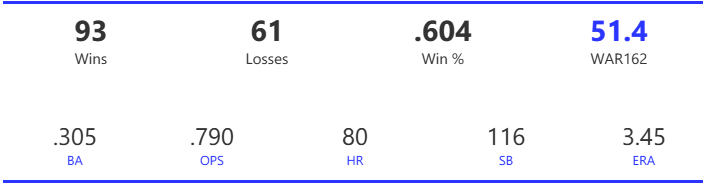
The Giants boasted a strong offense, finishing a close third in runs behind the Pirates and Cardinals. The team also ranked third in doubles, triples, home runs, and stolen bases, while placing second in both BA and OPS, and first in OBP. They were a strong, but not dominant, offensive squad. Pitching was a strength, as the Giants led the NL in ERA and ranked second in WHIP. Their staff also surrendered the fewest hits per 9 innings.
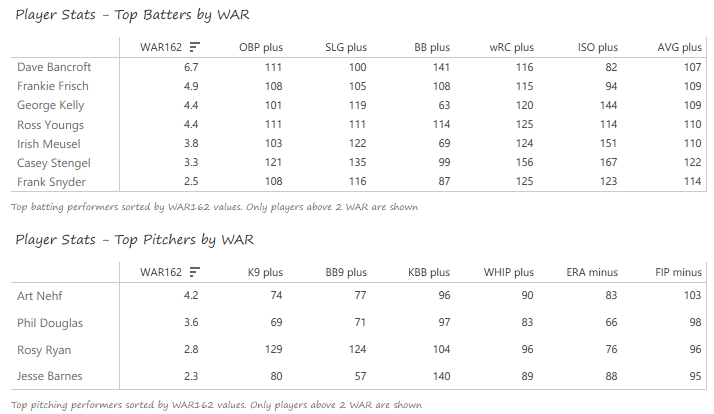
Dave Bancroft led an offense that featured multiple strong contributors. Bancroft batted .321 with 117 runs scored and 41 doubles; his infield partner Frankie Frisch batted .327 with 31 steals and 13 triples. George Kelly (.328 BA, 107 RBI), Ross Youngs (.331 BA, 105 runs), and Irish Meusel (.331 BA, 17 triples, 16 homers, 132 RBI) were also major contributors. Art Nehf led a balanced mound crew with a 19-13 mark, while Phil Douglas led the NL in fewest hits per 9 innings (8.8), ERA (2.63), and WHIP (1.199) in a challenging environment for pitchers. Rosy Ryan and Jesse Barnes combined for another 30 wins for the New Yorkers.
#9: 1928 New York Yankees, 51.5 WAR162
The 1928 Yankees were no match for the legendary 1927 team. However, they still won the American League pennant by 2.5 games over the resurgent Athletics, who actually had a higher projected win total. The Yankees exceeded their projection by six games to appear a bit better than their performance would indicate. They went on to sweep an overmatched Cardinals team in the World Series.
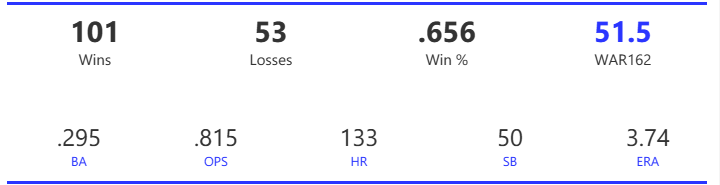
The Bronx Bombers featured a strong offense, leading the AL in runs, home runs, BA, OBP, and OPS, although their BA and OBP numbers were nearly matched by the Athletics. The Athletics did feature a stronger pitching staff, relegating the Yankees to second in ERA and strikeout-to-walk rate, and third in hits per 9 innings and WHIP.
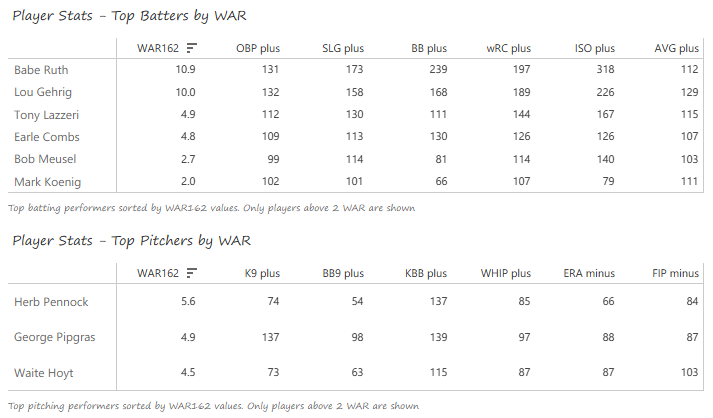
Babe Ruth and Lou Gehrig formed a dynamic duo in the middle of the lineup, with Ruth mashing 54 homers to go with an 1.172 OPS, 163 runs scored (all AL-best) and a .323 BA. Gehrig batted .374 with an AL-best .467 OBP, 47 doubles, and 147 RBI (also both AL-best). His 1.115 OPS was not far behind Ruth’s. Tony Lazzeri (.332 BA, 15 steals) and Earle Combs (.310 BA, 21 triples) provided additional offensive firepower. The moundsmen were led by Herb Pennock (17-6, 2.56 ERA), George Pipgras (AL-best 24 wins), and Waite Hoyt (23-7, AL-best 8 saves).
#8: 1921 Cleveland Indians, 52.8 WAR162
The 1921 Indians fell a bit short of the AL pennant, losing out to the Yankees by 4.5 games. Win projections had the Indians just 1.5 games behind the Yankees; in either case, the two teams were the best in the AL by a considerable distance.
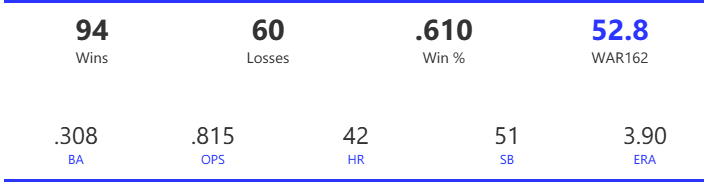
The Indians finished the season ranked second in runs scored, BA, and OBP, and third in OPS. They led the AL in doubles but were generally a good rather than a great offensive club for the season. One stark contrast versus the Yankees was in the home run category, where the New Yorkers topped the Indians 134 to 42. The Indians could not rely on the long ball the way the Babe Ruth-led Yankees could. On the mound, the Indians ranked second in ERA, first in shutouts, second in WHIP, and first in strikeout-to-walk rate.
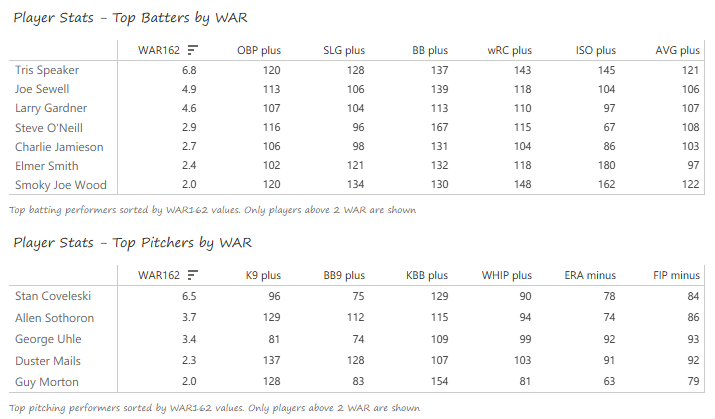
The veteran center fielder Tris Speaker (age 33) was the Indians’ top positional contributor, batting .362 (.977 OPS) with an AL-best 52 doubles. Joe Sewell chipped in with a .318 BA and .412 OBP, and Larry Gardner batted .319 with 14 triples. Stan Coveleski was the pitching standout, posting a 23-13 record with 28 complete games; Allen Sothoron went 12-4 with a 3.24 ERA as a fifth starter, and George Uhle won 16 games from the second spot in the rotation.
#7: 1923 New York Yankees, 53.8 WAR
Yet another Yankees team appears in these rankings, a clear indicator of their decade-long dominance. The 1923 club featured the classic recipe for teams of this era – unparalleled power at the plate coupled with well above-average pitching. This version of the team waltzed to the AL pennant by 16 games over the Tigers, and then avenged their 1922 World Series loss by beating the Giants in six games.
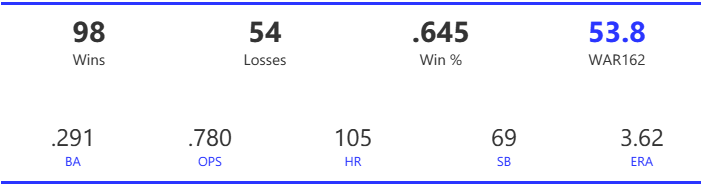
The Yankees’ offense ranked just third in runs scored, trailing both the Indians and Tigers, and also placed third in BA and OBP. The team’s considerable home run margin led to a second-place OPS ranking behind the Indians. On the mound, the New Yorkers coasted to the league’s top ERA, WHIP, and strikeout-to-walk rate. For the 1923 season, pitching played a strong part in the Yankees’ success.
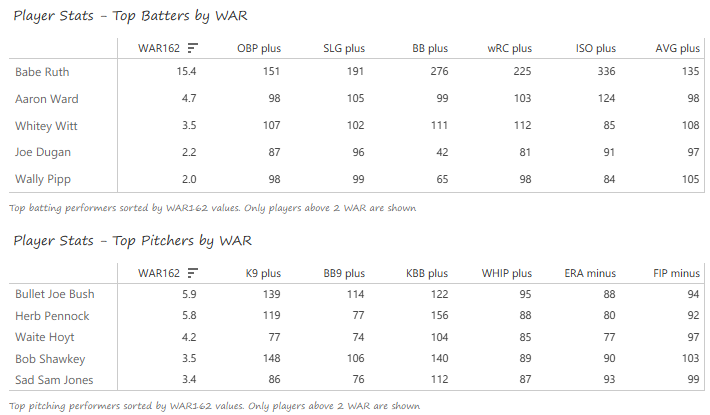
Babe Ruth was nearly a one-man show in 1923, authoring one of the best WAR seasons in history. Ruth posted an astonishing set of numbers – 41 homers, 130 RBI, a .545 OBP, 170 walks, a 1.309 OPS, and 151 runs scored. Each of these led the league, while his .393 BA trailed the Tigers’ Harry Heilmann’s .403 mark. Aaron Ward had a solid season at second base, batting .284 with 10 homers and 81 RBI, and Whitey Witt batted .314 with 113 runs scored. The pitching staff relied on five hurlers, with each winning between 16 and 21 games. Bullet Joe Bush (19-15, 3.43 ERA), Herb Pennock (19-6, 3.13 ERA), and Waite Hoyt (17-9, 3.02 ERA) topped the WAR rankings. Bob Shawkey (16-11, 3.51 ERA) and Sad Sam Jones (21-8, 3.63 ERA) were also major contributors; each of the core five logged between 238 and 275 innings pitched.
#6: 1921 New York Yankees, 55.4 WAR
The 1921 version of the Yankees ranks immediately ahead of the 1923 team, beating the Indians by 4.5 games in a two-team race for the pennant (the 3rd-place Browns were 17.5 games back). While the Yankees took home the AL hardware, the crosstown Giants beat them 5-3 in the best-of-9 World Series.
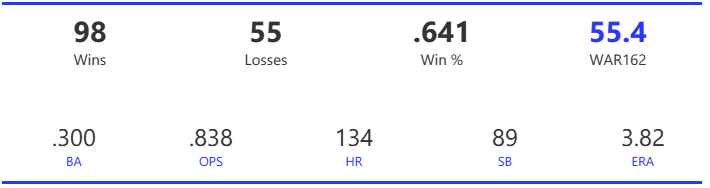
The Yankees led the AL with 948 runs scored, 134 home runs, and an .838 OPS. They trailed both the Tigers and Indians in BA and OBP, but offset those gaps by slamming more homers than those teams combined. The pitching staff was also proficient, leading the league in ERA (3.82), WHIP (1.416), and hits per 9 innings (9.6). In short, the Yankees could beat teams both offensively and on the mound, leading to this #6 ranking for the decade.
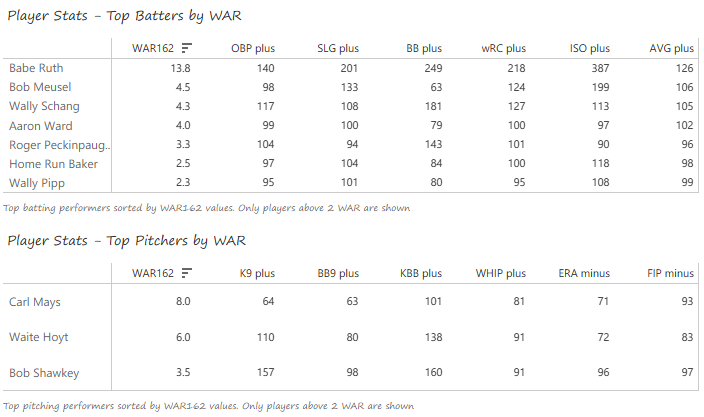
While Babe Ruth’s WAR numbers slightly trailed his massive 1923 season, they were nonetheless quite incredible. Ruth blasted a record 59 homers, scored 177 runs, had 168 RBI, drew 145 walks, posted a .512 OBP, and a 1.359 OPS, all tops in the AL. He also batted .378 for the campaign. Bob Meusel chipped in with a .318 BA and 138 RBI, while catcher Wally Schang batted .316 with a .428 OBP. Aaron Ward also contributed with a .306 BA and 76 RBI. The pitchers were led by Carl Mays, who put together a career year with a 27-9 record (and 7 saves) across 336 innings. Waite Hoyt won 19 games in his age-21 season, and Bob Shawkey added 18 wins despite a somewhat inflated 4.08 ERA.
Summary
That’s it for this entry in our MLB Team Rankings for the 1920s decade! Stay tuned for the countdown from #5 to #1, arriving in a few days. As always, thanks for reading!