Tag: 1920s

1920s MLB Team Rankings Countdown: 5 through 1

Welcome to the next countdown post in our series of 1920s MLB Team Rankings. As a reminder, the teams are ranked from #20 through #1 based on aggregate WAR162. For the 1920s (1920-1929), a total of 160 teams were eligible (16 teams x 10 seasons), so the top 20 teams are a fairly exclusive group. We’ll summarize each team, including portions of their team dashboard, and explain how they attained their ranking. So, without further ado, here are the teams ranked #5 through #1.

Here’s the interactive dashboard at Tableau Public: 1920s Top 20 MLB Teams Dashboard

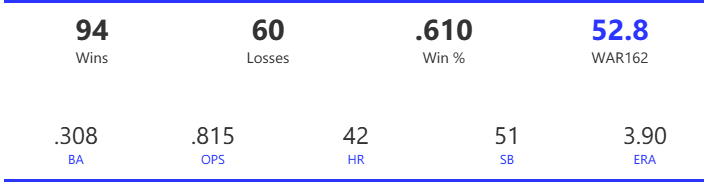
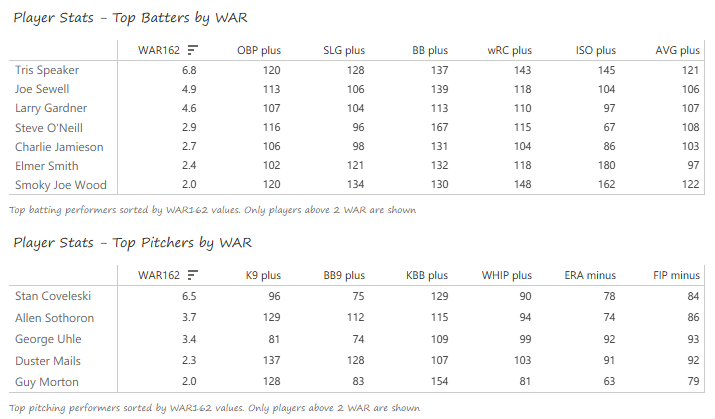
The 1920 Indians prevailed in a hotly contested AL pennant race, topping the White Sox by two games and the Yankees by four games. The team wound up a single game ahead of their projected 97-57 record, and would go on to defeat the Brooklyn Robins 5 games to 2 in a best-of-9 World Series.
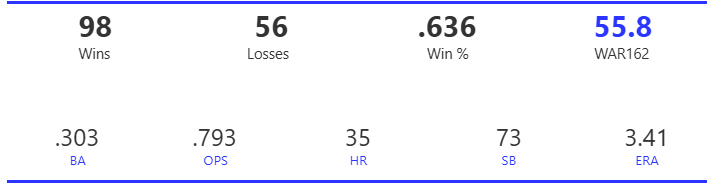
The Indians had a prolific offense that produced an AL-best 856 runs. They also led the league in doubles (301), OBP (.376), and OPS (.793), while placing second in BA and triples. The pitching performance was also strong, starting with a 3.41 ERA, trailing only the Yankees. They finished a close second in WHIP, and led the AL in strikeout-to-walk rate.
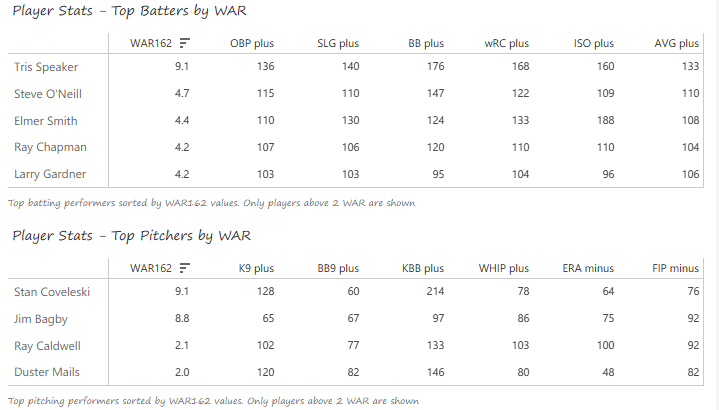
Center fielder Tris Speaker provided the offensive spark to go with his defensive prowess. Speaker batted .388, scored 137 runs, had 107 RBI, a 1.045 OPS, and led the AL with 50 doubles. Catcher Steve O’Neill batted .321 with 39 doubles, and Elmer Smith led the team with 12 homers while batting .316. Ray Chapman (.303 BA) and Larry Gardner (.310 BA, 118 RBI) round out the offensive production for the Indians. Stan Coveleski (24-14, 2.49 ERA) and Jim Bagby (31-12, 2.89 ERA) formed a formidable duo at the top of the Indians rotation. Bagby led the AL in wins and innings pitched, while Coveleski led the league in hits per 9 innings, WHIP, and strikeouts.

The 1928 version of the Athletics finished 2.5 games behind the pennant-winning Yankees, largely due to some exceptional luck on the Yankees’ end. Pythagorean projections had the A’s 2.5 games better than the Yankees, but they would have to wait a year for the standings to reflect that outcome.
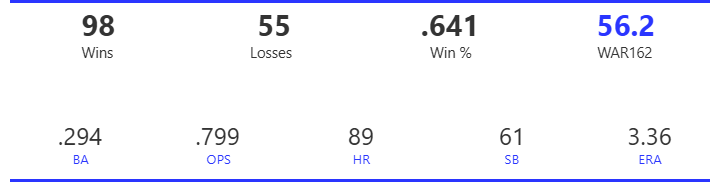
The A’s finished behind the Yankees across numerous offensive categories – runs, BA, OBP, and OPS, although the margins were often slim. They were a very good offensive squad, overshadowed by a slightly better Yankees unit. The Athletics possessed the top pitching staff across multiple measures – ERA (3.36), WHIP (1.296), hits per 9 innings, strikeouts per 9 innings, and strikeout-to-walk rate. The A’s staff was clearly the most effective group in the AL in 1928.
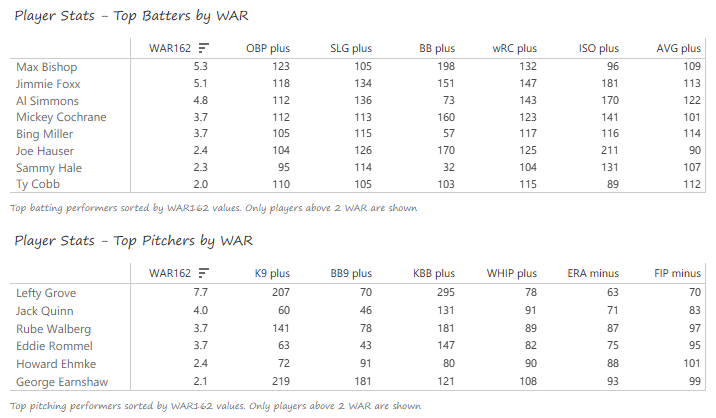
The A’s offense was a balanced group without any major stars in 1928, although some would emerge as stars in the following seasons. Max Bishop led the way, batting .316 with a .438 OBP, courtesy of 100 walks. The 20-year-old Jimmie Foxx batted .328 with a .964 OPS, and Al Simmons batted .351 with 107 RBI. Mickey Cochrane posted a .395 OBP from his catcher spot, and Bing Miller hit .329 with 85 RBI. The pitching staff was led by Lefty Grove and his 24-8 mark with a 2.58 ERA. Grove also topped the AL with 183 strikeouts. Jack Quinn posted a nifty 18-4 record with a 2.90 ERA, and Rube Walberg notched 17 wins from the second spot in the rotation. Eddie Rommel went 13-5, largely in relief, finishing 18 games.

The 1929 Athletics picked up where the 1928 club left off, winning the pennant this time by a remarkable 18 games over the Yankees. While they benefited from some good luck on their side, the A’s were still projected as a 100-win team. The A’s followed the pennant with a decisive 5-game triumph over the Cubs in the World Series.
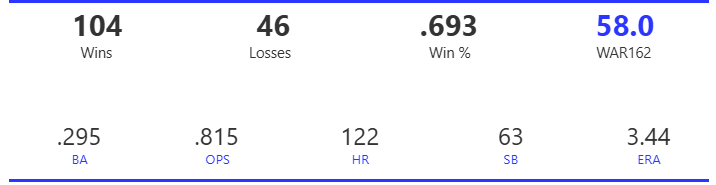
On a per-game basis, the A’s were dead even in runs scored with the Tigers. They also finished second in home runs, first in OBP and OPS, and third in BA. The team had a ridiculous 57-16 home record, and also excelled in one-run games (24-14). While the offense was very good, the pitching was even better. Their 3.44 ERA was far ahead of all rivals, as was their WHIP, strikeouts, and strikeout-to-walk rate.
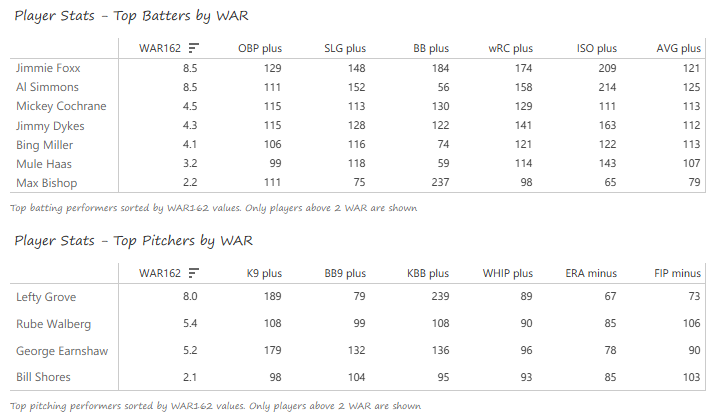
The offense was spearheaded by Jimmie Foxx and Al Simmons, who each put together huge seasons. Foxx (age 21) swatted 33 homers, batted .354, had an AL-best .463 OBP, and a 1.088 OPS. Simmons hit .365 with 34 homers and a league-best 157 RBI, plus a 1.040 OPS. Catcher Mickey Cochrane batted .331 with 113 runs scored, and Jimmie Dykes batted .327 while playing multiple infield positions. Bing Miller batted .331 with 93 RBI to round out a potent top five. On the mound, Lefty Grove went 20-6 with an AL-best 2.81 ERA and 170 strikeouts. Rube Walberg won 18 games, and George Earnshaw led the league with 24 wins.

The 1922 Browns are a surprise in the #2 spot in the rankings for a couple of reasons. First, they are the Browns, a franchise that had very little success until they became the Baltimore Orioles. They also finished in second place in 1922, a single game behind the Yankees. In true Browns fashion, their win projection was 7 games better than the Yankees’, but a combination of bad luck and some good luck for the Yankees relegated them to second place.
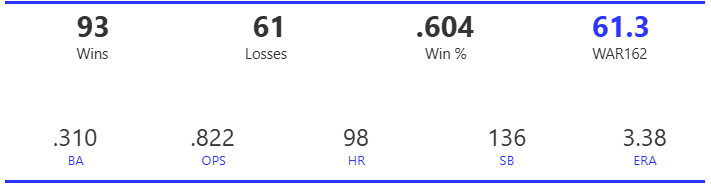
The Browns had a terrific offense in 1922, leading the AL in runs scored, 40 ahead of the Tigers. They ranked second in doubles, first in triples, second in homers, and easily led the league in stolen bases. They also paced the AL in BA and OPS; in short, they were a very potent offense, even given the high-scoring environment of 1922. The Browns’ pitching was also effective – their 3.38 ERA nosed out the Yankees to top the AL. The Browns ranked second in WHIP, and topped the league in both strikeouts and strikeout-to-walk rate.
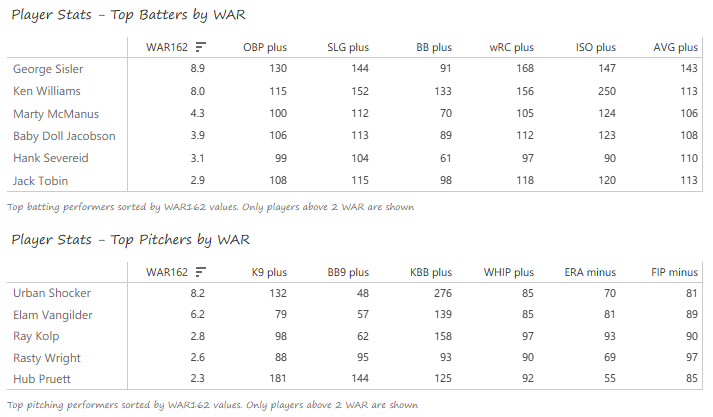
The 1922 Browns had three players with WAR162 values above 8, including two positional players. Star first baseman George Sisler led the AL with a .420 BA, 134 runs scored, 18 triples, 246 hits, and 51 stolen bases. His OPS of 1.061 was among the best in the AL. Teammate Ken Williams mashed 39 homers and added 155 RBI, both tops in the league, while batting .332 with a 1.040 OPS. Further support came from second baseman Marty McManus, who batted .312 with 109 RBI, and Baby Doll Jacobson, who paired 102 RBI with a .317 BA.

Urban Shocker was the third high-WAR player, authoring a 24-17 record with a 2.97 ERA and league-best 149 strikeouts in 348 innings. Elam Vangilder was a strong second starter with 19 wins and a solid 3.42 ERA. Ray Kolp, Rasty Wright, and Hub Pruett combined for 30 wins; Pruett finished 23 games and earned 7 saves.

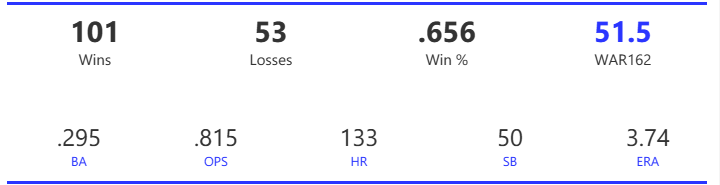
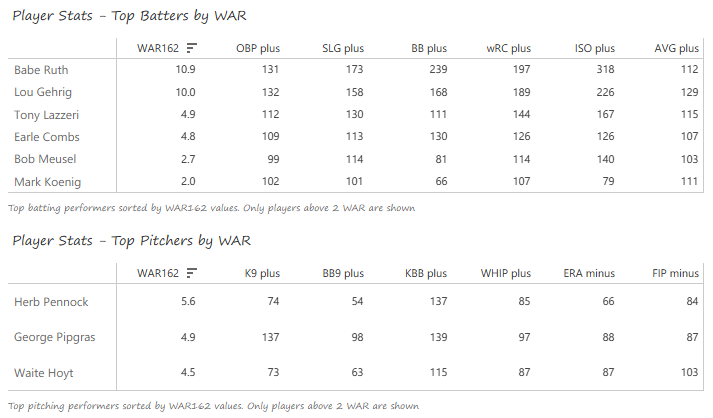
The 1927 Yankees are a legendary team in MLB history – peak Babe Ruth, emerging star Lou Gehrig, career years from the likes of Earle Combs, Tony Lazzeri, and more. They steamrolled the American League, topping a good Athletics team by 19 games, and then swept the Pirates in the World Series.
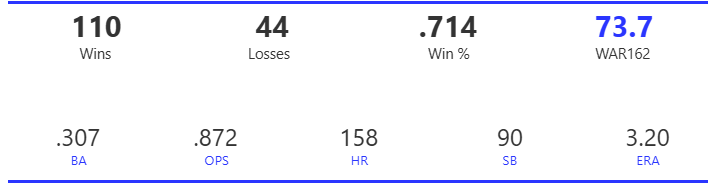
The Yankees were a dominant offensive team, piling up 976 runs, 131 more than the Tigers. They also led the league in home runs, swatting 102 more than any other team. Their .307 BA, .384 OBP, and .872 OPS all topped the league. As if the Yankees’ offense wasn’t enough, they also boasted the league’s best pitching staff, with a 3.20 ERA versus the next best 3.91 posted by the White Sox. The Yankees’ WHIP and hits per 9 innings were also far ahead of any rivals.
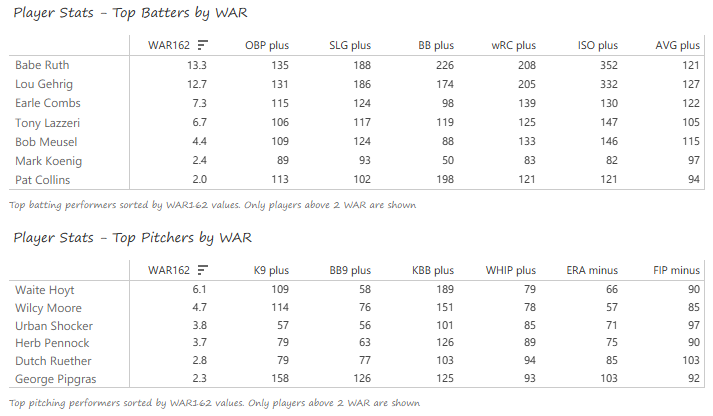
Ruth and Gehrig combined for a remarkable 26.0 WAR162 value, combining to lead the league in many offensive categories. Ruth led in home runs (60), walks (137), OBP (.486), OPS (1.258), and runs (158). Gehrig led in doubles (52) and RBI (173), while batting .373, posting a 1.240 OPS, and scoring 149 runs. Together, they formed the most intimidating two-man punch in MLB history. Earle Combs also had a fine year, leading the AL in hits (231) and triples (23), while batting .356, and Tony Lazzeri batted .309 with 102 RBI. Bob Meusel chipped in with a .337 BA and 103 RBI. Waite Hoyt led the pitching staff with a 22-7 record and 2.63 ERA, aided by Wilcy Moore (19-7, 2.28 ERA, 13 saves), and Urban Shocker (18-6, 2.84 ERA). Veteran Herb Pennock posted a 19-8 mark at age 33.

Summary

That’s it for this entry in our MLB Team Rankings for the 1920s decade! Here’s a quick summary of which franchises dominated the decade:
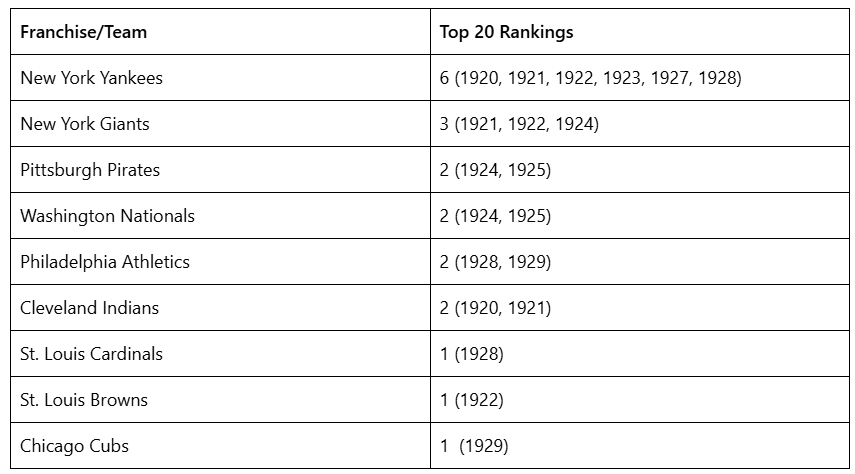
We’ll start visiting the 1930s next week. As always, thanks for reading!
1920s MLB Team Rankings Countdown: 10 through 6

Welcome to the next countdown post in our series of 1920s MLB Team Rankings. As a reminder, the teams are ranked from #20 through #1 based on aggregate WAR162. For the 1920s (1920-1929), a total of 160 teams were eligible (16 teams x 10 seasons), so the top 20 teams are a fairly exclusive group. We’ll summarize each team, including portions of their team dashboard, and explain how they attained their ranking. So, without further ado, here are the teams ranked #10 through #6.

Here’s the interactive dashboard at Tableau Public: 1920s Top 20 MLB Teams Dashboard

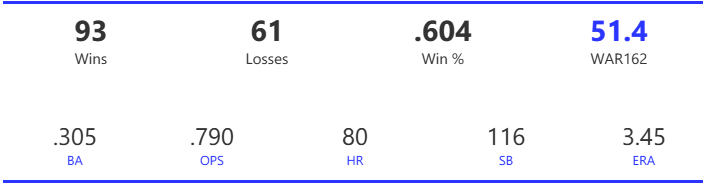
The 1922 Giants continued to dominate the National League, winning their second of four consecutive pennants. The Giants beat the Reds by a decisive seven-game margin, and then proceeded to sweep the crosstown rival Yankees in the World Series.

The Giants boasted a strong offense, finishing a close third in runs behind the Pirates and Cardinals. The team also ranked third in doubles, triples, home runs, and stolen bases, while placing second in both BA and OPS, and first in OBP. They were a strong, but not dominant, offensive squad. Pitching was a strength, as the Giants led the NL in ERA and ranked second in WHIP. Their staff also surrendered the fewest hits per 9 innings.

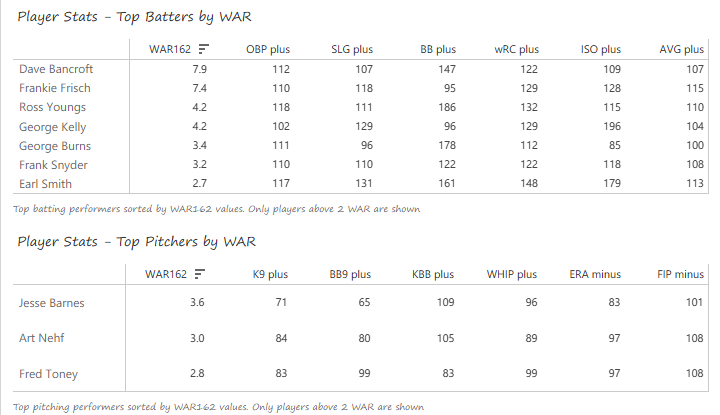
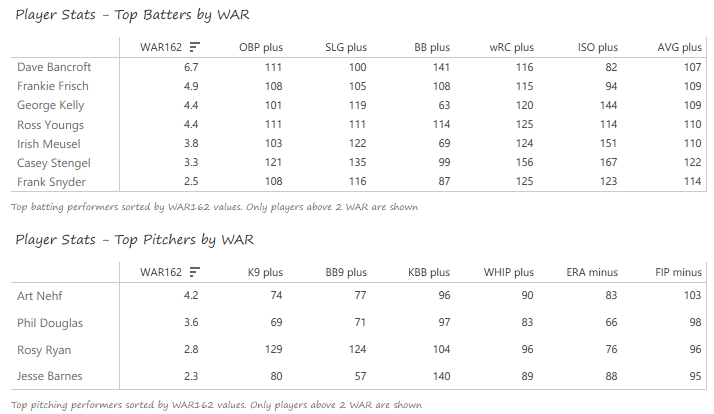
Dave Bancroft led an offense that featured multiple strong contributors. Bancroft batted .321 with 117 runs scored and 41 doubles; his infield partner Frankie Frisch batted .327 with 31 steals and 13 triples. George Kelly (.328 BA, 107 RBI), Ross Youngs (.331 BA, 105 runs), and Irish Meusel (.331 BA, 17 triples, 16 homers, 132 RBI) were also major contributors. Art Nehf led a balanced mound crew with a 19-13 mark, while Phil Douglas led the NL in fewest hits per 9 innings (8.8), ERA (2.63), and WHIP (1.199) in a challenging environment for pitchers. Rosy Ryan and Jesse Barnes combined for another 30 wins for the New Yorkers.

The 1928 Yankees were no match for the legendary 1927 team. However, they still won the American League pennant by 2.5 games over the resurgent Athletics, who actually had a higher projected win total. The Yankees exceeded their projection by six games to appear a bit better than their performance would indicate. They went on to sweep an overmatched Cardinals team in the World Series.

The Bronx Bombers featured a strong offense, leading the AL in runs, home runs, BA, OBP, and OPS, although their BA and OBP numbers were nearly matched by the Athletics. The Athletics did feature a stronger pitching staff, relegating the Yankees to second in ERA and strikeout-to-walk rate, and third in hits per 9 innings and WHIP.

Babe Ruth and Lou Gehrig formed a dynamic duo in the middle of the lineup, with Ruth mashing 54 homers to go with an 1.172 OPS, 163 runs scored (all AL-best) and a .323 BA. Gehrig batted .374 with an AL-best .467 OBP, 47 doubles, and 147 RBI (also both AL-best). His 1.115 OPS was not far behind Ruth’s. Tony Lazzeri (.332 BA, 15 steals) and Earle Combs (.310 BA, 21 triples) provided additional offensive firepower. The moundsmen were led by Herb Pennock (17-6, 2.56 ERA), George Pipgras (AL-best 24 wins), and Waite Hoyt (23-7, AL-best 8 saves).

The 1921 Indians fell a bit short of the AL pennant, losing out to the Yankees by 4.5 games. Win projections had the Indians just 1.5 games behind the Yankees; in either case, the two teams were the best in the AL by a considerable distance.

The Indians finished the season ranked second in runs scored, BA, and OBP, and third in OPS. They led the AL in doubles but were generally a good rather than a great offensive club for the season. One stark contrast versus the Yankees was in the home run category, where the New Yorkers topped the Indians 134 to 42. The Indians could not rely on the long ball the way the Babe Ruth-led Yankees could. On the mound, the Indians ranked second in ERA, first in shutouts, second in WHIP, and first in strikeout-to-walk rate.

The veteran center fielder Tris Speaker (age 33) was the Indians’ top positional contributor, batting .362 (.977 OPS) with an AL-best 52 doubles. Joe Sewell chipped in with a .318 BA and .412 OBP, and Larry Gardner batted .319 with 14 triples. Stan Coveleski was the pitching standout, posting a 23-13 record with 28 complete games; Allen Sothoron went 12-4 with a 3.24 ERA as a fifth starter, and George Uhle won 16 games from the second spot in the rotation.

Yet another Yankees team appears in these rankings, a clear indicator of their decade-long dominance. The 1923 club featured the classic recipe for teams of this era – unparalleled power at the plate coupled with well above-average pitching. This version of the team waltzed to the AL pennant by 16 games over the Tigers, and then avenged their 1922 World Series loss by beating the Giants in six games.

The Yankees’ offense ranked just third in runs scored, trailing both the Indians and Tigers, and also placed third in BA and OBP. The team’s considerable home run margin led to a second-place OPS ranking behind the Indians. On the mound, the New Yorkers coasted to the league’s top ERA, WHIP, and strikeout-to-walk rate. For the 1923 season, pitching played a strong part in the Yankees’ success.

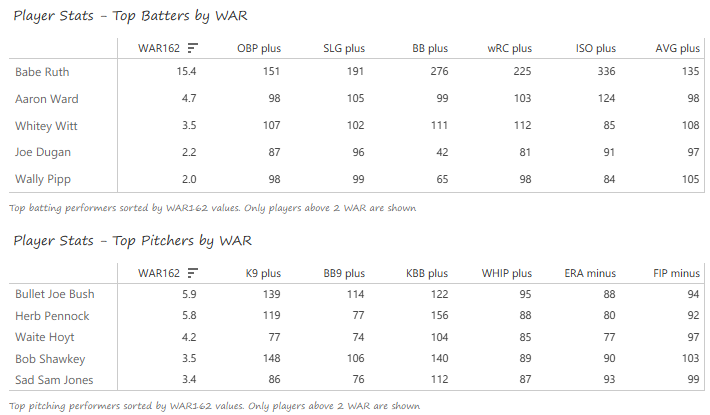
Babe Ruth was nearly a one-man show in 1923, authoring one of the best WAR seasons in history. Ruth posted an astonishing set of numbers – 41 homers, 130 RBI, a .545 OBP, 170 walks, a 1.309 OPS, and 151 runs scored. Each of these led the league, while his .393 BA trailed the Tigers’ Harry Heilmann’s .403 mark. Aaron Ward had a solid season at second base, batting .284 with 10 homers and 81 RBI, and Whitey Witt batted .314 with 113 runs scored. The pitching staff relied on five hurlers, with each winning between 16 and 21 games. Bullet Joe Bush (19-15, 3.43 ERA), Herb Pennock (19-6, 3.13 ERA), and Waite Hoyt (17-9, 3.02 ERA) topped the WAR rankings. Bob Shawkey (16-11, 3.51 ERA) and Sad Sam Jones (21-8, 3.63 ERA) were also major contributors; each of the core five logged between 238 and 275 innings pitched.

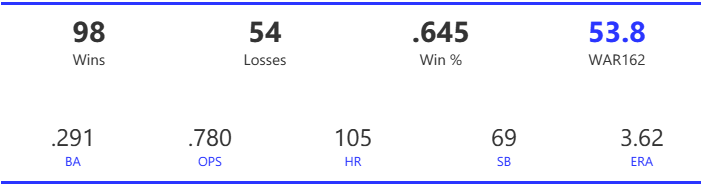
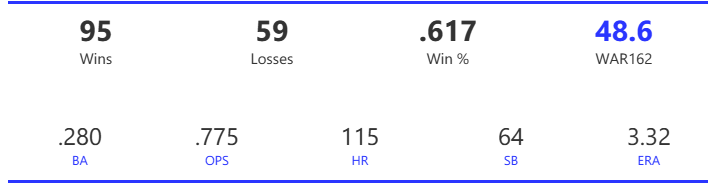
The 1921 version of the Yankees ranks immediately ahead of the 1923 team, beating the Indians by 4.5 games in a two-team race for the pennant (the 3rd-place Browns were 17.5 games back). While the Yankees took home the AL hardware, the crosstown Giants beat them 5-3 in the best-of-9 World Series.

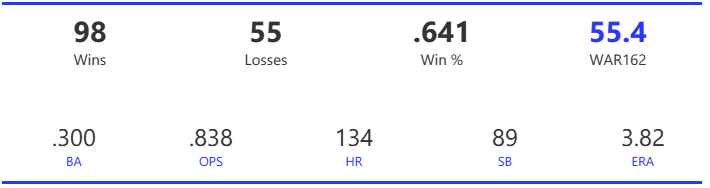
The Yankees led the AL with 948 runs scored, 134 home runs, and an .838 OPS. They trailed both the Tigers and Indians in BA and OBP, but offset those gaps by slamming more homers than those teams combined. The pitching staff was also proficient, leading the league in ERA (3.82), WHIP (1.416), and hits per 9 innings (9.6). In short, the Yankees could beat teams both offensively and on the mound, leading to this #6 ranking for the decade.

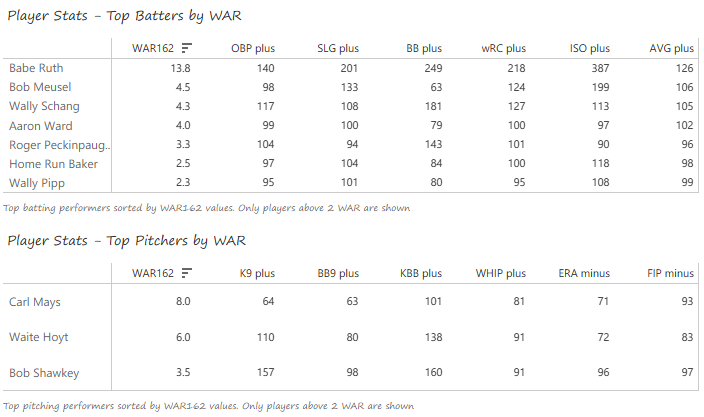
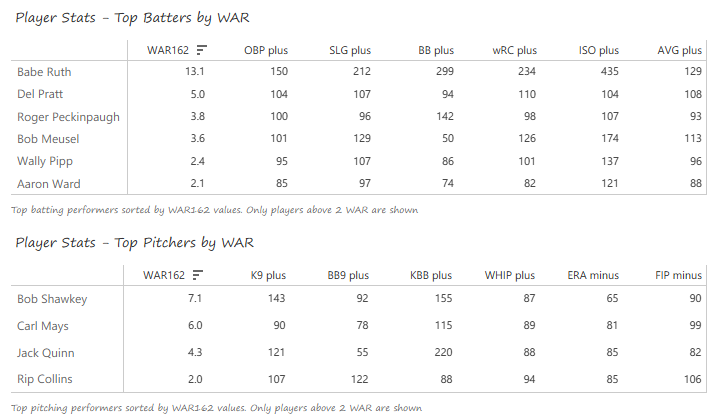
While Babe Ruth’s WAR numbers slightly trailed his massive 1923 season, they were nonetheless quite incredible. Ruth blasted a record 59 homers, scored 177 runs, had 168 RBI, drew 145 walks, posted a .512 OBP, and a 1.359 OPS, all tops in the AL. He also batted .378 for the campaign. Bob Meusel chipped in with a .318 BA and 138 RBI, while catcher Wally Schang batted .316 with a .428 OBP. Aaron Ward also contributed with a .306 BA and 76 RBI. The pitchers were led by Carl Mays, who put together a career year with a 27-9 record (and 7 saves) across 336 innings. Waite Hoyt won 19 games in his age-21 season, and Bob Shawkey added 18 wins despite a somewhat inflated 4.08 ERA.

Summary

That’s it for this entry in our MLB Team Rankings for the 1920s decade! Stay tuned for the countdown from #5 to #1, arriving in a few days. As always, thanks for reading!
1920s MLB Team Rankings Countdown: 15 through 11

Welcome to the next countdown post in our series of 1920s MLB Team Rankings. As a reminder, the teams are ranked from #20 through #1 based on aggregate WAR162. For the 1920s (1920-1929), a total of 160 teams were eligible (16 teams x 10 seasons), so the top 20 teams are a fairly exclusive group. We’ll summarize each team, including portions of their team dashboard, and explain how they attained their ranking. So, without further ado, here are the teams ranked #15 through #11.

Here’s the interactive dashboard at Tableau Public: 1920s Top 20 MLB Teams Dashboard

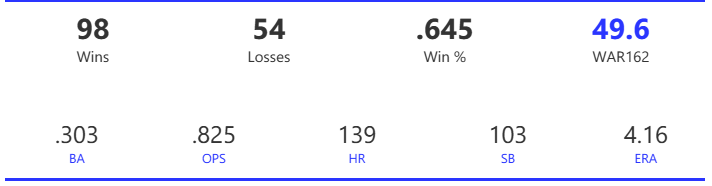
The 1929 Cubs ran away from their rivals in Pittsburgh and New York, finishing 10.5 games ahead of the second-place Pirates. While they claimed the NL pennant, they were soundly defeated by a powerful Athletics team in a 5-game World Series.

The Cubs rolled to 6.3 runs per game in a high-octane offensive season in the NL. The Cubs were considered a bit fortunate by the Pythagorean projection, which had them at 94 wins, still the best in the league. Their 982 runs were 78 more than the Pirates could muster, and their .303 BA, .377 OBP, 139 home runs, and .825 OPS all ranked second, behind the Phillies, who benefited from a better offensive home field environment. The Cubs pitchers ranked second in ERA, first in shutouts, second in strikeouts, and second in strikeout-to-walk rate.

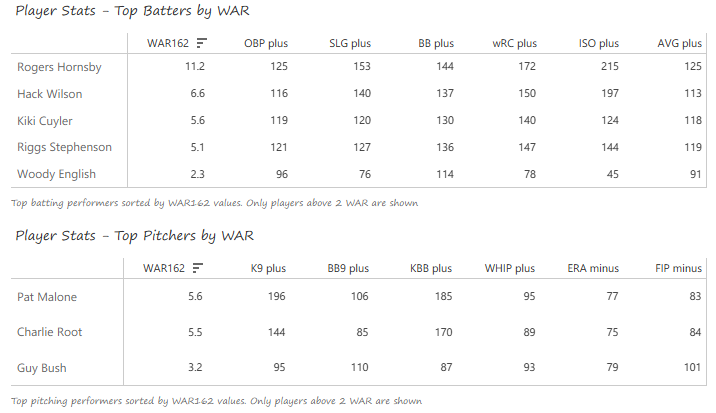
The legendary Rogers Hornsby spent four seasons with the Cubs, with 1929 ranking as the best of his tenure. Hornsby scored 156 runs (NL-best), batted .380, slugged 39 home runs, and had a league-leading 1.139 OPS. Hack Wilson, Kiki Cuyler, and Riggs Stephenson all provided ample support behind Hornsby. Wilson belted 39 homers with an NL-best 159 RBI, while batting .345. Cuyler led the NL with 43 steals, batted .360, and scored 111 runs, while Stephenson batted .362 with 17 homers. The Cubs were a powerful run-scoring team, even given the high offensive levels in 1929. Their pitching was led by Pat Malone (22-10, 3.57 ERA) and Charlie Root (19-6, 3.47 ERA). Malone led the league with 166 strikeouts.

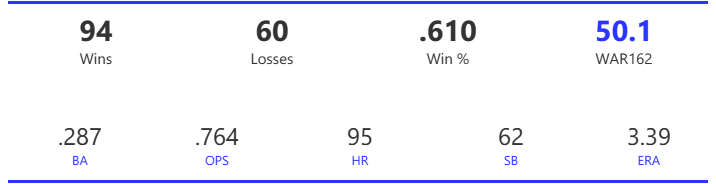
The 1922 Yankees snuck past the upstart Browns to claim the AL pennant by a single game. Pythagorean win projections have the Browns as the better team (by 7 games), but the Yankees exceeded their projection while the Browns fell well short of their expected 98 wins.

The Yankees were a rather ordinary offensive team, and certainly not a great one. They ranked fourth in runs, third in homers, fourth in BA, and third in OPS, and were below the league average in other categories. Pitching is what propelled them to the top; they ranked second in ERA, first in WHIP, and second in strikeout-to-walk rate.

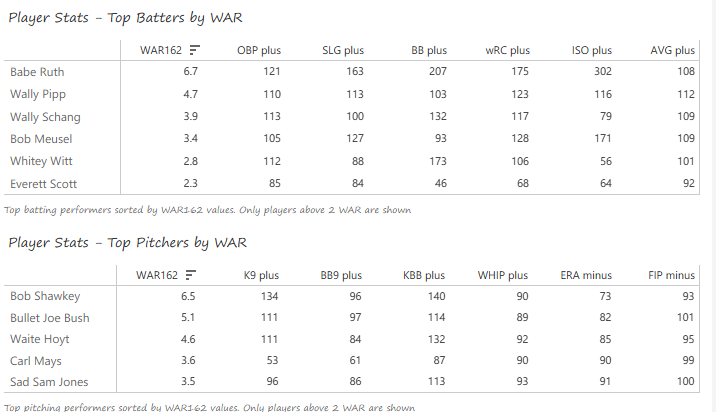
Babe Ruth led the team in WAR, despite playing just 110 out of 154 games. His 1.106 OPS topped the AL, and he added a .315 BA, 35 homers, and 96 RBI. Wally Pipp batted .329 with 94 RBI, Wally Schang hit .319. Bob Meusel added his own .319 BA to go with 88 RBI. The pitching staff stepped up in the absence of a huge season from Ruth, led by Bob Shawkey. Shawkey won 20 games while posting a 2.91 ERA, while Bullet Joe Bush posted a glitzy 26-7 mark. Waite Hoyt had a strong season at age 22, going 19-12, and Carl Mays and Sad Sam Jones each added 13 wins.

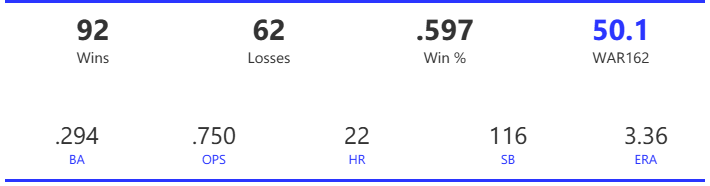
The 1924 Nationals outlasted the Yankees, riding the arms of their pitching staff to the first of back-to-back AL pennants. Their 92-62 record was exactly equal to the expected win projection, and landed them 2 games ahead of the New Yorkers. They then went on to defeat the Giants in a 7-game World Series.

The Nationals took home the pennant despite a lackluster offense that saw them finish sixth in runs scored and last in home runs. Their offense was more like a deadball-era team: they ranked first in triples and second in stolen bases, but were quite ordinary in other metrics. Pitching made the difference for the Nationals, as their ERA was by far the best in the AL; they also led in WHIP and hits per 9 innings, and were near the top in other measures.

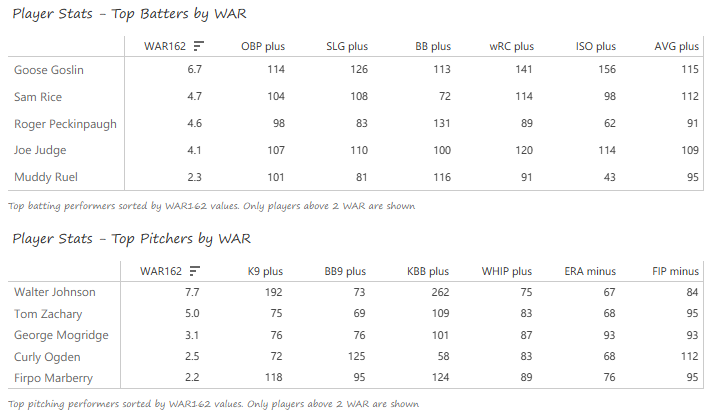
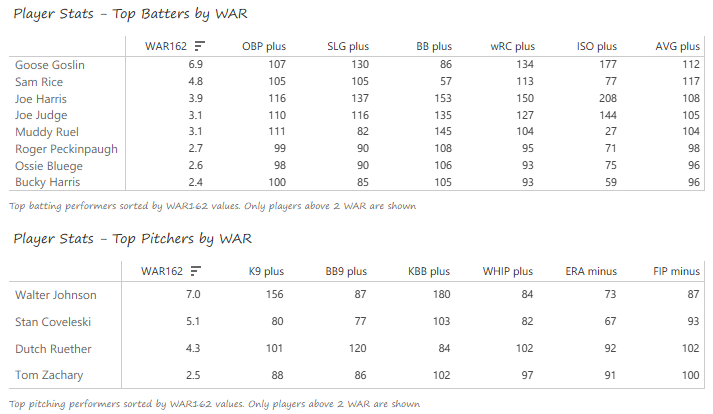
Goose Goslin was the Nationals’ top offensive threat, batting .344 with an AL-best 129 RBI and 12 of the team’s 22 homers. Sam Rice batted .334 and scored 106 runs, while Roger Peckinpaugh earned a .360 OBP from his shortstop position. Joe Judge batted .324 with 79 RBI to round out the Nationals’ top producers. The ageless Walter Johnson was finally rewarded with a pennant, leading the AL in wins (23), ERA (2.72), shutouts (6), and strikeouts (158) in his age-36 season. Tom Zachary won 15 with a 2.75 ERA, and George Mogridge added 16 more wins to provide solid support behind Johnson.

The 1925 Nationals repeated as AL champs, this time topping the Athletics by a comfortable 8.5 game margin. However, their return trip to the World Series was spoiled by the Pirates in another 7-game series. The team would not return to a similar level of success until the early 1930s.

The Nationals offense once again paled compared to several AL rivals. Their 828 runs placed fourth, same as their .786 OPS. They ranked first in stolen bases and second in both BA and OBP, so their offense was slightly improved compared to the 1924 edition. Once again, the Nationals staff posted the top ERA, WHIP, and hits per 9 innings marks.

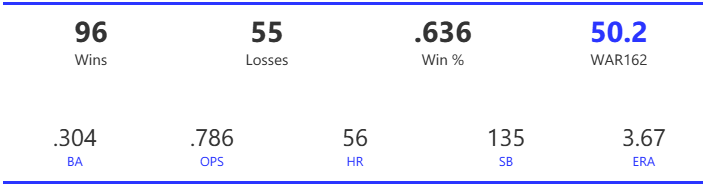
Goose Goslin again led the offense, batting .334 with an NL-best 20 triples. He also cracked 18 homers, had 113 RBI, and 116 runs scored. Sam Rice again was the next biggest threat, batting .350 with 111 runs scored. Joe Harris batted .323 with 12 homers in just 100 games, and Joe Judge (.314 BA) and Muddy Ruel (.310 BA) provided additional support. Walter Johnson (age 37) and Stan Coveleski (age 35) each won 20 games, with Coveleski posting an AL-best 2.84 ERA. Dutch Ruether chipped in with 18 wins to give the Nationals a strong mound trio.

The 1924 Giants edged the Brooklyn Robins (1.5 games back) and Pittsburgh Pirates (4.5 back) in a three-team race for the NL pennant. The Giants would go on to lose to the Senators in a classic 7-game World Series.

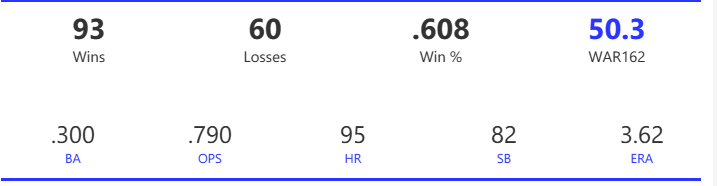
The Giants had a big offense in 1924 that carried them to the pennant. Their 857 runs scored topped the Cardinals by 117 runs, and they made a clean sweep of the BA, OBP, and OPS metrics. They also ranked at or near the top in doubles, homers, and walks. The Giants’ pitching was adequate, but clearly not the equal of their offense. They ranked third in ERA, fourth in WHIP, and first in saves (with 19).

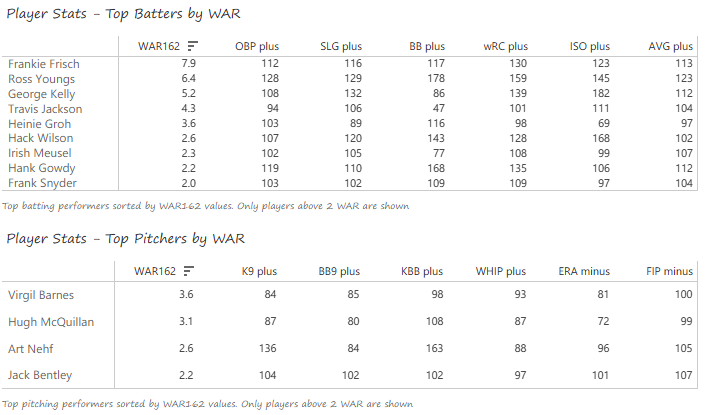
Frankie Frisch led a deep positional lineup, batting .328 with an NL-best 121 runs scored to go with his excellent range at second base. Ross Youngs batted a robust .356 with 112 runs scored, while George Kelly led the NL with 136 RBI to go with 21 homers. The left side of the infield was productive – shortstop Travis Jackson batted .302 in his age-20 season, and 3rd baseman Heinie Groh batted .281 in his age-34 season. On the mound, Virgil Barnes posted a 16-10 mark, while Hugh McQuillan added 14 wins with a 2.69 ERA. Art Nehf (14) and Jack Bentley (16) combined for another 30 wins.

Summary

That’s it for this entry in our MLB Team Rankings for the 1920s decade! Stay tuned for the countdown from #10 to #6, arriving in a few days. As always, thanks for reading!
MLB Team Rankings Countdown: 1920s 20 through 16

Welcome to the first countdown post in our series of MLB team rankings for the 1920s. As a reminder, the teams are ranked from #20 through #1 based on aggregate WAR162. For the 1920s (1920-1929), a total of 160 teams were eligible (16 teams x 10 seasons), so the top 20 teams are a fairly exclusive group. We’ll summarize each team, including portions of their team dashboard, and explain how they attained their ranking. So, without further ado, here are the teams ranked #20 through #16.

Here’s the interactive dashboard at Tableau Public: 1920s Top 20 MLB Teams Dashboard

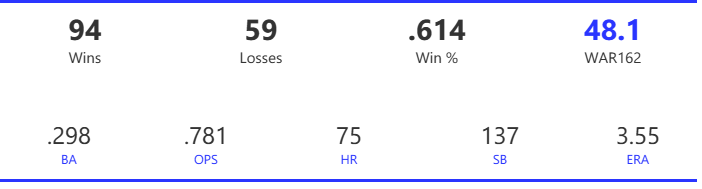
The 1921 Giants returned to the top of the National League, winning the pennant by four games over the Pirates. The team had a high-scoring offense to pair with above-average pitching. This formula would make them the NL’s dominant team for the first half of the decade.

The Giants’ 840 runs were well ahead of the Cardinals (809 runs) and far ahead of all other rivals. The Cardinals boasted a .308 BA, 10 points ahead of the Giants in the high-scoring, lively ball era that was taking shape. The Giants did edge out the Cards in OBP, courtesy of an NL-best 469 walks. They also placed second in OPS, and first in stolen bases, albeit with far fewer than in the deadball era. The team’s 3.55 ERA placed third, while their WHIP was second; other categories ranked in the middle of the NL.

Dave Bancroft and Frankie Frisch were the clear leaders of the team, each scoring 121 runs to top the Giants. Bancroft batted .318 at shortstop, while Frisch stole 49 bases and picked up 100 RBI while manning third base. Ross Youngs (.327 BA, 16 triples) and George Kelly (.308 BA, NL-best 23 HR) provided the second-level offensive support. The mound corps was led by Jesse Barnes (15-9, 3.10 ERA, 6 saves) and Art Nehf (20-10), with support from Fred Toney (18-11).

The 1920 Yankees finished third in a tight AL pennant chase, four games behind the 1st-place Indians. The 1920 team was a forerunner of greater seasons to come in a dominant Yankees decade.

The Yankees displayed a potent offense that ranked first in home runs, second in runs scored, and third in OPS, while lagging behind in stolen bases and triples. This was a team built for power in the new live ball era. The pitching staff was quite effective, leading the AL in ERA, shutouts, WHIP, and hits per 9 innings.

Babe Ruth almost single-handedly carried the offense, putting up unprecedented numbers – 54 homers, 135 RBI, 158 runs scored, and 150 walks, leading to a .532 OBP and 1.379 OPS. Baseball had not seen anything like the 1920 version of Ruth. Del Pratt was next in line, batting .314 with 108 RBI, followed by Roger Peckinpaugh (.270 BA, 109 runs) and Bob Meusel (.328 BA, 40 doubles).

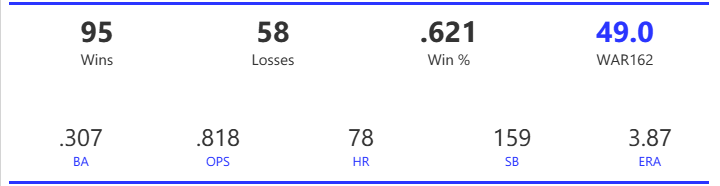
The 1925 edition of the Pirates won both the NL pennant and World Series, defeating the Nationals in seven games. The Pittsburgh club cruised to an 8.5 game margin over the Giants, riding a potent offense that plated 912 runs for the season, far ahead of the Cardinals’ 828.

The Pirates batted .307 (the NL average was an elevated .292), stole 159 bases, rapped 316 doubles, and had a team OPS of .818, all tops in the NL. The pitching was solid, if not at the level of the offense. Their 3.87 ERA ranked second; they also ranked second in WHIP, and third in hits per 9 innings.

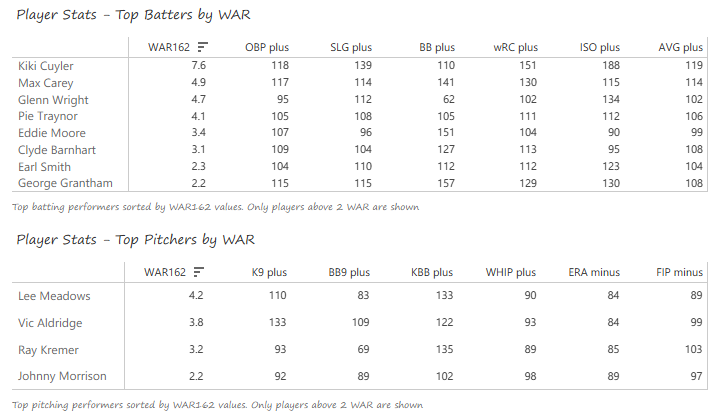
Kiki Cuyler was the clear offensive leader for Pittsburgh, with a .357 BA, 26 triples and 144 runs (both NL-best), and a healthy 1.021 OPS. Max Carey (46 steals, .343 BA), Glenn Wright (18 homers, .308 BA), and Pie Traynor (.320 BA, 39 doubles) also contributed significantly.

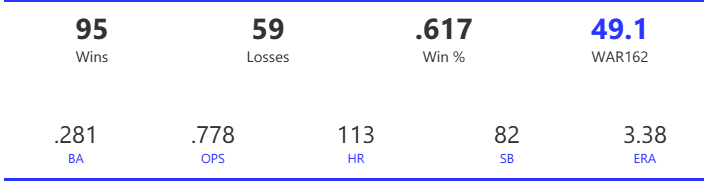
The 1928 Cardinals triumphed over the Giants (2 games behind) and Cubs (4 games back) in a competitive NL pennant race, before being swept by the Yankees in a one-sided World Series.

The Cards were solid both offensively and defensively, finishing tied for second in runs scored, first in doubles, second in homers, and a very close third in stolen bases. They also ranked third in BA and OPS, and second in OBP. The pitching numbers were similar – second in ERA, first in WHIP, and second in strikeout-to-walk rate.

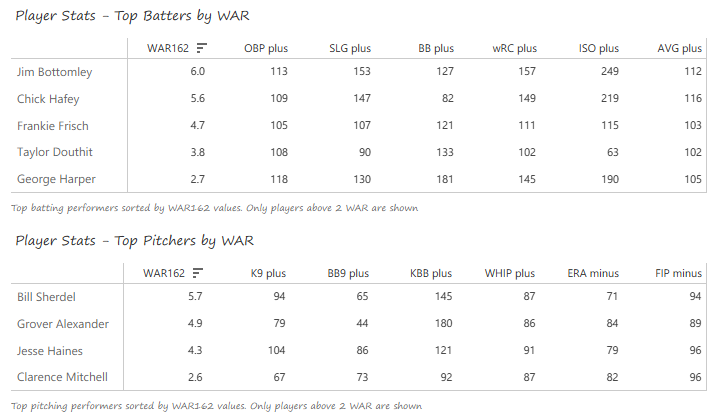
The offense was balanced without having a single big-name star. Jim Bottomley did lead the NL with 20 triples, 31 homers, and 136 RBI, and also posted a 1.030 OPS. Chick Hafey batted .337 with 46 doubles and 111 RBI, Frankie Frisch stole 29 bases while batting .300, and Taylor Douthit batted .295. The pitching was led by Bill Sherdel, who posted a 21-10 record with a 2.86 ERA, and the 41-year-old Grover Alexander put together a 16-9 campaign. Jesse Haines went 20-8 as the third starter; all three pitched between 240 and 250 innings.

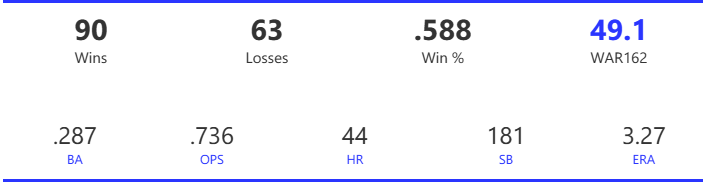
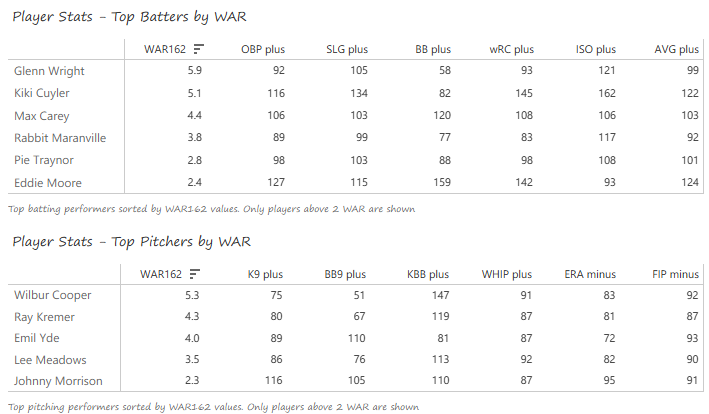
The 1924 Pirates finished a very close third in the 1924 NL pennant race, trailing the Giants (by 4.5 games) and the Robins (by 3 games). A year later, the Pirates would take the top spot with a better record (95-58) but a lower team WAR162.

The Pirates in 1924 possessed a good (not great) offense and a strong pitching staff that kept them in the pennant chase throughout the season. They ranked third in runs (far behind the Giants), first in triples, first in stolen bases, and third in OPS. The pitching staff ranked second in ERA, first in shutouts, second in WHIP, and second in walks per 9 innings.

Glenn Wright led the position players for the Pirates, batting .287 from his shortstop position with 111 RBI. Kiki Cuyler batted a robust .354 with 32 steals, and Max Carey led the NL with 49 steals to go with his 113 runs scored. The pitching was led by veteran Wilbur Cooper, who posted a 20-14 mark with 4 shutouts, and Ray Kremer, who had an 18-10 mark with 4 shutouts of his own. Emil Yde also tossed 4 shutouts on his way to a 16-3 mark and an excellent 2.83 ERA. The four shutouts for each pitcher tied for the NL lead in 1924.

Summary

That’s it for the first entry in our MLB Team Rankings for the 1920s decade! Stay tuned for the countdown from #15 to #11, arriving in a few days. As always, thanks for reading!