Tag: 1930s

1930s MLB Team Rankings Countdown: 5 through 1

Welcome to the final countdown post in our series of MLB team rankings for the 1930s. As a reminder, the teams are ranked from #20 through #1 based on aggregate WAR162. For the 1930s (1930-1939), a total of 160 teams were eligible (16 teams x 10 seasons), so the top 20 teams are a fairly exclusive group. We’ll summarize each team, including portions of their team dashboard, and explain how they attained their ranking. So, without further ado, here are the teams ranked #5 through #1.

Here’s the interactive dashboard at Tableau Public: 1930s Top 20 MLB Teams Dashboard

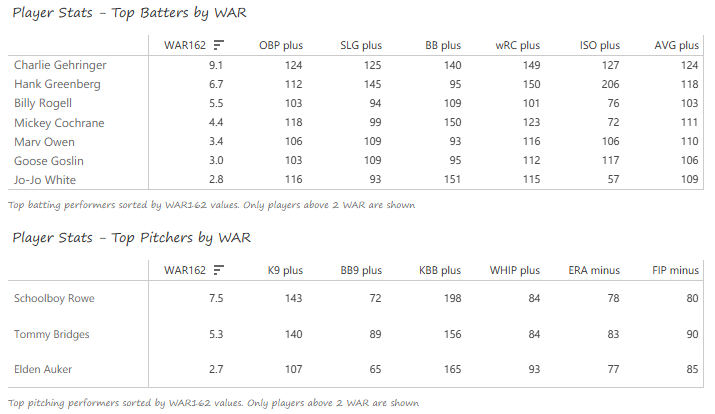
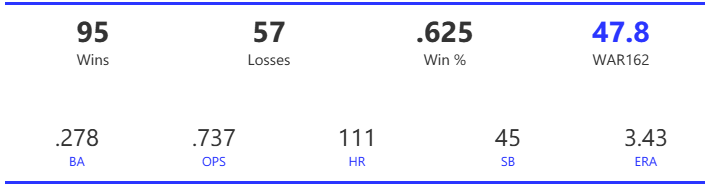
The 1935 Tigers defended their AL pennant and went on to defeat the Cubs in the World Series. Their 93-58 mark landed them 3 games ahead of the Yankees; the Tigers win projection was a few games higher at 97-54. They would then go on to defeat the Cubs in 6 games for the World Series title.
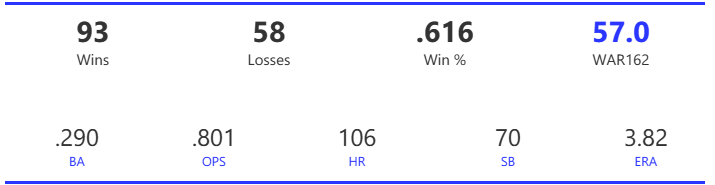
The Tigers had a very strong offense, scoring 918 runs, 95 ahead of the Nationals. They were second in the AL in doubles and homers, and topped the league in BA, OBP, and OPS. Their pitching was also very good, leading the AL in shutouts and finishing second in strikeouts and strikeout-to-walk rate.
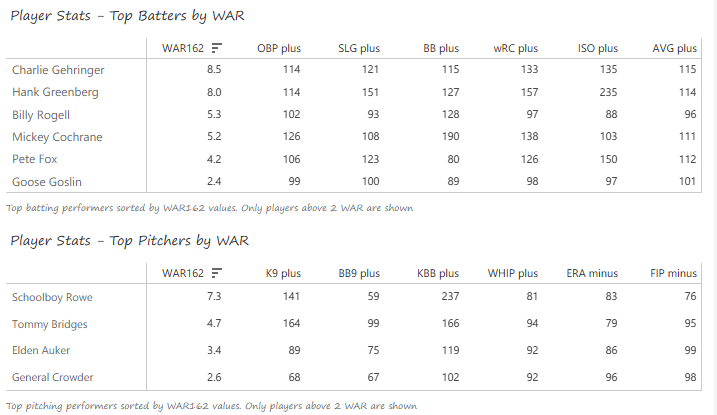
Charlie Gehringer and Hank Greenberg formed a potent 1-2 offensive punch, with Gehringer accounting for 123 runs, 108 RBI, and a .330 BA. Greenberg led the league with 36 homers and 168 RBI while batting .328. Billy Rogell excelled at shortstop, scoring 90 runs and taking 80 walks, and catcher Mickey Cochrane batted .319 with a .452 OBP. The pitching staff was led by Schoolboy Rowe, who tossed an AL-best 6 shutouts with a 2.06 strikeout-to-walk rate. Tommy Bridges won 21 games and led the AL with 169 strikeouts, and Elden Auker added 18 wins.

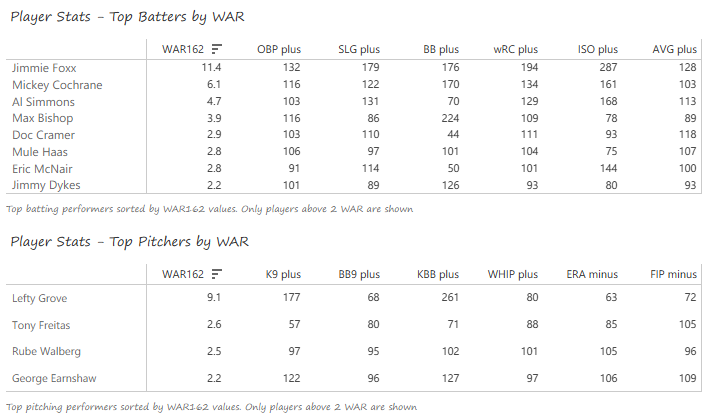
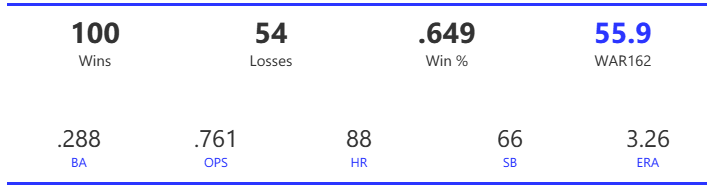
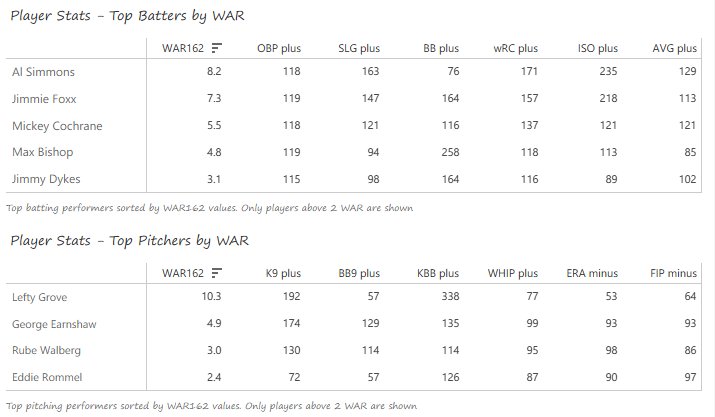
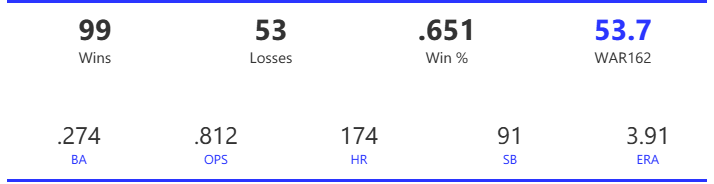
The 1931 A’s won an impressive 107 games, finishing 13.5 games ahead of the Yankees, to claim their third consecutive AL pennant. Win projections tell a different story, as the A’s were a full 10 games ahead of their 97-win Pythagorean estimate. In simple terms, they were an excellent team, but not as dominant as their record indicates. The A’s would go on to lose a 7-game World Series to the Cardinals.
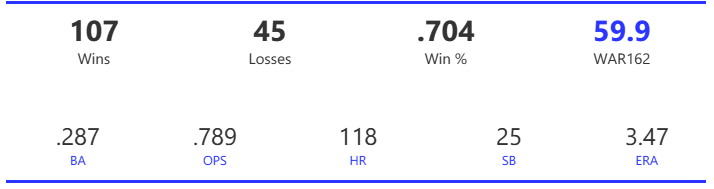
The A’s ranked just third in runs scored, trailing both the Yankees and Indians, and placed second in both doubles and home runs. They ranked third in BA and OBP, and a distant second to the Yankees in OPS. Pitching set the Athletics apart from their rivals in 1931, as they led the AL in numerous categories – ERA, shutouts, WHIP, and strikeout-to-walk rate.
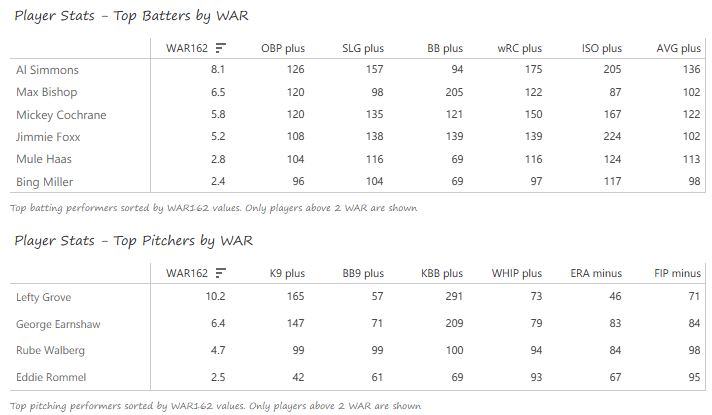
Al Simmons was the A’s offensive leader for the 1931 season, leading the AL with a .390 BA, adding 22 homers, 128 RBI, and a 1.085 OPS. Max Bishop had a fine .426 OBP and 115 runs scored, and catcher Mickey Cochrane batted .349. Jimmie Foxx stroked 30 homers with 120 RBI to round out the Athletics’ top offensive producers. The mound was anchored by veteran Lefty Grove, who compiled a career season with a 31-4 record, 2.06 ERA, 27 complete games, 175 strikeouts, and 4 shutouts. All these numbers were tops in the league for 1931. George Earnshaw (21-7, 3.67 ERA) and Rube Walberg (20-12, 3.74 ERA) rounded out a formidable pitching staff.

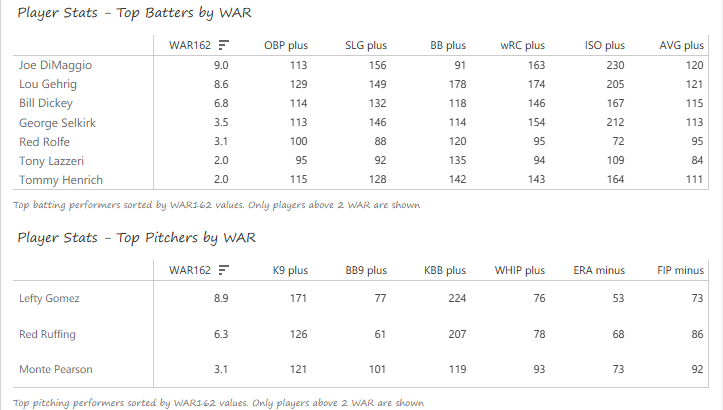
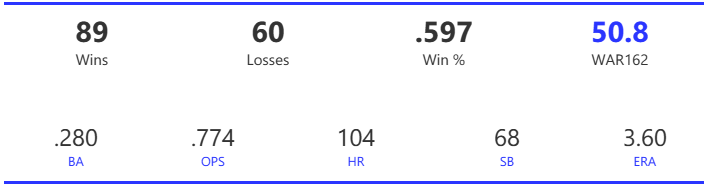
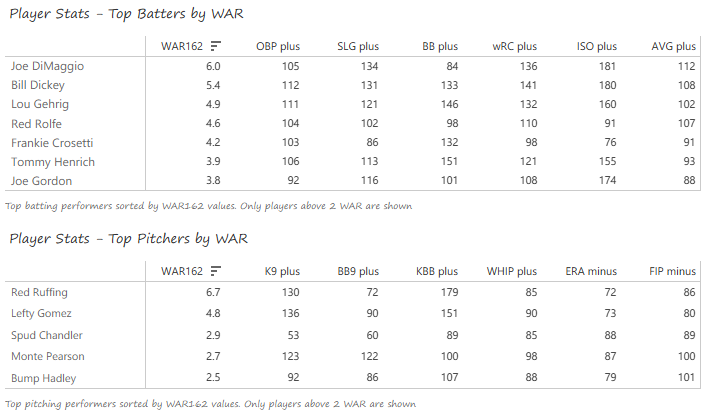
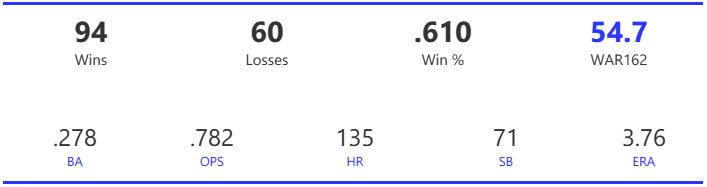
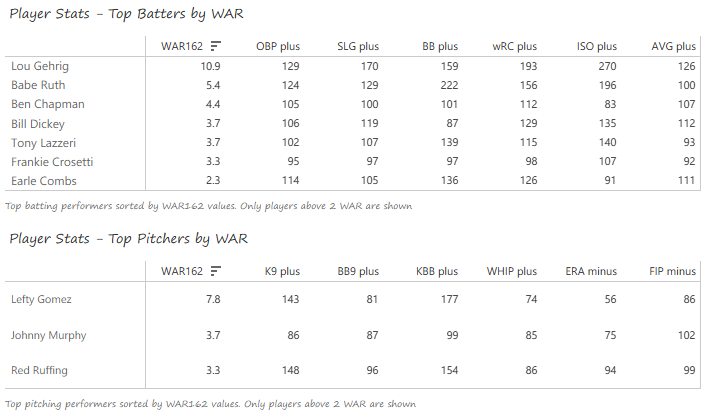
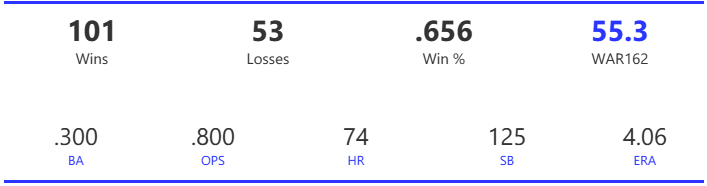
The 1936 Yankees were a powerhouse club that ran away with the AL pennant, finishing 19.5 games ahead of the defending champ Tigers. Their 102 wins were not a fluke, as the New Yorkers dominated the AL in scoring and preventing runs. The Yankees finished business by defeating the crosstown Giants in a 6-game World Series.
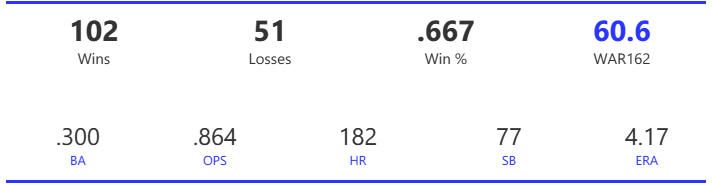
The Yankees scored 1,065 runs, 144 more than both the Indians and Tigers. They also clobbered an absurd (for the time) 182 homers, 59 ahead of the Indians. The team ranked second in BA, first in OBP, and a resounding first in OPS. This was an offensive powerhouse. The pitching was also very good, leading the AL in ERA and strikeouts, and placing second in WHIP.
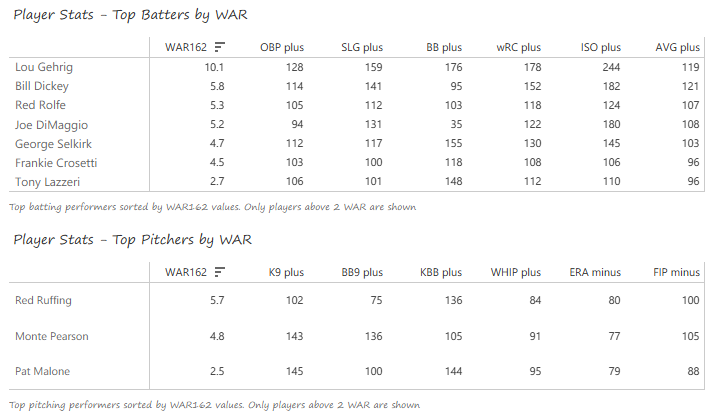
Veteran Lou Gehrig led the offense for the Yanks, scoring 167 runs, belting 49 homers, drawing 130 walks, and compiling a .478 OBP, .696 SLG, and 1.174 OPS, all topping the league. Catcher Bill Dickey had one of his best seasons, batting .362 with 22 homers, and Red Rolfe added an AL-best 15 triples to go with 116 runs scored and a .319 BA. The 21-year-old Joe DiMaggio made an auspicious debut, batting .323, hitting 29 homers, driving in 125 runs, and matching Rolfe’s 15 triples. George Selkirk (18 HR, 107 RBI) and Frankie Crosetti (18 steals, 137 runs scored) were also major contributors. The pitching was led by veteran Red Ruffing, who authored a 20-12 mark, and Monte Pearson, who posted a 19-7 record. Pat Malone led the league with 9 saves.

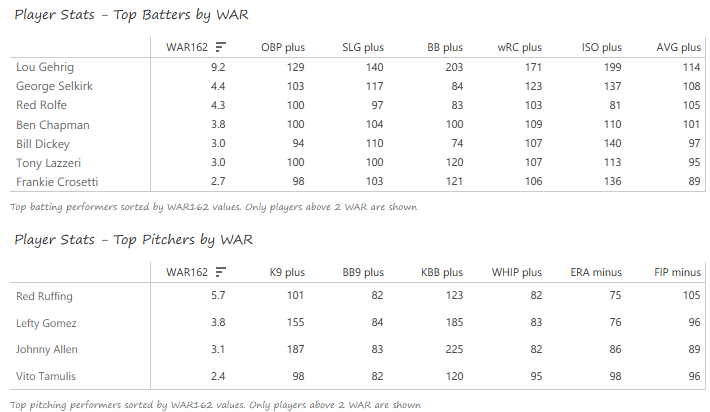
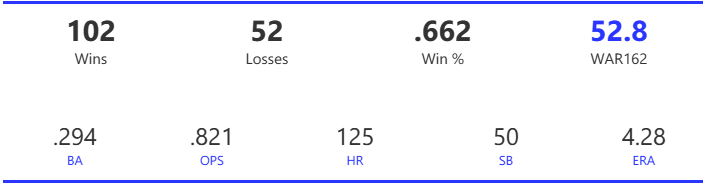
The 1931 edition of the Yankees finished 13.5 games back of the Athletics, but this was quite a deceiving result. Based on Pythagorean projections, the Yankees were a 100-win team (versus the A’s 97), but would have to wait until 1932 to return to the top of the AL.
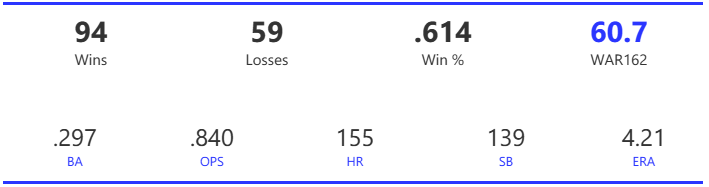
The Yankees’ 1067 runs topped the league by a staggering 182 runs over the Indians, and belted 155 homers while stealing 139 bases, all tops in the AL. The New Yorkers also swept the BA (.297), OBP (.383), and OPS (.840) categories. Their pitching staff was not as strong as some other editions – they placed third in ERA and WHIP, while leading the AL in strikeouts.
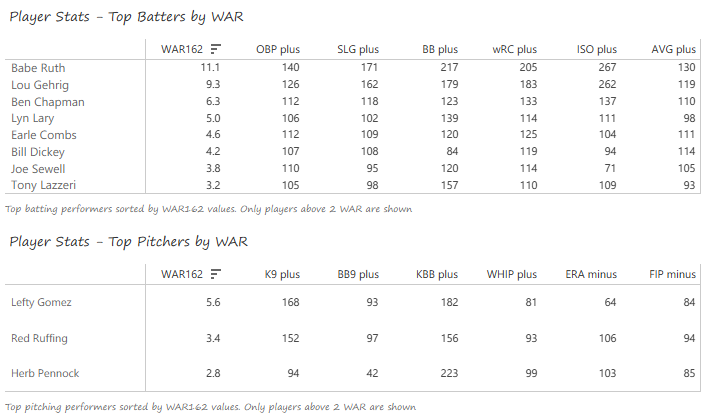
Babe Ruth put together a great season at age 36, swatting 46 homers with 162 RBI, 149 runs scored, and AL-bests in walks (128), OBP (.495), and OPS (1.195). Lou Gehrig belted 46 homers with 185 RBI to go with a .341 BA and 1.108 OPS, while Ben Chapman stole 61 bases (AL-best) and batted .315. Lyn Lary drove in 107 RBI with a .376 OBP, and veteran Earle Combs batted .318 with 13 triples. Lefty Gomez (age 22) posted a 21-9 record with a 2.67 ERA to lead the pitching staff. Red Ruffing won 16 games, and 37-year-old Herb Pennock posted an 11-6 mark.

The 1939 Yankees were the last of four consecutive pennant winners, coasting to the AL pennant by an astounding 17 games over the Red Sox. They then swept the Reds in the World Series. Not only was this the highest-rated WAR team since the 1927 Yankees, but their 106 wins actually fell five games short of their Pythagorean projection.
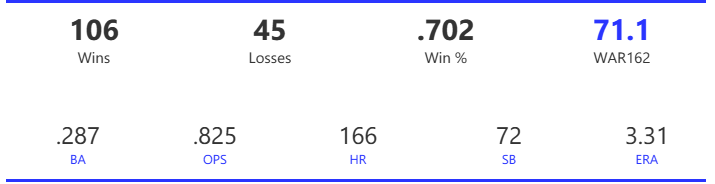
The Yankees led the league in both run scoring and run prevention. The team’s 967 runs easily topped the Red Sox, as did their 166 homers. The New Yorkers ranked second in BA, first in OBP, and first in OPS. The pitching was perhaps even more impressive, with a team ERA (3.31) more than 0.75 runs better than their closest rival. They also led the AL in complete games, shutouts, WHIP, and hits per 9 innings.
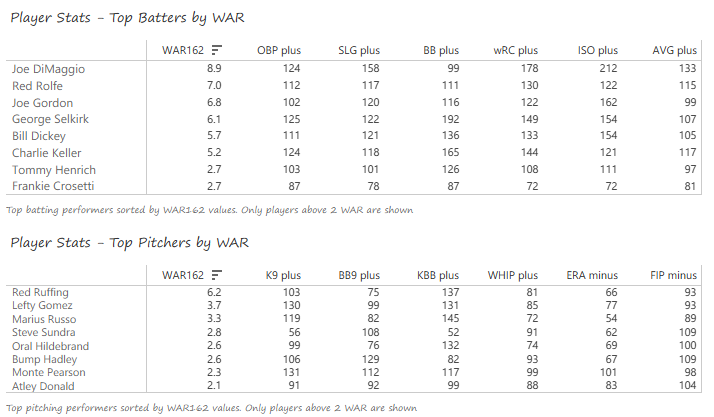
The Yankees had a staggering six position players above 5.0 WAR162, led by Joe DiMaggio, who led the AL with a .381 BA, while swatting 30 homers, driving in 126 runs, and posting a 1.119 OPS. Red Rolfe had a career year, scoring 139 runs with 213 hits and 46 doubles (all AL-best) and batting .329. Joe Gordon had a great age-24 campaign, with 28 homers, 111 RBI, and a .370 OBP, while George Selkirk batted .306 with 21 homers and 101 RBI. Veteran catcher Bill Dickey batted .302 with 24 homers and 105 RBI, and 22-year-old Charlie Keller batted .334 with 83 RBI and a .447 OBP. Veteran hurler Red Ruffing posted a 21-7 mark with a 2.93 ERA and AL-best 5 shutouts, and Lefty Gomez went 12-8. The depth of the staff was a strength, with 8 men earning at least 2.1 WAR162 on the season.

Summary

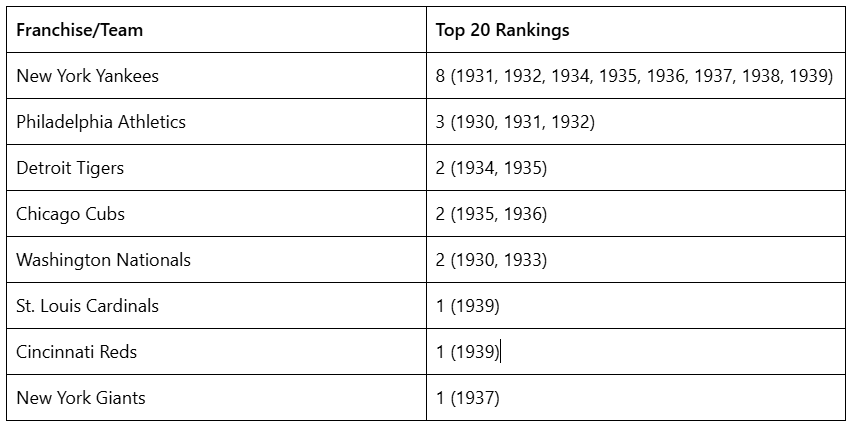
That’s it for this entry in our MLB Team Rankings for the 1930s decade! Here’s a quick summary of which franchises dominated the decade:
1930s MLB Team Rankings Countdown: 10 through 6

Welcome to the next countdown post in our series of MLB team rankings for the 1930s. As a reminder, the teams are ranked from #20 through #1 based on aggregate WAR162. For the 1930s (1930-1939), a total of 160 teams were eligible (16 teams x 10 seasons), so the top 20 teams are a fairly exclusive group. We’ll summarize each team, including portions of their team dashboard, and explain how they attained their ranking. So, without further ado, here are the teams ranked #10 through #6.

Here’s the interactive dashboard at Tableau Public: 1930s Top 20 MLB Teams Dashboard

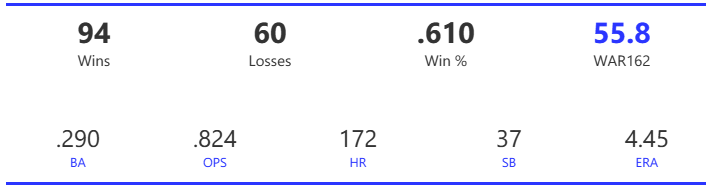
The 1932 Athletics were the final highly competitive A’s team in an impressive stretch starting with the 1925 season. Their 94-60 mark fell far short of the Yankees’ 107 wins, although the gap between the teams was not that large – win projections had them separated by just 4 games, not the 13-game difference in the standings.

The A’s had a powerful offense, evidenced by their 981 runs, just 21 shy of the Yankees’ league-leading total. They actually out-homered the Yanks 172-160, and ranked first in BA, second in OBP, and second in OPS. The A’s didn’t run a lot; their 37 steals ranked last in the AL. The A’s pitching was their weak link in 1932 – they ranked third in WHIP, fifth in ERA, and a distant second in strikeouts behind the Yankees.

Jimmie Foxx put together a massive 1932 campaign, crushing 58 homers, scoring 151 runs, compiling 169 RBI, and posting a 1.218 OPS, all tops in the AL. He also had a .364 batting average. Foxx was assisted by catcher Mickey Cochrane, who owned a .412 OBP with 23 homers and 112 RBI, and Al Simmons, who led the AL with 216 hits. Simmons belted 35 homers to go with his 151 RBI and 144 runs scored. Lefty Grove was his typical all-world self in 1932, winning 25 games with a league-best 2.84 ERA, 27 complete games, and 4 shutouts. Unfortunately for the A’s, Grove received minimal help from the rest of the staff – Tony Freitas won 12 as a fifth starter, and Rube Walberg (17) and George Earnshaw (19) combined for 36 wins, but with rather high ERAs, even for the 1930s.

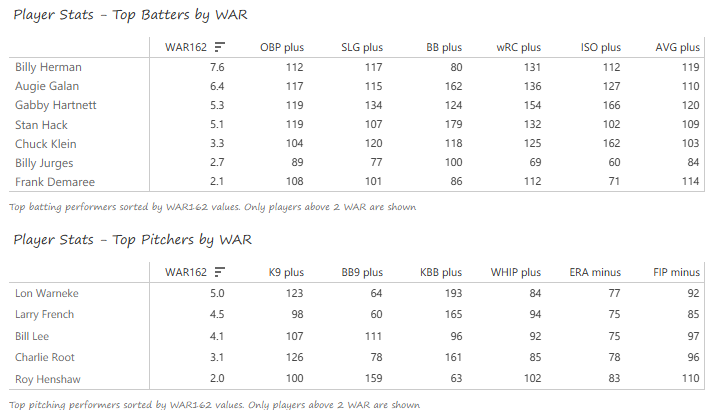
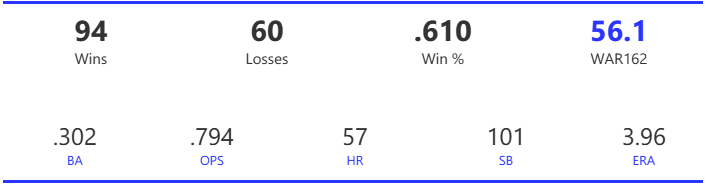
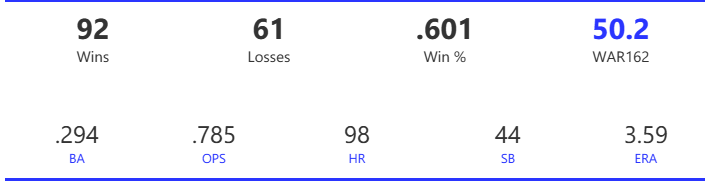
The 1935 Cubs claimed the NL pennant by 4 games over the defending champion Cardinals, only to fall to the Detroit Tigers in a 6-game World Series. The Cubs led the NL both in runs scored and runs allowed in 1935.

The Cubs’ 847 runs scored topped the Cardinals by 18, while their 88 homers ranked third in the league. Doubles were their forte, as they stroked 303, easily topping the NL. They also made a clean sweep of BA, OBP, and OPS; this was a strong offensive team despite their middling power credentials. The pitching staff easily compiled the best ERA in the league and placed second in both WHIP and strikeouts per 9 innings.

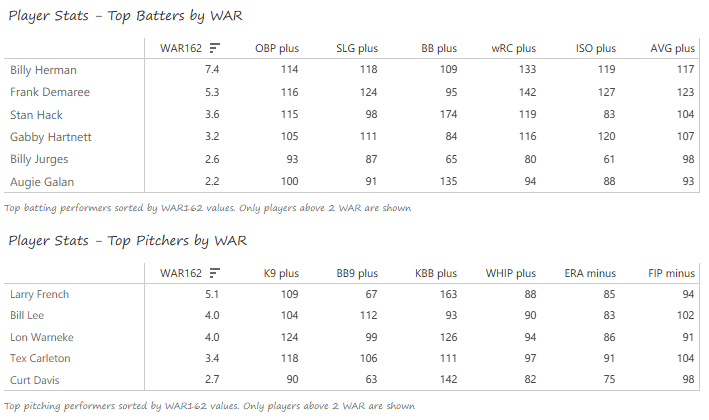
Billy Herman led a balanced offensive crew with four position players above 5 WAR162 for the season. Herman stroked 227 hits with 57 doubles (both NL-bests) while batting .341. Auge Galan led the NL with 22 steals and sported a .314 BA, while veteran catcher Gabby Hartnett batted .344 with 91 RBI. Third baseman Stan Hack was the final big offensive contributor, batting .311 with a .406 OBP. The Cubs’ pitching featured three strong starters, led by Lon Warneke (20-13, 3.06ERA). Larry French posted a 17-10 mark with a 2.96 ERA, and Bill Lee went 20-6 with the same 2.96 ERA.

The 1930 Nationals were an excellent team that had the misfortune to finish 8 games back of a quite lucky Athletics squad. According to Pythagorean projections, the A’s should have won 93 rather than 101 games. In any case, the AL pennant race should have been much tighter.

The Nationals’ 892 runs placed them well back of both the Yankees and A’s. Their .302 BA placed second in a very high-scoring season; they also placed second in triples and OBP, but just fourth in OPS. This rather ordinary offense was offset by a first-rate pitching staff that led the AL in ERA, WHIP, complete games, and hits per 9 innings.

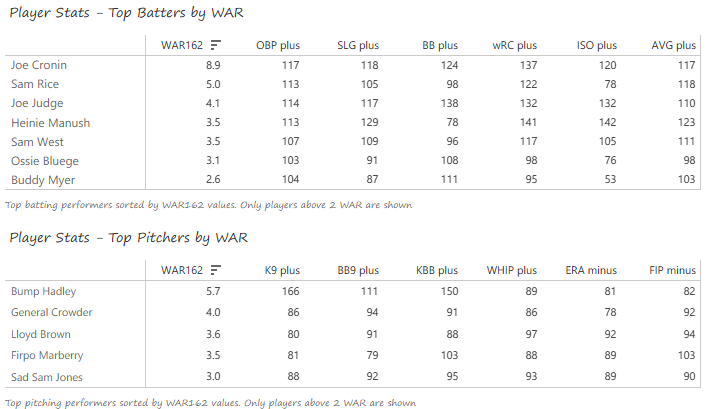
Shortstop Joe Cronin had a marvelous age-23 season, batting .346 with 127 runs scored and 126 RBI. The 40-year-old Sam Rice batted .349 with 121 runs scored, and 13 triples (and just 14 strikeouts!), and Joe Judge batted .326 in his age-36 campaign. Bump Hadley led a rather no-name pitching staff with a 15-11 mark and 3.73 ERA. General Crowder (15-9), Lloyd Brown (16-12), Firpo Marberry (15-5), and Sad Sam Jones (15-7) contributed to one of the most balanced groups in history – no stars, but five men with 15+ wins.

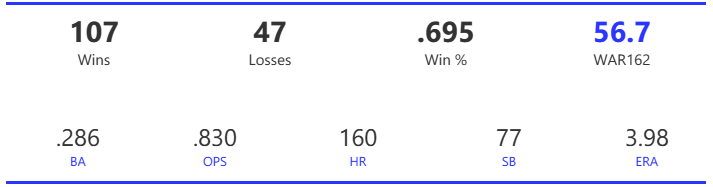
The 1932 edition of the Yankees rolled to the AL title after three years looking up at the Athletics. Their 107 wins were well above their Pythagorean projection of 99; in any case, they bested the A’ by 13 games and went on to sweep the Cubs in the World Series.

The Yankees’ 1002 runs topped the league, although their 160 homers trailed the A’s by 12. The New Yorkers led the AL in OBP and OPS, and ranked second in BA. It was a very potent offense, even considering the high-scoring context of the 1932 season. Pitching was again a strength, with an AL-best 3.98 ERA. The Yankees staff also led the AL in WHIP, complete games, strikeouts, and strikeout-to-walk rate.

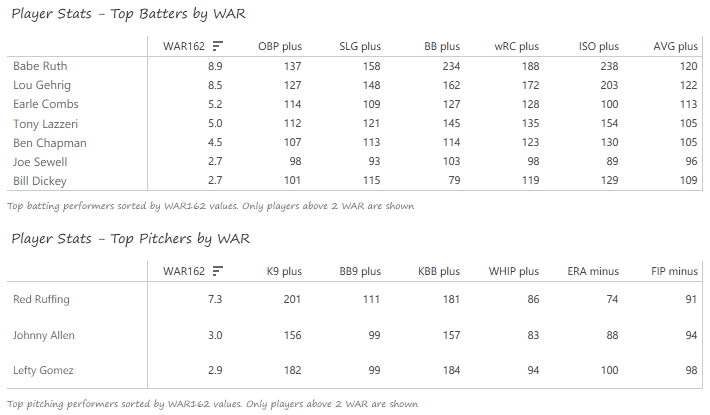
Babe Ruth put together one more terrific season at age 37, swatting 41 homers with 137 RBI, 120 runs scored, and AL-bests in walks (130) and OBP (.489). Lou Gehrig belted 34 homers and 42 doubles to go with a .349 BA and 1.072 OPS, while Earle Combs batted .321 with 143 runs scored. Tony Lazzeri (113 RBI, .399 OBP) and Ben Chapman (AL-best 38 steals) were also major contributors. The pitching was led by Red Ruffing (18-7, 3.09 ERA, AL-best 190 strikeouts) and Johnny Allen (17-4, 3.70 ERA). Lefty Gomez won 24 games despite an elevated 4.21 ERA.

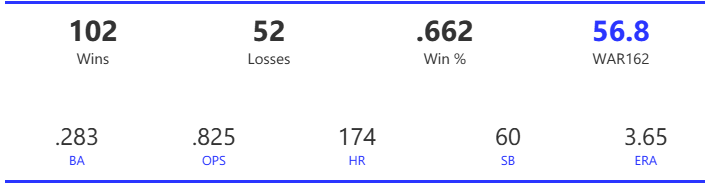
The 1937 Yankees were the second of four consecutive pennant winners, coasting to the AL pennant by 13 games over the Tigers. They then claimed New York bragging rights by defeating the Giants in a 5-game World Series.

The Yankees led the league in both run scoring and run prevention. The team’s 979 runs easily topped the Tigers, as did their 174 homers. The New Yorkers ranked third in BA, second in OBP, and first in OPS. The pitching was even more impressive, with a team ERA (3.65) more than half a run better than their closest rival. They also led the AL in complete games, WHIP, and strikeout-to-walk rate.

Joe DiMaggio was in the process of assuming the lead role that Lou Gehrig had held for several years, batting .346 with an AL-best 46 homers and 151 runs scored. DiMaggio also totaled 167 RBI and played great defense in center field. Gehrig led the league in walks (127), OBP (.473), and OPS (1.116) while driving in 158 runners and batting .351. Bill Dickey was the third starter with impressive numbers, including a .332 BA, 29 homers, and 133 RBI from his catcher position. George Selkirk added 18 home runs in limited duty. Lefty Gomez was the ace in 1937, winning 21 games with a league-best 2.33 ERA and 194 strikeouts. Red Ruffing had another fine season, posting a 20-7 mark with a 2.98 ERA.

Summary

That’s it for this entry in our MLB Team Rankings for the 1930s decade! Stay tuned for the countdown from #5 to #1, arriving in a few days. As always, thanks for reading!

1930s MLB Team Rankings Countdown: 15 through 11

Welcome to the next countdown post in our series of MLB team rankings for the 1930s. As a reminder, the teams are ranked from #20 through #1 based on aggregate WAR162. For the 1930s (1930-1939), a total of 160 teams were eligible (16 teams x 10 seasons), so the top 20 teams are a fairly exclusive group. We’ll summarize each team, including portions of their team dashboard, and explain how they attained their ranking. So, without further ado, here are the teams ranked #15 through #11.

Here’s the interactive dashboard at Tableau Public: 1930s Top 20 MLB Teams Dashboard

The 1935 Yankees were a good, not great, team relative to other Yankees teams of the 1930s. They were a bit unlucky, with a win projection of 92 wins, three more than their actual total. Regardless, they were relegated to a second-place finish, three games behind the Tigers.

The Yankees’ 818 runs scored trailed the Tigers by a full 100 runs; this was not the juggernaut team that rolled over their rivals. They ranked a mere 4th in BA, tied for second in OBP, and were a rather distant 2nd in OPS. Pitching is what kept this club in contention, as they led the AL in ERA, WHIP, hits per 9 innings, and strikeout-to-walk rate.

Lou Gehrig was the dominant offensive leader for this edition, leading the AL in runs (125), walks (132), and OBP (.466). Teams could pitch around Gehrig when needed, as evidenced by his 21 intentional passes. George Selkirk (.312 BA, 12 triples, 94 RBI) and Red Rolfe (.300 BA, 108 runs scored) provided secondary support for Gehrig. The pitching was led by Red Ruffing, who posted a 16-11 mark with a 3.12 ERA. Lefty Gomez had similar metrics to Ruffing (3.18 ERA, 1.256 WHIP) but struggled to a 12-15 record.

The 1930 Athletics were the middle team in a 3-year run at the top of the AL, topping the runner-up Nationals by 8 games. The Athletics were unusually fortunate to win 102; their Pythagorean projection was for just 93 wins, or roughly even with the Nationals. They did stake their claim to being the best MLB team by defeating the Cardinals in a 6-game World Series.

Although the A’s had a strong offense, they scored 111 fewer runs than the Yankees (951 vs. 1,062). They ranked second in homers, second in doubles, fourth in BA, and second in both OBP and OPS. Their pitching numbers were also strong, but not dominant. The A’s trailed the Nationals in both ERA and WHIP, although they ranked first in strikeouts and strikeout-to-walk rate.

Al Simmons was one of four position players with high WAR162 numbers. Simmons led the AL with a .381 BA and 152 runs scored while swatting 36 homers and compiling 165 RBI. Foxx was close behind, with 37 homers, 156 RBI, and a 1.066 OPS. Catcher Mickey Cochrane batted .357 with 42 doubles, and Max Bishop had a .426 OBP, thanks to 128 walks. Lefty Grove assembled one of his best seasons on the mound, winning 28 games with a 2.54 ERA, 209 strikeouts, and 9 saves, all AL-best numbers. George Earnshaw added 22 wins (despite a 4.44 ERA) with a league-best 3 shutouts.

The 1938 Yankees were an excellent team that will forever live in the shadow of the far superior 1939 club. The 1938 squad rolled to the AL pennant, finishing 9.5 games ahead of the Red Sox, and went on to sweep the Cubs in the World Series, riding both the best offense and pitching in the league.

The Yankees scored 966 runs while launching 174 home runs, both figures far ahead of their AL rivals. Their BA was a surprisingly weak 6th in the league, but they rose to 2nd in OBP and OPS (a virtual tie for 1st) on the strength of their home runs and an AL-best 749 walks. The Yankees pitchers easily topped the AL in ERA and WHIP, and also tossed an AL-best 11 shutouts.

This Yankees team lacked a single star with huge WAR162 numbers, but had many players performing at a high level. Joe DiMaggio batted .324 with 32 home runs and 140 RBI to lead the way, and catcher Bill Dickey had one of his better seasons with a .313 BA, 27 homers, and 115 RBI. 35-year-old Lou Gehrig swatted 29 homers with 114 RBI, and Red Rolfe batted .311 from his third base position. Frankie Crosetti (AL-best 27 steals), Tommy Heinrich (22 homers, 91 RBI), and Joe Gordon (25 homers, 97 RBI) rounded out a deep offense. The pitching was dominated by Red Ruffing (21-7, 3.31 ERA) and Lefty Gomez (AL-best 4 shutouts, 18-12, 3.35 ERA).

Yet another Yankees team checks in at #12 in our Top 20 for the 1930s, albeit a 2nd-place finisher behind the resurgent Tigers. The Yankees were in an interesting transition window, with Babe Ruth on the way out and Joe DiMaggio about to appear. Lou Gehrig was the constant for the 1934 team, keeping them near the top of the American League.

The Yankees’ offense was no match for the Tigers in 1934, finishing 117 runs behind the pennant winners. They also ranked second in homers (behind the A’s) and were 4th in BA, 2nd in OBP, and 2nd in OPS. Their pitching staff led the AL in ERA, WHIP, and strikeouts, helping the team stay in the pennant chase.

Lou Gehrig put together one of his best seasons, leading the league in homers (49), RBI (166), BA (.363), OBP (.465), and OPS (1.172). The 39-year-old Babe Ruth added 22 home runs and a .448 OBP, while Ben Chapman batted .308 with 13 triples and 26 steals. Bill Dickey batted .322 and Tony Lazzeri chipped in with 11 steals and a .369 OBP. Lefty Gomez led the AL in multiple categories with 26 wins, a 2.33 ERA, 25 complete games, 6 shutouts, and 158 strikeouts. Johnny Murphy was effective as a starter and in relief, with 14 wins, and Red Ruffing won 19 games with 5 shutouts.

The Tigers put together back-to-back pennant-winning campaigns in 1934 and 1935, unseating the Yankees and Nationals atop the AL. The 1934 team topped the league by 7 games over the Yankees before falling to the Cardinals in a 7-game World Series.

The Tigers had a potent offense in 1934, easily leading the AL in runs (959), BA (.300), OBP (.376), OPS (.800), doubles, and stolen bases. While they didn’t hit a lot of home runs, their combination of speed and gap power propelled them to the pennant. The pitching staff was solid, placing second in ERA and WHIP, and topping the AL in strikeout-to-walk rate.

Second baseman Charlie Gehringer authored one of his finest seasons, batting .356 with135 runs scored (AL-best) and 127 RBI. Hank Greenberg led the league with 63 doubles at age 23, batting .339 with 139 RBI. Shortstop Billy Rogell batted .296 with 13 steals, and catcher Mickey Cochrane batted .320 with a .428 OBP. Schoolboy Rowe was the staff ace, winning 24 games with a league-best strikeout-to-walk rate. Tommy Bridges added 22 wins, and Elden Auker chipped in with 15 as a starter and reliever.

Summary

That’s it for this entry in our MLB Team Rankings for the 1930s decade! Stay tuned for the countdown from #10 to #6, arriving in a few days. As always, thanks for reading!

1930s MLB Team Rankings Countdown: 20 through 16

Welcome to the first countdown post in our series of MLB team rankings for the 1930s. As a reminder, the teams are ranked from #20 through #1 based on aggregate WAR162. For the 1930s (1930-1939), a total of 160 teams were eligible (16 teams x 10 seasons), so the top 20 teams are a fairly exclusive group. We’ll summarize each team, including portions of their team dashboard, and explain how they attained their ranking. So, without further ado, here are the teams ranked #20 through #16.

Here’s the interactive dashboard at Tableau Public: 1930s Top 20 MLB Teams Dashboard

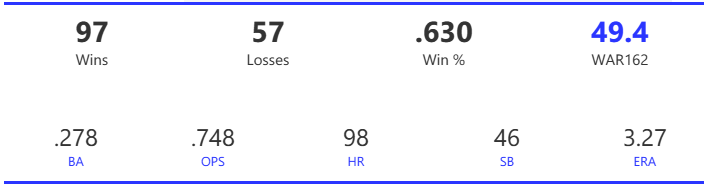
The Giants returned to the rankings after an extended absence. Their presence here does not resemble the dominant eras of prior Giants editions from the 1910s and 1920s; it is more of a single-season breakthrough. While the Giants did capture the NL pennant by two games over the Cubs, their Pythagorean projection had them as an 89-63 team with good fortune leading to the 95 wins they achieved. The Giants would go on to lose the World Series in 5 games to the crosstown Yankees.

The Giants’ 732 runs scored placed them a distant third behind the Cubs and Cardinals. While they led the NL with 111 homers, their offense was otherwise just above average – fourth in BA, third in OBP, and second in OPS. The pitching staff posted good, but not exceptional numbers, finishing second in ERA and WHIP. They did lead the NL in strikeouts and strikeout-to-walk rate, edging the Pirates in both categories.

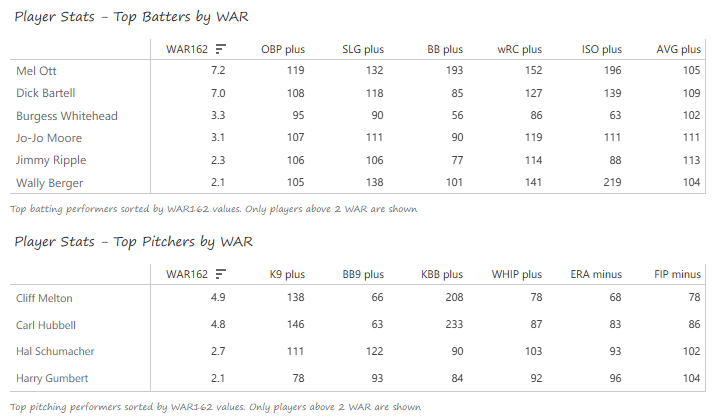
Mel Ott and Dick Bartell were the clear offensive leaders for the New Yorkers, with Ott leading the league in home runs (31) and walks (102), on his way to a .931 OPS. Bartell batted .306 with 38 doubles and a .306 BA, strong numbers for a shortstop. Burgess Whitehead (.286 BA) and Jo-Jo Moore (.310 BA, 37 doubles) provided additional support. The pitching staff was led by a pair of 20-game winners. Cliff Melton posted a 20-9 mark with a 2.61 ERA and NL-best 7 saves, while veteran lefty Carl Hubbell went 22-8 with a league-leading 159 strikeouts.

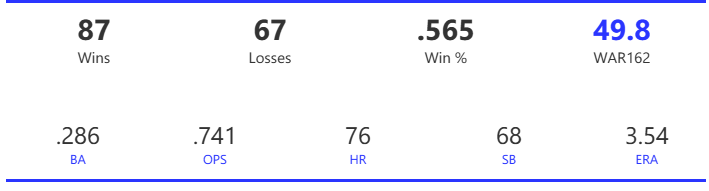
The Reds continued their ascent to the top of the National League in 1939, culminating in a pennant just two years removed from a last-place finish. The Cincinnati club bested the Cardinals by 4.5 games, which allowed the Cardinals to be swept in the World Series by the 1939 Yankees, considered one of the best teams ever. Nonetheless, the 1939 team lifted the Reds into the NL’s first division for the next several seasons.

The Reds rose to the top through a combination of good hitting and excellent pitching. Their 767 runs scored were just 12 behind the Cardinals’ NL-best total, and their 98 homers tied for second behind the Giants. The Reds also placed second in BA, OBP, and OPS, trailing the Cardinals in each category. The pitching staff led the NL in ERA by a considerable margin and placed second in WHIP. The Reds also led the league in strikeouts and hits per 9 innings.

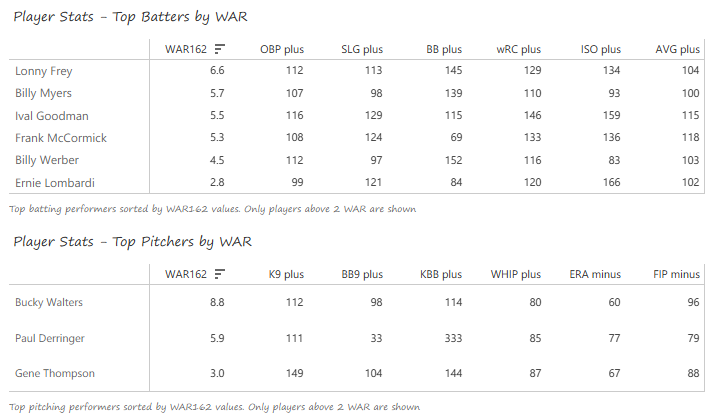
The Reds’ offense doesn’t feature many household names, but it did have four players top the 5.0 WAR162 mark. Lonny Frey batted .291 with a .388 OBP and 95 runs scored, while Billy Myers batted .281 from his shortstop position. Ival Goodman batted at a .323 clip, and Frank McCormick hit .332 with an NL-best 128 RBI. Billy Werber led the league with 115 runs scored and swiped a team-high 15 bases. On the mound, the Reds had a very effective one-two tandem in Bucky Walters and Paul Derringer. Walters won 27 with a 2.29 ERA and 1.125 WHIP across 319 innings, all NL-best numbers. Derringer tossed 301 innings, posting a 25-9 record with 5 shutouts. Gene Thompson won 13 games as the Reds’ primary reliever.

The 1936 edition of the Cubs finished tied for second in the NL behind the Giants, but were the best team on paper. Their Pythagorean projection had them winning 93 games (versus 87), while the Giants’ 92 wins exceeded their projection by three games. Instead of winding up five games back, they should have finished ahead of the New York club.

The Cubs had a balanced profile in 1936, featuring solid offensive and pitching metrics. The club finished in a virtual dead heat with the Pirates in BA and OBP, and placed third in OPS. Their 755 runs also placed third, trailing the Pirates and Cardinals. The team’s 3.54 ERA was behind only the Giants, and their 18 shutouts and 77 complete games both led the NL. The Cubs also placed second in WHIP and strikeout-to-walk rate.

Billy Herman had an exceptional season from his second base spot, batting .334 with 101 runs scored, 57 doubles, and 93 RBI. Frank Demaree swatted 16 homers to go with his .350 BA and 96 RBI, and Stan Hack batted .298 with a .396 OBP. Veteran catcher Gabby Hartnett batted .307 in his age-35 season to round out the Cubs’ offense. Larry French and Bill Lee each won 18 games, while Lon Warneke (16) and Tex Carleton (14) added another 30 wins. Interestingly, each of the four tied for the NL lead with four shutouts apiece.

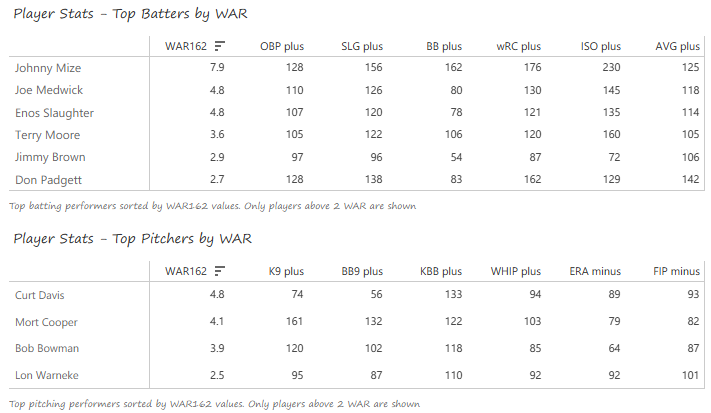
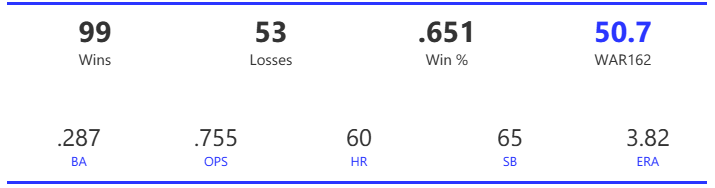
The Cardinals lost to the Reds in the 1939 NL pennant race, but placed slightly higher on a WAR162 basis. The 1939 campaign would turn out to be a springboard for the next decade, when the Cards would claim multiple pennants.

The Cardinals were a strong offensive club, leading the NL in multiple offensive categories, including runs, doubles, BA, OBP, and OPS. Their pitching numbers were quite solid, finishing second in ERA, first in shutouts, second in strikeouts, and third in WHIP.

Johnny Mize powered the offense, leading the NL in homers (28), BA (.349), SLG (.626), and OPS (1.070). He also rapped 44 doubles and 14 triples. Joe Medwick (.332, 48 doubls, 117 RBI) and Enos Slaughter (.320 BA, NL-best 52 doubles) were Mize’s primary accomplices. The pitching staff was led by 35-year-old Curt Davis (22-16) and Mort Cooper (12-6, 3.25 ERA). Bob Bowman was effective from the bullpen, finishing 19 games and earning 8 saves with a 2.60 ERA.

The Nationals returned to the top of the AL for the first time since 1925, finishing 7 games ahead of the Yankees. They wound up losing a 5-game World Series to the Giants, putting a damper on a fine season.

The Nationals were third in runs scored behind the high-powered Yankees and Athletics, although they did lead the AL in both triples and BA (.287). The team’s greater strength was in their pitching metrics, where they placed 2nd in ERA and first in WHIP, due to their AL-best walk rate.

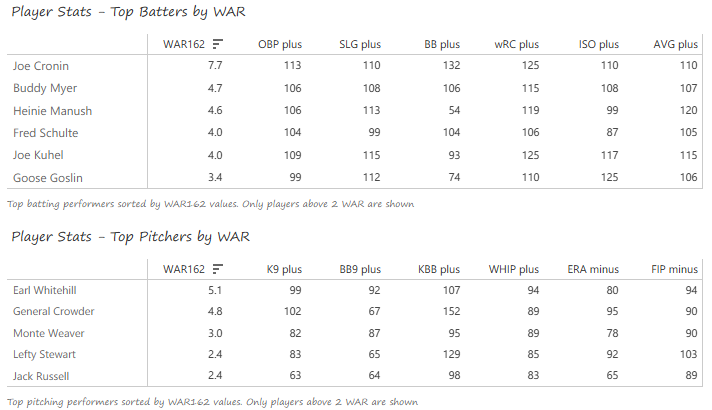
Shortstop Joe Cronin was the offensive star, batting .309 with a .398 OBP, 118 RBI, and an AL-best 45 doubles. Buddy Myer batted .302, and Henie Manush hit .336 while leading the league with 17 triples, and scoring 115 runs. Fred Schulte (.295, 98 runs, 87 RBI) and Joe Kuhel (.322 BA, 11 homers, 107 RBI) provided ample offensive support. The pitching was led by a pair of 20-game winners in Earl Whitehill (22-8, 3.33 ERA) and General Crowder (24-15).

Summary

That’s it for the first entry in our MLB Team Rankings for the 1930s decade! Stay tuned for the countdown from #15 to #11, arriving in a few days. As always, thanks for reading!