Month: April 2026

1940s MLB Team Rankings Countdown: 20 through 16

Welcome to the first countdown post in our series of MLB team rankings for the 1940s. As a reminder, the teams are ranked from #20 through #1 based on aggregate WAR162. For the 1940s (1940-1949), a total of 160 teams were eligible (16 teams x 10 seasons), so the top 20 teams are a fairly exclusive group. We’ll summarize each team, including portions of their team dashboard, and explain how they attained their ranking. So, without further ado, here are the teams ranked #20 through #16.

Here’s the interactive dashboard at Tableau Public: 1940s Top 20 MLB Teams Dashboard

The 1940 Tigers prevailed in a tight AL pennant chase, finishing one game ahead of the Indians and three up on the Yankees. The Tigers were then defeated by the Reds in a 7-game World Series, denying them a second crown in six years.
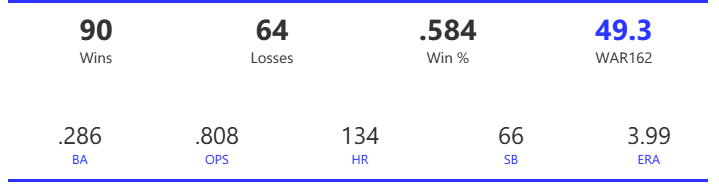
The Tigers had a high-octane offense, scoring 888 runs to edge the Red Sox (872). They also placed first in BA, OBP, OPS, and doubles, and third in home runs. The pitching was not on par with the offense, ranking just fourth in ERA and WHIP, although they topped the league in strikeouts.
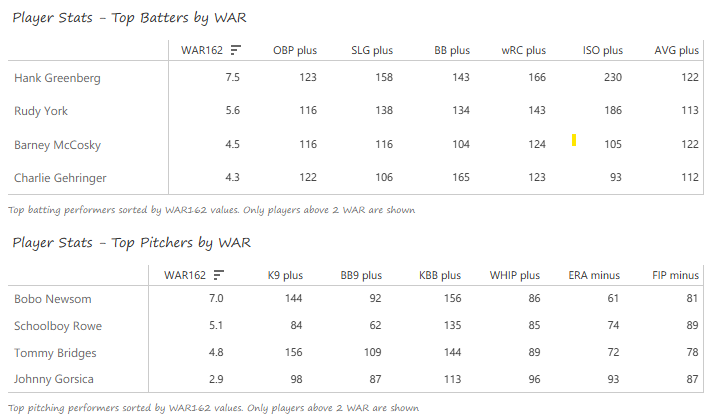
Hank Greenberg provided much of the offensive spark, leading the AL with 41 homers, 150 RBI, a 1.103 OPS, and 50 doubles, while batting .340. Rudy York added 33 homers and 134 RBI, and Barney McCosky batted .340 with 19 triples. Veteran second baseman Charlie Gehringer batted .313 at age 37 to round out the offense. The pitching corps was led by Bobo Newsom (21-5, 2.83 ERA) and Schoolboy Rowe (16-3, 3.46 ERA). Tommy Bridges added 12 wins from the second spot in the rotation.

The Cardinals continued their strong decade with the 1946 NL pennant and World Series winners, who defeated the Red Sox in seven games in the fall classic. The Cards’ 98 regular-season wins edged the Dodgers by two games in a tight NL pennant battle.
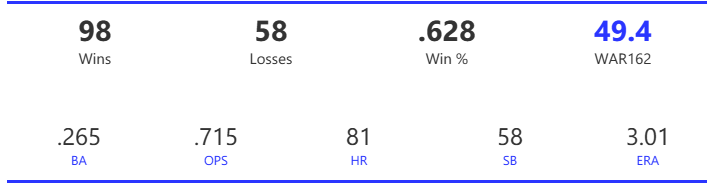
The Cardinals’ 712 runs topped the NL during a period when scoring continued to decline from the inflated offensive numbers of the 1930s. They also topped the NL in BA and OPS, and finished second in home runs with a modest total of 81. Pitching was a strong point for the 1946 team, as they led the NL in ERA, shutouts, and strikeout-to-walk rate, while placing third in WHIP.
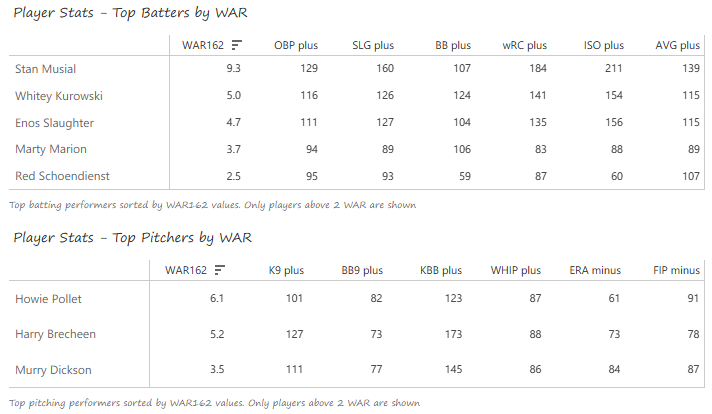
Stan Musial was the driving force of the offense, leading the NL in many offensive categories, including BA (.365), OPS (1.021), doubles (50), and triples (20). Whitey Kurowski batted .301 with 89 RBI, and Enos Slaughter led the NL with 130 RBI while compiling a .300 BA. Shortstop Marty Marion batted only .233, but was a strong defender at shortstop for the Cards. The pitching was led by the strong one-two combo of Howie Pollet and Harry Brecheen, both left-handers. Pollet led the league with 21 wins, a 2.10 ERA, and 266 innings pitched; Brecheen tossed a league-best 5 shutouts while posting 15 wins, a number matched by Murry Dickson, a combination starter and reliever.

The 1947 Yankees cruised to the AL title, finishing 12 games ahead of the Tigers. The Yanks were armed with the best offense and pitching in the AL, and capped the season by defeating the crosstown Dodgers in a seven-game World Series.
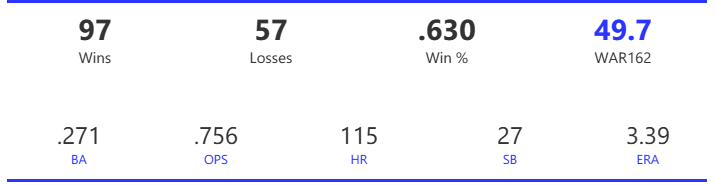
The Yankees’ 794 runs easily topped the AL; they also led the league in BA, OPS, triples, and home runs. Their pitching was also strong, as they led the league in ERA and strikeouts, and finished second in WHIP behind the Indians.
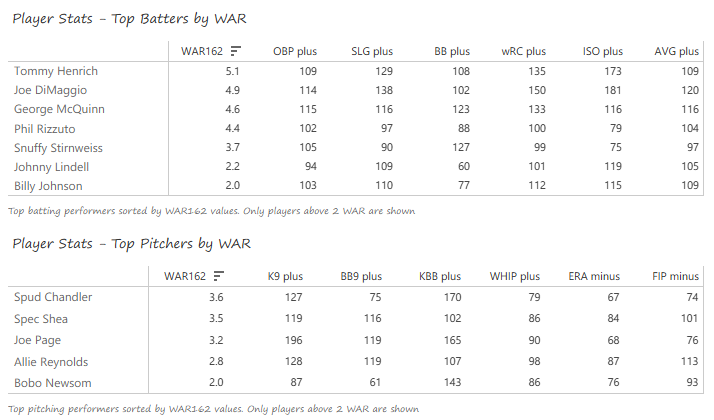
The Yankees’ offense was well distributed across multiple players, with 34-year-old Tommy Henrich leading the way. Henrich totaled 13 triples (AL-best), 109 runs scored, and 98 RBI; Joe DiMaggio had a quiet year (by his standards), batting .315 with 20 homers and 97 RBI, and 37-year-old George McQuinn batted .304 with a .397 OBP. Phil Rizzuto played his usual strong defense at shortstop while batting .273, with his infield partner Stuffy Stirnweiss picking up 89 walks, leading to a .358 OBP. Spud Chandler posted a fine 2.46 ERA as the fourth starter, and Spec Shea allowed the fewest hits per 9 innings from the second spot in the rotation. Reliever Joe Page saved an AL-best 17 games, and veteran righty Allie Reynolds posted a 19-8 mark.

The Red Sox fielded a very solid team in 1942, but were no match for the Yankees, who won the pennant by a comfortable 9 games over the Red Sox. The Boston squad would have to wait four more years to break through for an AL pennant.
The Sox were a strong offensive team, but trailed the Yankees in several categories. Their 761 runs ranked second, as did their 103 homers, but they did lead the AL in BA, OBP, and OPS. If their offense was at a similar level to the Yankees’, their pitching was not. The staff ranked a distant third in ERA, second in WHIP, fourth in strikeouts, and fifth in strikeout-to-walk rate.
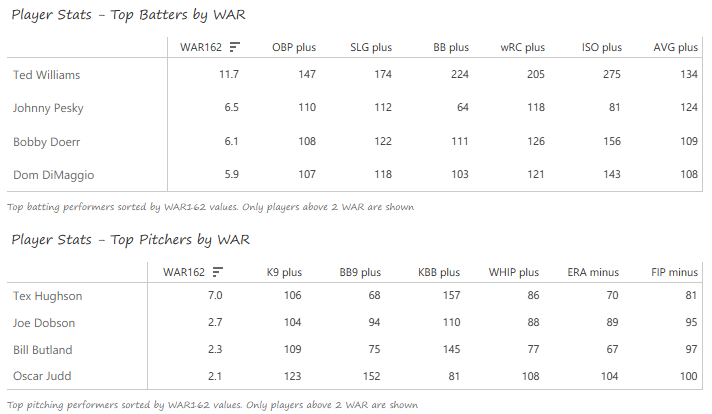
Ted Williams was indisputably the star for the Red Sox, leading the league in multiple categories. Williams batted .356, had a .499 OBP, .648 SLG, and 1.147 OPS, while swatting 36 homers, drawing 145 walks, scoring 141 runs, and amassing 137 RBI. His excellent supporting crew included shortstop Johnny Pesky (.331 BA, 205 hits), Bobby Doerr (.290 BA, 102 RBI), and Dom DiMaggio (.286 BA, 110 runs scored). On the mound, Tex Hughson was by far the most effective hurler, leading the league in wins (22), complete games (22), innings pitched (281), and strikeouts (113). Joe Dobson was the next most effective starter, but had just an 11-9 record for the season.

The Red Sox finally broke through for their first AL pennant in 28 years, winning 104 games (7 more than projected) to top the Tigers by 12 games. Unfortunately for the Sox, they fell short in the World Series, losing to the Cardinals in seven games.
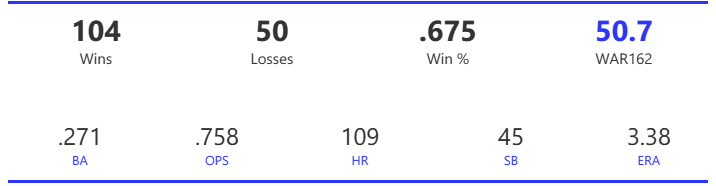
The Sox topped the AL standings primarily via their high-scoring offense. Their 792 runs were 88 more than the Tigers could muster, and they easily led the league in BA, OBP, and OPS. The pitching was generally middle of the pack, ranking fourth in ERA, third in WHIP, fourth in strikeouts, and second in strikeout-to-walk rate.
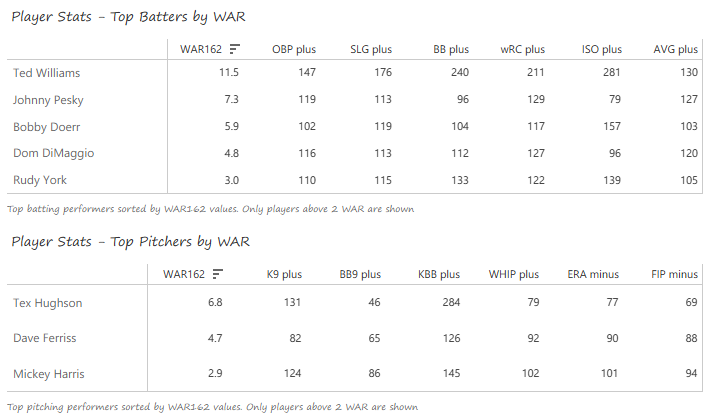
Ted Williams again powered the offense with help from the supporting crew of Johnny Pesky, Bobby Doerr, and Dom DiMaggio. Williams led the AL in runs (142), walks (156), OBP (.497), SLG (.667), and OPS (1.164) while batting .342. Pesky batted .335 with an AL-best 208 hits, Doerr totaled 116 RBI, and DiMaggio batted .316. Tex Hughson (20-11, 2.75 ERA, 3.37 strikeout-to-walk rate) and Dave Ferriss (25-6) supplied a strong top of the rotation for the Boston squad.

Summary

That’s it for the first entry in our MLB Team Rankings for the 1940s decade! Stay tuned for the countdown from #15 to #11, arriving in a few days. As always, thanks for reading!
1930s MLB Team Rankings Countdown: 5 through 1

Welcome to the final countdown post in our series of MLB team rankings for the 1930s. As a reminder, the teams are ranked from #20 through #1 based on aggregate WAR162. For the 1930s (1930-1939), a total of 160 teams were eligible (16 teams x 10 seasons), so the top 20 teams are a fairly exclusive group. We’ll summarize each team, including portions of their team dashboard, and explain how they attained their ranking. So, without further ado, here are the teams ranked #5 through #1.

Here’s the interactive dashboard at Tableau Public: 1930s Top 20 MLB Teams Dashboard

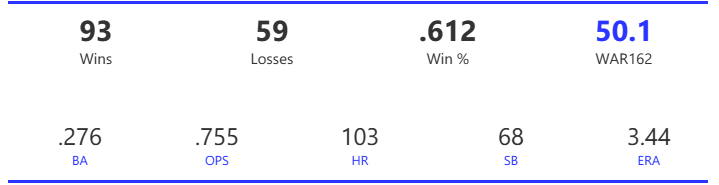
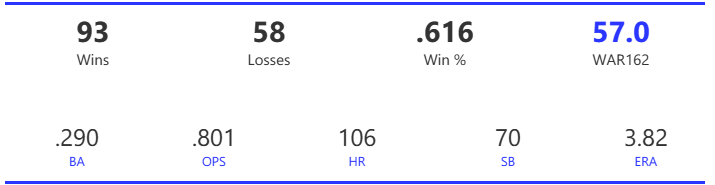
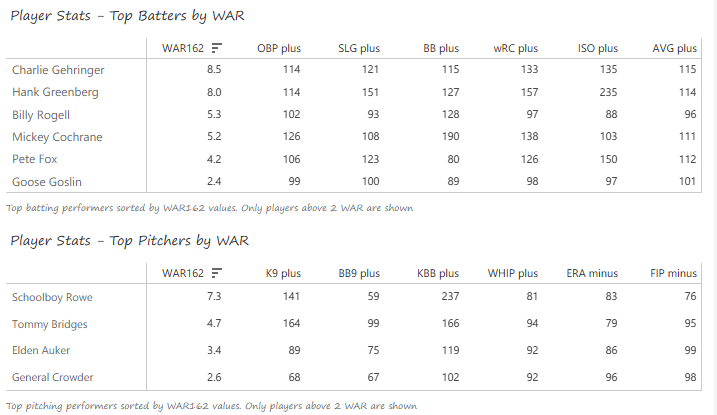
The 1935 Tigers defended their AL pennant and went on to defeat the Cubs in the World Series. Their 93-58 mark landed them 3 games ahead of the Yankees; the Tigers win projection was a few games higher at 97-54. They would then go on to defeat the Cubs in 6 games for the World Series title.

The Tigers had a very strong offense, scoring 918 runs, 95 ahead of the Nationals. They were second in the AL in doubles and homers, and topped the league in BA, OBP, and OPS. Their pitching was also very good, leading the AL in shutouts and finishing second in strikeouts and strikeout-to-walk rate.

Charlie Gehringer and Hank Greenberg formed a potent 1-2 offensive punch, with Gehringer accounting for 123 runs, 108 RBI, and a .330 BA. Greenberg led the league with 36 homers and 168 RBI while batting .328. Billy Rogell excelled at shortstop, scoring 90 runs and taking 80 walks, and catcher Mickey Cochrane batted .319 with a .452 OBP. The pitching staff was led by Schoolboy Rowe, who tossed an AL-best 6 shutouts with a 2.06 strikeout-to-walk rate. Tommy Bridges won 21 games and led the AL with 169 strikeouts, and Elden Auker added 18 wins.

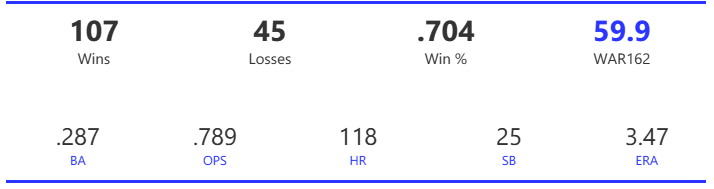
The 1931 A’s won an impressive 107 games, finishing 13.5 games ahead of the Yankees, to claim their third consecutive AL pennant. Win projections tell a different story, as the A’s were a full 10 games ahead of their 97-win Pythagorean estimate. In simple terms, they were an excellent team, but not as dominant as their record indicates. The A’s would go on to lose a 7-game World Series to the Cardinals.

The A’s ranked just third in runs scored, trailing both the Yankees and Indians, and placed second in both doubles and home runs. They ranked third in BA and OBP, and a distant second to the Yankees in OPS. Pitching set the Athletics apart from their rivals in 1931, as they led the AL in numerous categories – ERA, shutouts, WHIP, and strikeout-to-walk rate.

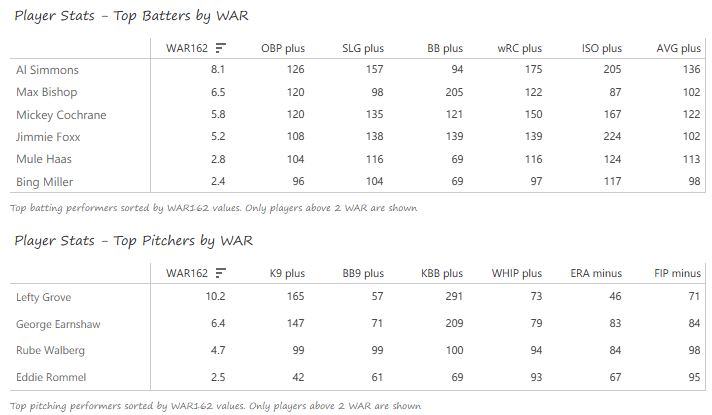
Al Simmons was the A’s offensive leader for the 1931 season, leading the AL with a .390 BA, adding 22 homers, 128 RBI, and a 1.085 OPS. Max Bishop had a fine .426 OBP and 115 runs scored, and catcher Mickey Cochrane batted .349. Jimmie Foxx stroked 30 homers with 120 RBI to round out the Athletics’ top offensive producers. The mound was anchored by veteran Lefty Grove, who compiled a career season with a 31-4 record, 2.06 ERA, 27 complete games, 175 strikeouts, and 4 shutouts. All these numbers were tops in the league for 1931. George Earnshaw (21-7, 3.67 ERA) and Rube Walberg (20-12, 3.74 ERA) rounded out a formidable pitching staff.

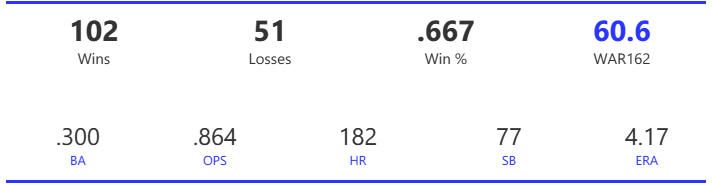
The 1936 Yankees were a powerhouse club that ran away with the AL pennant, finishing 19.5 games ahead of the defending champ Tigers. Their 102 wins were not a fluke, as the New Yorkers dominated the AL in scoring and preventing runs. The Yankees finished business by defeating the crosstown Giants in a 6-game World Series.

The Yankees scored 1,065 runs, 144 more than both the Indians and Tigers. They also clobbered an absurd (for the time) 182 homers, 59 ahead of the Indians. The team ranked second in BA, first in OBP, and a resounding first in OPS. This was an offensive powerhouse. The pitching was also very good, leading the AL in ERA and strikeouts, and placing second in WHIP.

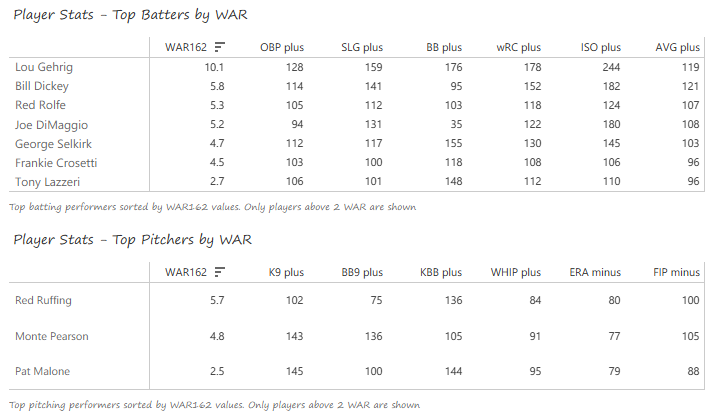
Veteran Lou Gehrig led the offense for the Yanks, scoring 167 runs, belting 49 homers, drawing 130 walks, and compiling a .478 OBP, .696 SLG, and 1.174 OPS, all topping the league. Catcher Bill Dickey had one of his best seasons, batting .362 with 22 homers, and Red Rolfe added an AL-best 15 triples to go with 116 runs scored and a .319 BA. The 21-year-old Joe DiMaggio made an auspicious debut, batting .323, hitting 29 homers, driving in 125 runs, and matching Rolfe’s 15 triples. George Selkirk (18 HR, 107 RBI) and Frankie Crosetti (18 steals, 137 runs scored) were also major contributors. The pitching was led by veteran Red Ruffing, who authored a 20-12 mark, and Monte Pearson, who posted a 19-7 record. Pat Malone led the league with 9 saves.

The 1931 edition of the Yankees finished 13.5 games back of the Athletics, but this was quite a deceiving result. Based on Pythagorean projections, the Yankees were a 100-win team (versus the A’s 97), but would have to wait until 1932 to return to the top of the AL.

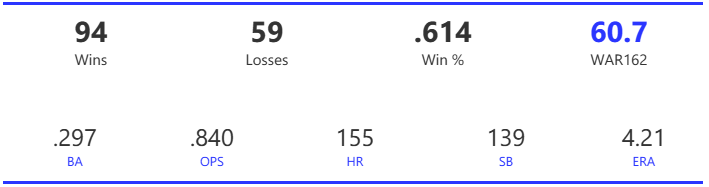
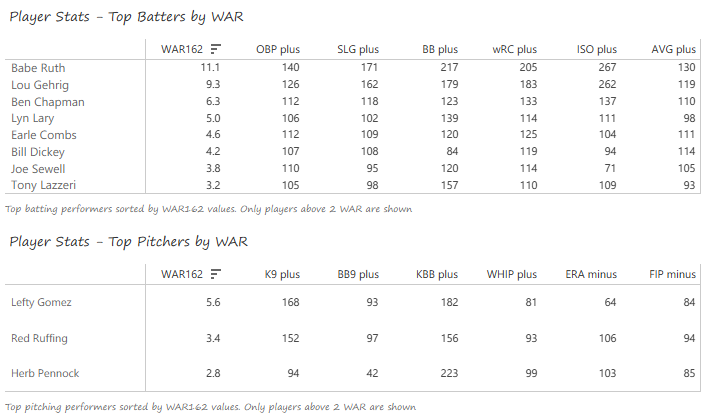
The Yankees’ 1067 runs topped the league by a staggering 182 runs over the Indians, and belted 155 homers while stealing 139 bases, all tops in the AL. The New Yorkers also swept the BA (.297), OBP (.383), and OPS (.840) categories. Their pitching staff was not as strong as some other editions – they placed third in ERA and WHIP, while leading the AL in strikeouts.

Babe Ruth put together a great season at age 36, swatting 46 homers with 162 RBI, 149 runs scored, and AL-bests in walks (128), OBP (.495), and OPS (1.195). Lou Gehrig belted 46 homers with 185 RBI to go with a .341 BA and 1.108 OPS, while Ben Chapman stole 61 bases (AL-best) and batted .315. Lyn Lary drove in 107 RBI with a .376 OBP, and veteran Earle Combs batted .318 with 13 triples. Lefty Gomez (age 22) posted a 21-9 record with a 2.67 ERA to lead the pitching staff. Red Ruffing won 16 games, and 37-year-old Herb Pennock posted an 11-6 mark.

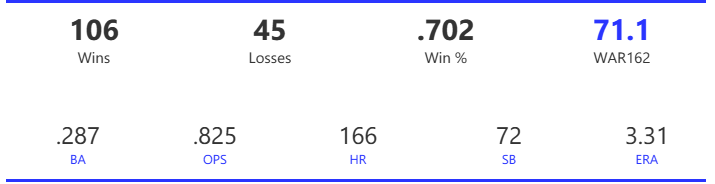
The 1939 Yankees were the last of four consecutive pennant winners, coasting to the AL pennant by an astounding 17 games over the Red Sox. They then swept the Reds in the World Series. Not only was this the highest-rated WAR team since the 1927 Yankees, but their 106 wins actually fell five games short of their Pythagorean projection.

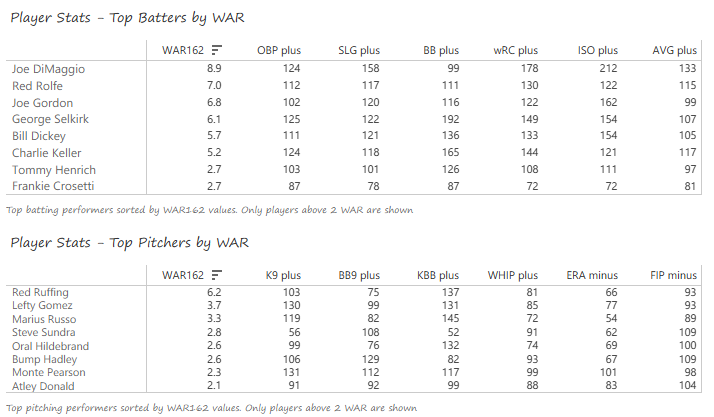
The Yankees led the league in both run scoring and run prevention. The team’s 967 runs easily topped the Red Sox, as did their 166 homers. The New Yorkers ranked second in BA, first in OBP, and first in OPS. The pitching was perhaps even more impressive, with a team ERA (3.31) more than 0.75 runs better than their closest rival. They also led the AL in complete games, shutouts, WHIP, and hits per 9 innings.

The Yankees had a staggering six position players above 5.0 WAR162, led by Joe DiMaggio, who led the AL with a .381 BA, while swatting 30 homers, driving in 126 runs, and posting a 1.119 OPS. Red Rolfe had a career year, scoring 139 runs with 213 hits and 46 doubles (all AL-best) and batting .329. Joe Gordon had a great age-24 campaign, with 28 homers, 111 RBI, and a .370 OBP, while George Selkirk batted .306 with 21 homers and 101 RBI. Veteran catcher Bill Dickey batted .302 with 24 homers and 105 RBI, and 22-year-old Charlie Keller batted .334 with 83 RBI and a .447 OBP. Veteran hurler Red Ruffing posted a 21-7 mark with a 2.93 ERA and AL-best 5 shutouts, and Lefty Gomez went 12-8. The depth of the staff was a strength, with 8 men earning at least 2.1 WAR162 on the season.

Summary

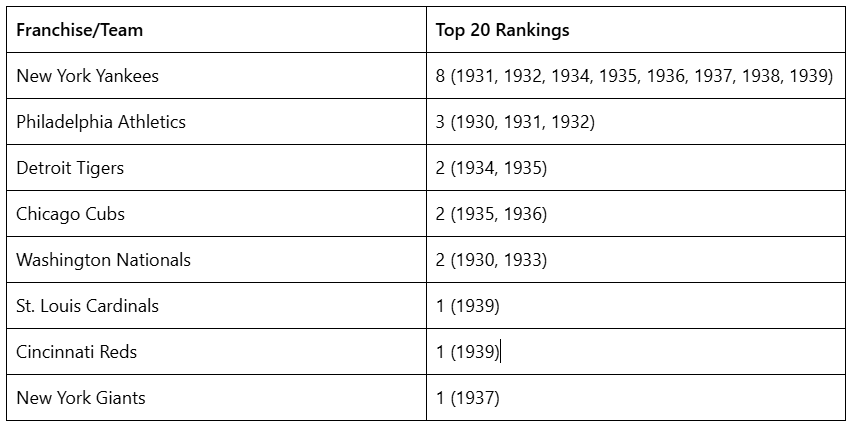
That’s it for this entry in our MLB Team Rankings for the 1930s decade! Here’s a quick summary of which franchises dominated the decade: