Tag: 1940s

1940s MLB Team Rankings Countdown: 5 through 1

Welcome to the final countdown post in our series of MLB team rankings for the 1940s. As a reminder, the teams are ranked from #20 through #1 based on aggregate WAR162. For the 1940s (1940-1949), a total of 160 teams were eligible (16 teams x 10 seasons), so the top 20 teams are a fairly exclusive group. We’ll summarize each team, including portions of their team dashboard, and explain how they attained their ranking. So, without further ado, here are the teams ranked #5 through #1.

Here’s the interactive dashboard at Tableau Public: 1940s Top 20 MLB Teams Dashboard

The seasons between 1942 and 1945 are a bit unusual, due to the impact of World War 2 on team rosters. Some teams suffered greater harm by losing star players such as Ted Williams (Red Sox) or Joe DiMaggio (Yankees). The war-era Cardinals maintained an edge by retaining their biggest star (Stan Musial), which helped propel them to the top of the rankings. The 1942 Cardinals won just enough to hold off the Dodgers by two games in the NL race. The Cards went on to defeat the Yankees in a five-game World Series.
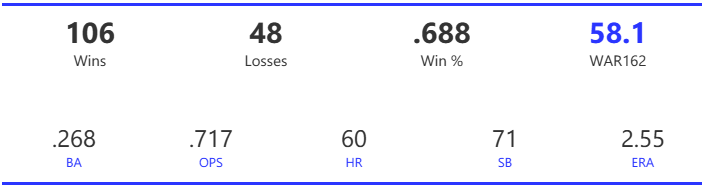
The Cardinals nosed out the Dodgers by a scant 13 runs on the season, and also led the NL in doubles, triples, BA, OBP, and OPS. Their pitching staff easily led the league in ERA and WHIP, as well as strikeouts and strikeout-to-walk rate.
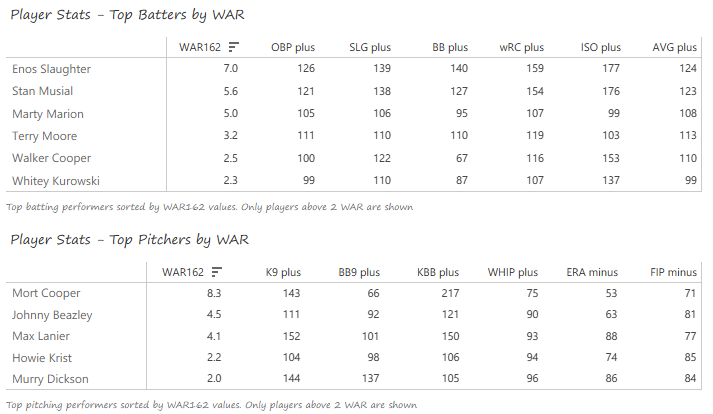
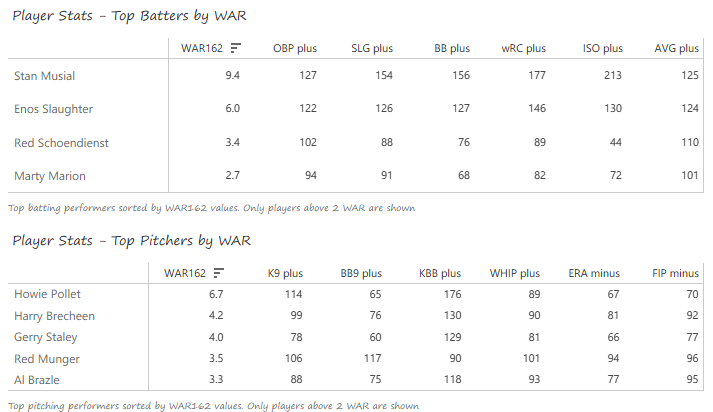
Enos Slaughter led the offensive charge, totaling 17 triples and 188 hits (both NL-bests) while batting .318. A 21-year-old Stan Musial batted .315, and shortstop Marty Marion laced 38 doubles (NL-best) with a .276 BA while standing out defensively. Mort Cooper had a great year on the mound winning 22 with 10 shutouts and a 1.78 ERA, all tops in the NL. Johnny Beazley (21-6, 2.13 ERA) and Max Lanier (13-8, 2.96 ERA) rounded out a strong threesome on the hill for the Cards.

The Cardinals followed up their 1942 pennant with another title a year later. This time, the Yankees defeated them in a five-game World Series rematch.
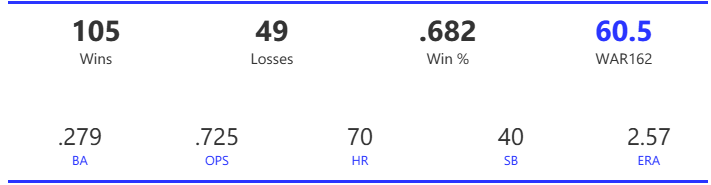
The 1943 version of the team trailed the Dodgers in runs scored (715 to 679), and also placed second in doubles, triples, and home runs. They easily topped the NL in BA and OPS, and were second in OBP. The pitching staff had an ERA a half-run better than their closest rival, and also led the NL in WHIP, shutouts, strikeouts, and strikeout-to-walk rate.
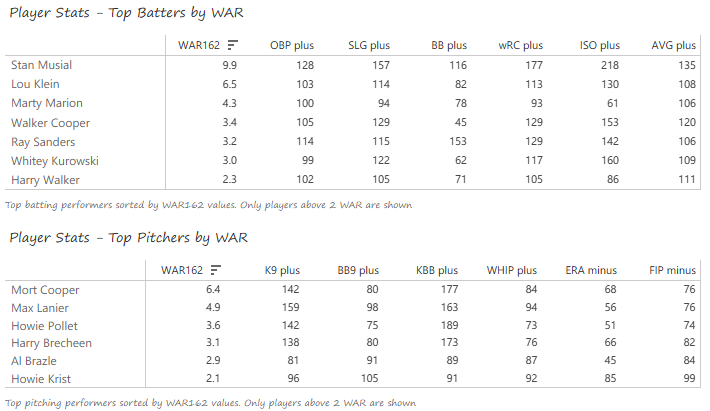
Stan Musial had a big 1943 season, leading the league in hits (220), BA (.357), doubles (48), and triples (20), while scoring 108 runs. Lou Klein provided strong support with a .287 BA and 91 runs scored, while Marty Marion batted .280 and played sterling defense at shortstop. Catcher Walker Cooper added a .318 BA and 81 RBI from the catcher spot. On the mound, Mort Cooper was again the ace, winning 21 games with a 2.30 ERA, and Max Lanier posted a 15-7 mark with an NL-best 1.90 ERA. Howie Pollet went 8-4 in limited duty to bolster the staff.

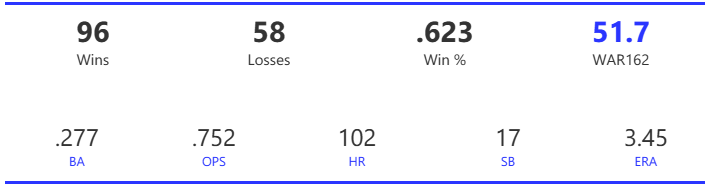
The 1942 Yankees coasted to an easy AL pennant by 9 games over the Red Sox. Their 103 wins were actually four shy of their Pythagorean projection for 107 victories. The season ended with a disappointing five-game World Series loss to the Cardinals.
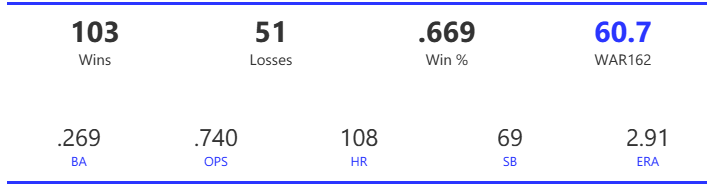
The Yankees topped the AL with 801 runs, 40 more than the Red Sox, and totaled 108 homers to top the AL. They ranked second behind their Boston rivals in BA, OBP, and OPS. Once again, it was the team’s pitching that outshone their rivals. The staff posted a splendid 2.91 ERA and led the league in nearly every meaningful category except strikeouts, where they ranked second to the Tigers.
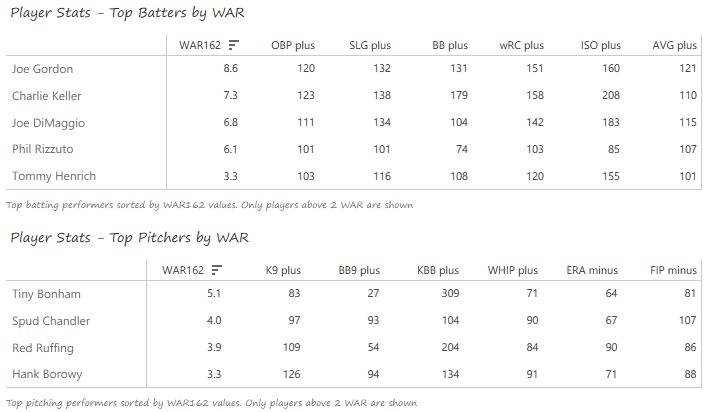
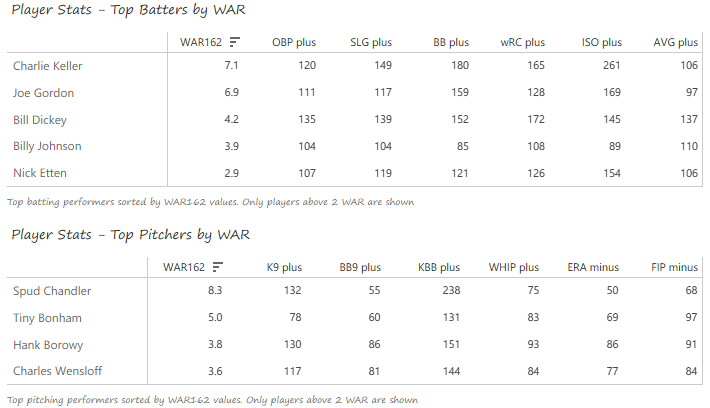
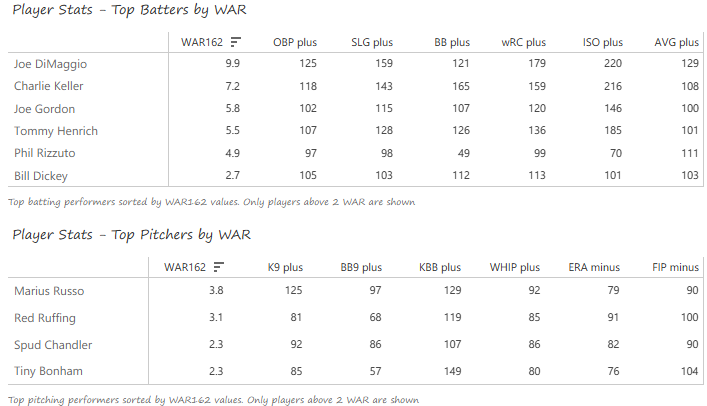
Second baseman Joe Gordon had a career year in 1942, batting .322 with a .409 OBP, 18 homers, and 103 RBI. Charlie Keller belted 26 homers with 114 walks and 108 RBI, and Joe DiMaggio batted .305 with 123 runs scored and 114 RBI. Shortstop Phil Rizzuto batted .284 with 22 steals and formed a great double-play combo with Gordon. Tiny Bonham starred on the mound with a 21-5 mark, 2.27 ERA, and 6 shutouts (AL-best). Veteran Spud Chandler won 16 at age 34, and the 37-year-old Red Ruffing added 14 more wins.

The 1948 Indians prevailed in one of the great three-team pennant races in AL history, topping the Red Sox in a single-game tiebreaker to capture the flag. The third-place Yankees finished 2.5 games back (just 2 games before the tiebreaker). The Indians went on to defeat the other Boston team (the Braves) in a six-game World Series.
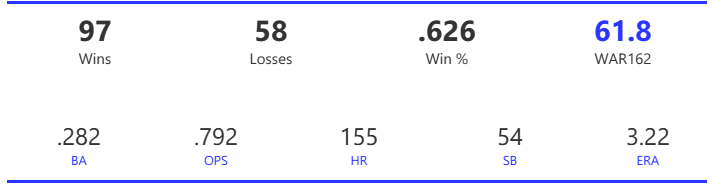
The Indians scored 840 runs, well behind the Red Sox’s 907, and slightly behind the 857 scored by the Yankees. They did lead the league in homers, BA, and OPS, and were second in OBP. Pitching was the team’s major strength, as they posted a 3.22 ERA, more than half a run ahead of the Yankees, and more than a full run better than Boston. The Indians staff tossed 26 shutouts, 10 more than their closest rival, and were far ahead of everyone on WHIP.
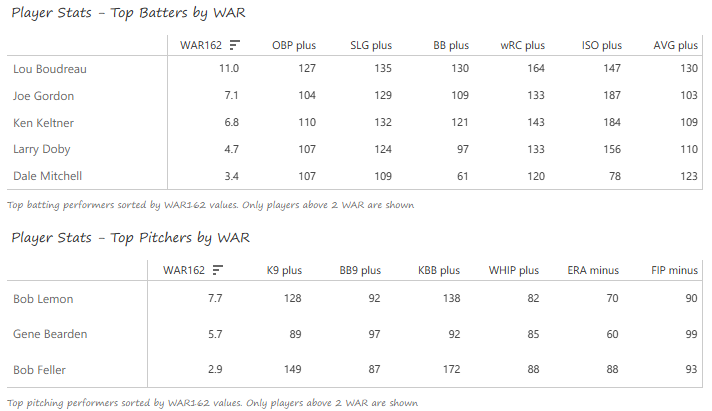
Shortstop Lou Boudreau had an amazing campaign, batting .355 with a .453 OBP, 116 runs scored, and 106 RBI. Infield mates Joe Gordon (32 homers, 124 RBI) and Ken Keltner (31 homers, 119 RBI) supplied the power for the club. Larry Doby batted .301 in his age-24 season, and Dale Mitchell batted .336. The pitching was led by Bob Lemon, who had 20 complete games and 10 shutouts in his 20-win season. Gene Bearden also won 20 and posted an AL-best 2.43 ERA, while Bob Feller had a down year by his standard but still led the league with 164 strikeouts and managed a 19-15 record.

The 1944 Cardinals blitzed the NL on their way to a 14.5-game margin over the Pirates before defeating the crosstown Browns in a six-game World Series.
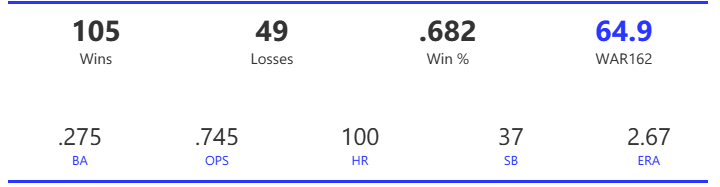
The Cards possessed both the best offense and pitching in the league in 1944. Their 772 runs scored led the NL, as did their 274 doubles and 100 home runs. They also swept the BA, OBP, and OPS rankings by a comfortable margin. The pitching was even better, leading the NL with a 2.67 ERA and 26 shutouts, 9 more than their closest competitor. They also ranked first in WHIP, strikeouts, and strikeout-to-walk rate.
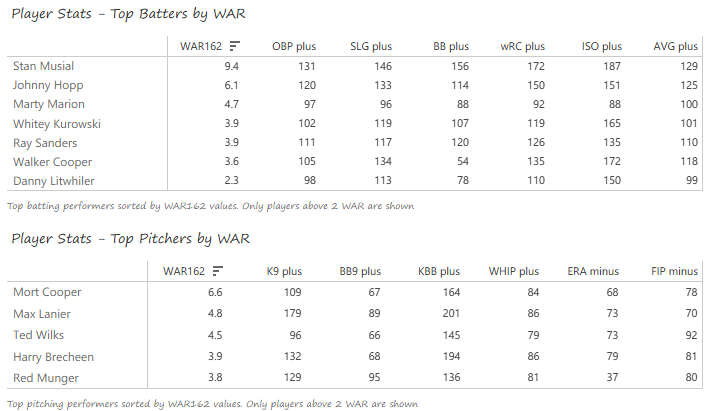
Stan Musial had a huge age-23 season, leading the league in doubles (51), OBP (.440), and OPS (.990) while batting a robust .347 and scoring 112 runs. His primary support came from Johnny Hopp (.336 BA, 106 runs) and Marty Marion, the Cards’ outstanding defensive shortstop. Whitey Kurowski slugged 20 homers with 87 RBI, and Ray Sanders added 102 RBI. Catcher Walker Cooper posted a .317 BA to round out the offensive firepower. Veteran hurler Mort Cooper posted 22 wins with a league-best 7 shutouts, and Ted Wilks led the NL in WHIP on his way to a 17-4 mark. Harry Brecheen (16) and Red Munger (11) added another 27 wins; Munger posted a microscopic 1.34 ERA for the season.

Summary

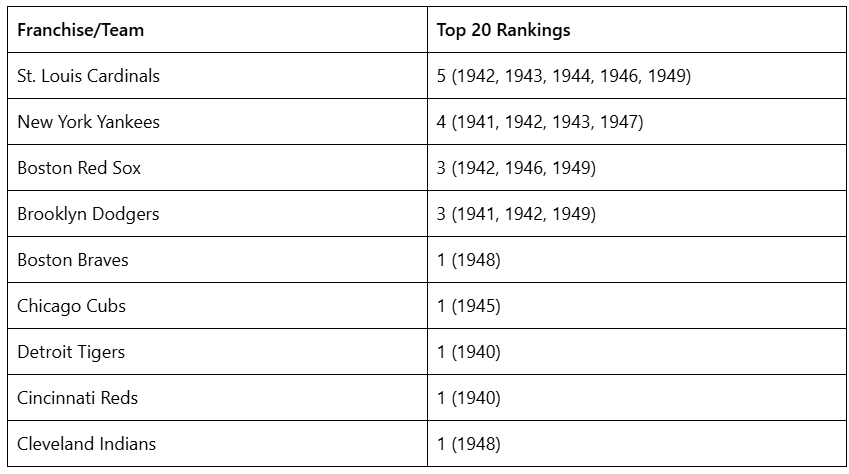
That’s it for the final entry in our MLB Team Rankings for the 1940s decade! Here’s a summary of the most dominant franchises of the 1940s:
1940s MLB Team Rankings Countdown: 10 through 6

Welcome to the third countdown post in our series of MLB team rankings for the 1940s. As a reminder, the teams are ranked from #20 through #1 based on aggregate WAR162. For the 1940s (1940-1949), a total of 160 teams were eligible (16 teams x 10 seasons), so the top 20 teams are a fairly exclusive group. We’ll summarize each team, including portions of their team dashboard, and explain how they attained their ranking. So, without further ado, here are the teams ranked #10 through #6.

Here’s the interactive dashboard at Tableau Public: 1940s Top 20 MLB Teams Dashboard

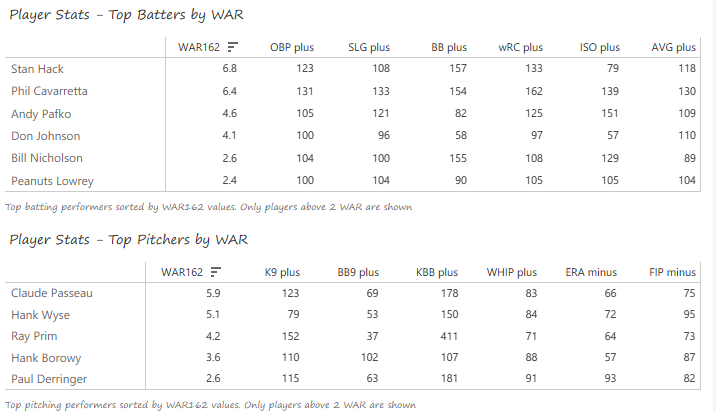
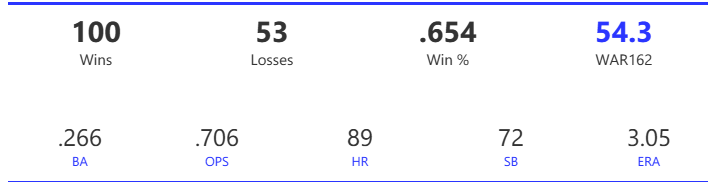
The 1945 Cubs returned to the top of the National League for the first time since 1938, outpacing the Cardinals by 3 games. This would also be their last pennant until 1984. The Cubs lost the World Series in seven games to the Tigers, their nemesis from the 1935 series.

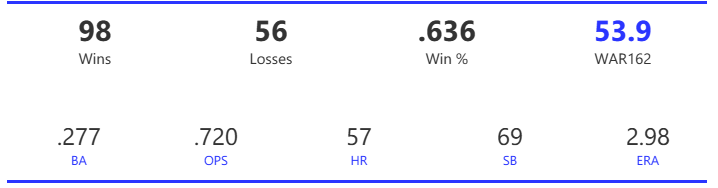
The 1945 edition of the Cubs succeeded despite a rather ordinary offensive output. The Chicagoans ranked just fourth in runs scored and were near the bottom in home runs. They did rank first in BA, and second in OBP and OPS behind the Dodgers. Pitching is what carried the Cubs to the top of the NL, led by a 2.98 team ERA, far ahead of their rivals. They easily led the NL in WHIP, yielded the fewest walks, and sported the best strikeout-to-walk rate.

Veteran third baseman Stan Hack had a fine age-35 campaign, batting .323 with 110 runs scored. Phil Cavaretta led the league with a .355 BA and .449 OBP, and Andy Pafko provided further support with 12 triples, 12 homers, and 110 RBI. Don Johnson batted .302 from his second base pot, scoring 94 runs. Claude Passeau had an excellent age-36 season on the mound, winning 17 games with a 2.46 ERA and 5 shutouts, while Hank Wyse went 22-10 with a 2.68 ERA. Ray Prim (at age 38) led the league in both ERA and WHIP while adding 13 wins, and Hank Borowy posted an 11-2 mark in limited duty.

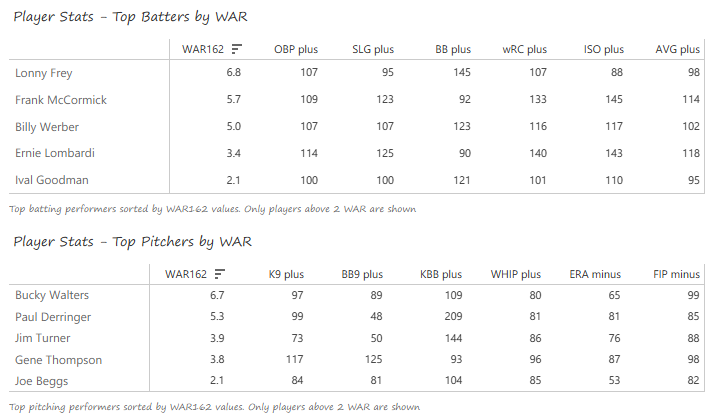
The 1940 Reds ran away with the NL pennant before defeating the Tigers in a seven-game World Series. The Reds were a bit fortunate to win 100 games (their projection was 96), but they were easily the best club in the NL for the season, besting the Dodgers by 12 games.

The Reds were the third-best run-scoring team in the NL, finishing 102 runs behind the Pirates. They finished in the middle of the pack in almost all offensive categories, but were saved by their pitching. The pitching staff led the NL in ERA and WHIP, and had solid metrics in other categories.

The Reds’ offense was a collection of relative unknowns, led by Lonny Frey, their second baseman. Frey led the NL with 22 steals and drew 80 walks with 102 runs scored. Frank McCormick led the league with 44 doubles and batted .309 with 127 RBI. Third Baseman Billy Werber was the third wheel of the offense, scoring 105 runs with 35 doubles and 12 homers. Bucky Walters led the pitchers with 22 wins, a 1.092 WHIP, and a 2.48 ERA across 305 innings, all tops in the NL. Paul Derringer posted a 20-12 mark, and Jim Turner (14) and Gene Thompson (16) combined for an additional 30 wins.

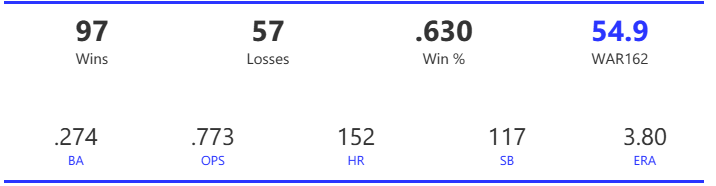
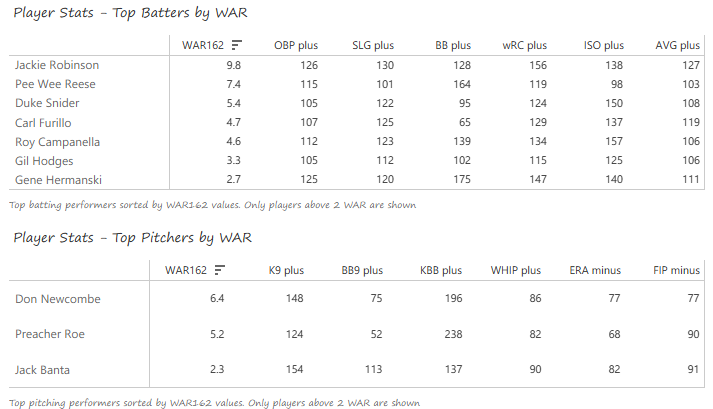
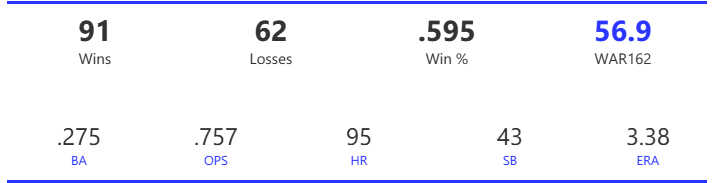
The 1949 Dodgers had a fine season, at least until they ran into the Yankees in the World Series, where they lost in five games.

The Dodgers were by far the most prolific offensive team in the league in 1949. Their 879 runs were 113 ahead of their closest rival, and their 152 homers also ranked first. The Dodgers also had speed on the basepaths, stealing 117 bases; their closest competitor stole 53 bases. The team ranked second in BA and first in both OBP and OPS. The pitching was also good, albeit not the equal of the offense. The Dodgers ranked second in ERA and WHIP, and led the NL in strikeout-to-walk rate.

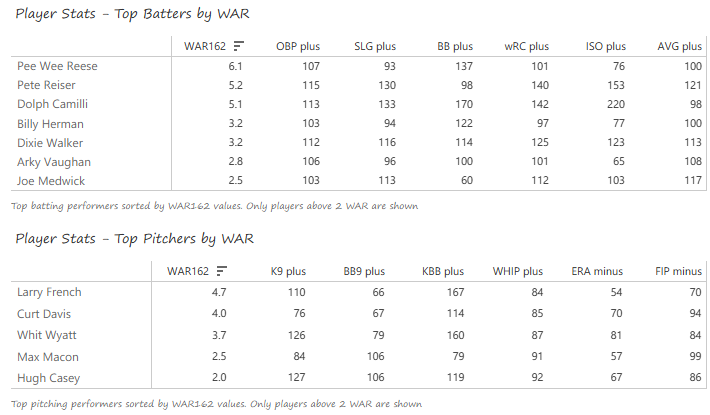
Jackie Robinson had a sensational year, leading the NL with a .342 BA and 37 steals. He also scored 122 runs. His double-play partner Pee Wee Reese led the NL with 132 runs scored and drew 116 walks on the season. The 22-year-old Duke Snider batted .292 with 23 homers, and outfield mate Carl Furillo batted .322 with 18 homers and 106 RBI. Catcher Roy Campanella batted .287 with 22 homers to round out the top position performers. On the mound, Don Newcombe assembled a 17-8 record with five shutouts at age 23, while veteran lefty Preacher Roe won 15 games with a 2.79 ERA.

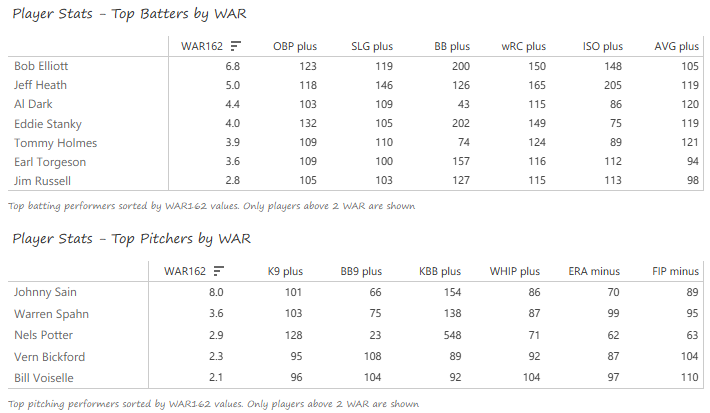
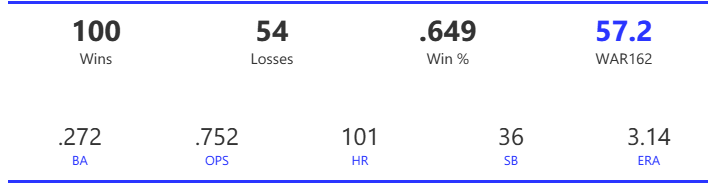
The 1948 Braves make a rare appearance for the Boston club, which more often was relegated to the lower depths of the NL. The Braves outlasted the Cardinals by 6.5 games to win the NL pennant before losing a six-game World Series to the Indians.

The Braves were a solid offensive team, ranking fourth in runs scored, fifth in home runs, but first in doubles, BA, OBP, and OPS. Pitching was their real strength, with ERA and WHIP numbers far ahead of their NL rivals. They also ranked first in strikeout-to-walk rate, largely due to an NL-best walks level.

The Braves’ offense lacked star power, but received strong performances from Bob Elliott, Jeff Heath, Alvin Dark, and Eddie Stanky. Elliott drew an NL-best 131 walks, leading to a .423 OBP, while belting 23 homers and driving in 100 runs. Heath added 20 homers and a .319 BA, and Dark batted .322 from his shortstop position. Stanky added a .320 BA with a .455 OBP in just 67 games. The pitching was led by Johnny Sain, who won 24 games, tossed 314 innings, and completed 28 games, all NL-best numbers. Lefty Warren Spahn added 15 wins, and Nels Potter, Vern Bickford, and Bill Voiselle provided solid support behind the Braves’ big two of Sain and Spahn.

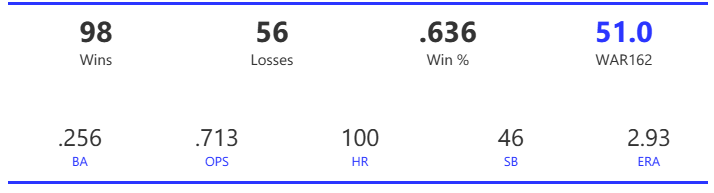
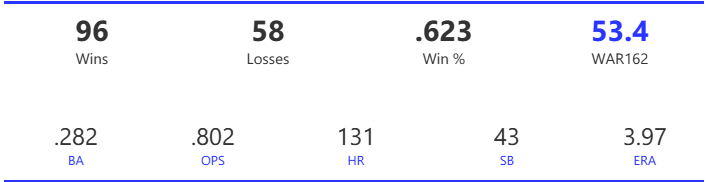
The 1941 Dodgers fought off a challenge from the Cardinals, eventually taking the pennant by 2.5 games. However, their World Series drought continued after a five-game defeat at the hands of the Yankees.

The Dodgers’ offense was the class of the NL in 1941, scoring 800 runs versus the Cardinals’ 734. They also swept the BA, OBP, and OPS rankings, and led the NL in both walks and triples. The pitching was also very good, leading the league in both ERA and WHIP.

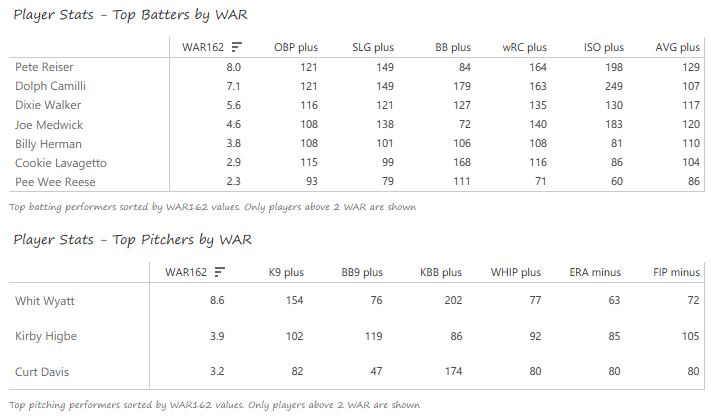
Outfielder Pete Reiser paved the way for the offense, scoring 117 runs with 39 doubles, 17 triples, and a .343 BA, all topping the NL. Dolph Camilli led the league in homers (34) and RBI (120), and posted a .407 OBP. Dixie Walker batted .311 with just 18 strikeouts in 606 plate appearances, and Joe Medwick batted .318 with 100 runs scored and 88 RBI. Whit Wyatt had a career year at age 33, winning 22 games with 7 shutouts, a 2.34 ERA, and topping the NL in WHIP. Kirby Higbe also posted 22 wins, and Curt Davis added 13 more.

Summary

That’s it for the third entry in our MLB Team Rankings for the 1940s decade! Stay tuned for the final countdown from #5 to #1, arriving in a few days. As always, thanks for reading!

1940s MLB Team Rankings Countdown: 15 through 11

Welcome to the second countdown post in our series of MLB team rankings for the 1940s. As a reminder, the teams are ranked from #20 through #1 based on aggregate WAR162. For the 1940s (1940-1949), a total of 160 teams were eligible (16 teams x 10 seasons), so the top 20 teams are a fairly exclusive group. We’ll summarize each team, including portions of their team dashboard, and explain how they attained their ranking. So, without further ado, here are the teams ranked #15 through #11.

Here’s the interactive dashboard at Tableau Public: 1940s Top 20 MLB Teams Dashboard

The Yankees continued a dominant era where they typically wound up on top of the AL standings. In 1943, they coasted to a 13.5 game margin over the Nationals, and then defeated the Cardinals in a five-game World Series.

This was not an offensive powerhouse compared to the Yankees teams of just a few years earlier, in part due to the impact of the Second World War and its effect on MLB rosters. Without Joe DiMaggio and Phil Rizzuto on the field, the Yankees’ 669 runs were just three ahead of the Nationals. The New Yorkers did lead the AL in triples, homers, OBP, and OPS, all at lower levels than in the pre-war years. Their pitching was dominant in 1943, easily leading the league in ERA, WHIP, and strikeout-to-walk rate.

In the absence of DiMaggio and Rizzuto, other Yankees stepped to the fore, led by outfielder Charlie Keller, who thumped 31 homers and led the league with a .922 OPS. Joe Gordon batted just .249 but earned 98 walks while playing a strong second base defensively, and 36-year-old catcher Bill Dickey batted .351 in part-time duty. Spud Chandler was the pitching star, posting a 20-4 mark with a 1.64 ERA and 0.992 WHIP, all topping the league. Tiny Bonham posted a 15-8 mark, and Hank Borowy (14) and Charles Wensloff (13) combined for 27 wins.

The Cardinals lost the 1949 NL pennant by a single game to the Dodgers, although the Pythagorean projection had them at 92 rather than 96 wins. So they were a bit lucky and came so close to capturing a pennant.

The Cardinals came very close due to their pitching. The offense was good, not great, totaling 766 runs, far behind the Dodgers’ 879. They did lead the league in doubles, and were second in triples, but far back in home runs and last in stolen bases. The Cards led the league in BA, and placed second to the Dodgers in OBP and OPS. On the pitching side, the Cards staff easily topped the NL in ERA and WHIP, and ranked near the top in other categories.

Stan Musial was the offensive leader for the Cards once again, leading the NL in hits, doubles, triples, and OBP, drawing 107 walks (to just 38 strikeouts). Enos Slaughter was the second big contributor, batting .336 (to Musial’s .338) and driving in 96 runs. Second baseman Red Schoendienst scored 102 runs while batting .297 as the third wheel in the offense. Howie Pollet topped the pitchers with a 20-9 mark and 2.77 ERA, and led the NL with 5 shutouts. Harry Brecheen won 14 games, and Gerry Staley won 10 as a hybrid starter/reliever.

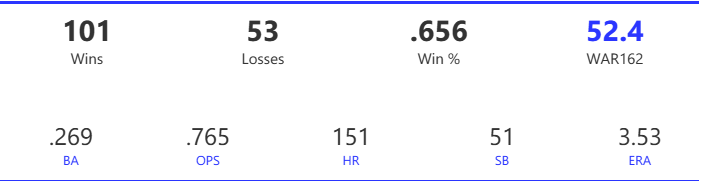
The 1941 Yankees powered and pitched their way to a 17-game edge over the Red Sox, although win projections suggest the Yankees were on the lucky side to the tune of 5 games. In any case, they were clearly the top team in the AL and went on to defeat the crosstown Dodgers in a five-game World Series.

The Yankees were outscored by the Red Sox by 35 runs on the season, but managed to bash the most homers (151) by a wide margin. They ranked third in BA and OBP, and second in OPS, trailing the Boston club each time. Pitching is where they outperformed their closest pursuers. Their team ERA was a whisker behind the White Sox (3.53 vs. 3.52), and they also ranked second in WHIP, but first in the fewest hits per 9 innings.

Joe DiMaggio had a big season in 1941, the year of his famous 56-game hitting streak. DiMaggio batted .357 with 30 homers and 125 RBI (AL-best) while scoring 122 runs. His principal support came from Charlie Keller (33 HR, 122 RBI), Joe Gordon (24 HR, 104 runs scored), and Tommy Henrich (31 HR, 106 runs scored). Shortstop Phil Rizzuto batted .307 and swiped 14 bases. The pitching was led by Marius Russo, who won 14 games with a 3.09 ERA, and the veteran Red Ruffing, who won 15 in his age-36 season.

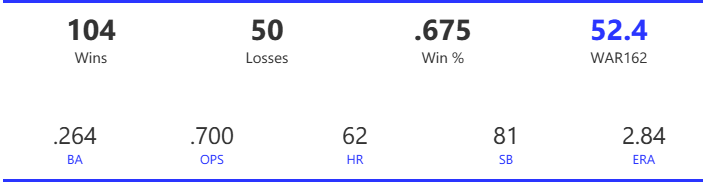
The 1942 Dodgers won 104 games and finished second to the Cardinals. While it was a tough pill to swallow in Brooklyn, the Cardinals’ edge on the mound brought them the NL pennant.

The Dodgers finished close behind the Cardinals in run production, trailing 755 to 742. They were not a power-hitting team, finishing in the lower half of the NL in triples and homers, and second in doubles. The Dodgers led the league in stolen bases with a rather modest total of 81, and ranked second behind the Cardinals in BA, OBP, and OPS. Pitching was a strength, except when compared to the Cardinals. The Dodgers ranked third in ERA, second in shutouts, second in WHIP, and second in strikeouts.

Shortstop Pee Wee Reese compiled the highest WAR numbers, largely due to his defensive prowess, although he did earn 82 walks on the season. Pete Reiser batted .310 with an NL-best 20 steals in just 125 games, and Dolph Camilli slugged 26 homers with 109 RBI. Larry French fashioned a fine 15-4 record with a 1.83 ERA in combined starter and relief pitcher duty, while Curt Davis also won 15 games and posted a 2.36 ERA. Starter Whit Wyatt went 19-7 with a 2.73 ERA as the third effective hurler for the Dodgers.

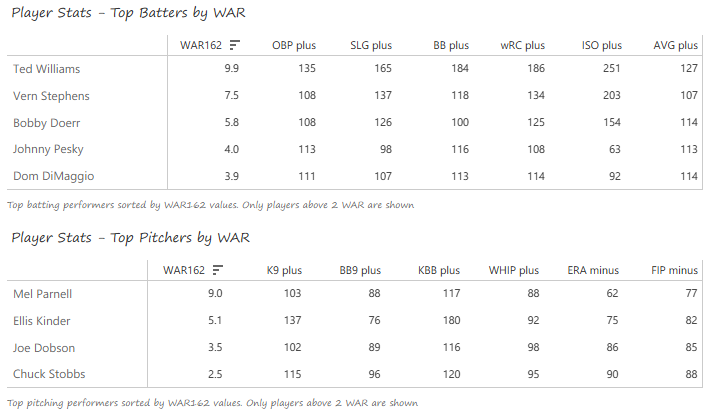
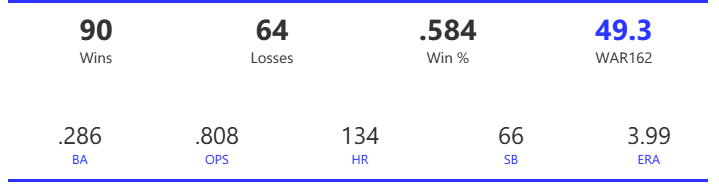
The 1949 Red Sox were another 1940s team to lose out in a close pennant race; in this case, their projection was two games better than the Yankees, but the Sox wound up a game back in the standings.

The Red Sox had a high-powered offense that led the AL in runs, home runs, doubles, BA, OBP, and OPS. Unfortunately, the pitching couldn’t keep pace with the offense, winding up fourth in ERA, third in WHIP, and fourth in strikeouts. The Yankees’ pitching was just effective enough to make a difference in the standings.

Ted Williams again led the Sox, as he batted .343 with 150 runs scored, 39 doubles, 43 homers, 159 RBI, 162 walks, a .490 OBP, and a 1.141 OPS. Except for BA, he led the league in each category. Shortstop Vern Stephens tied Williams with 159 RBI and belted 39 homers of his own, and second baseman Bobby Doerr batted .309 with 109 RBI. Johnny Pesky (.306, 111 runs) and Dom DiMaggio (.307, 126 runs) provided additional support. On the mound, left-hander Mel Parnell had a career year with a 25-7 mark and a 2.77 ERA across 295 innings, leading the AL in wins, ERA, and innings pitched. Ellis Kinder had a fine 23-6 season behind Parnell, and Joe Dobson won 14 games.

Summary

That’s it for the second entry in our MLB Team Rankings for the 1940s decade! Stay tuned for the countdown from #10 to #6, arriving in a few days. As always, thanks for reading!

1940s MLB Team Rankings Countdown: 20 through 16

Welcome to the first countdown post in our series of MLB team rankings for the 1940s. As a reminder, the teams are ranked from #20 through #1 based on aggregate WAR162. For the 1940s (1940-1949), a total of 160 teams were eligible (16 teams x 10 seasons), so the top 20 teams are a fairly exclusive group. We’ll summarize each team, including portions of their team dashboard, and explain how they attained their ranking. So, without further ado, here are the teams ranked #20 through #16.

Here’s the interactive dashboard at Tableau Public: 1940s Top 20 MLB Teams Dashboard

The 1940 Tigers prevailed in a tight AL pennant chase, finishing one game ahead of the Indians and three up on the Yankees. The Tigers were then defeated by the Reds in a 7-game World Series, denying them a second crown in six years.

The Tigers had a high-octane offense, scoring 888 runs to edge the Red Sox (872). They also placed first in BA, OBP, OPS, and doubles, and third in home runs. The pitching was not on par with the offense, ranking just fourth in ERA and WHIP, although they topped the league in strikeouts.

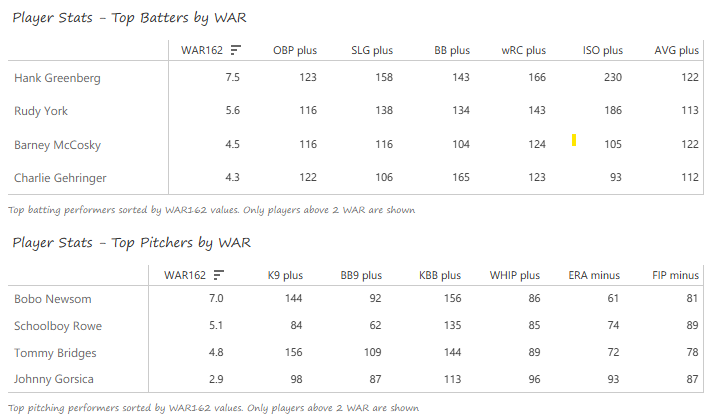
Hank Greenberg provided much of the offensive spark, leading the AL with 41 homers, 150 RBI, a 1.103 OPS, and 50 doubles, while batting .340. Rudy York added 33 homers and 134 RBI, and Barney McCosky batted .340 with 19 triples. Veteran second baseman Charlie Gehringer batted .313 at age 37 to round out the offense. The pitching corps was led by Bobo Newsom (21-5, 2.83 ERA) and Schoolboy Rowe (16-3, 3.46 ERA). Tommy Bridges added 12 wins from the second spot in the rotation.

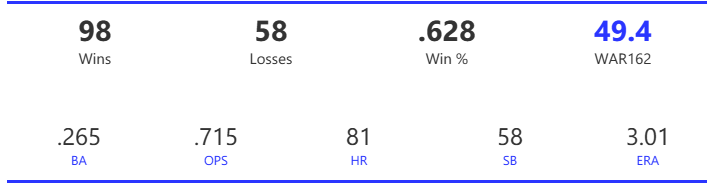
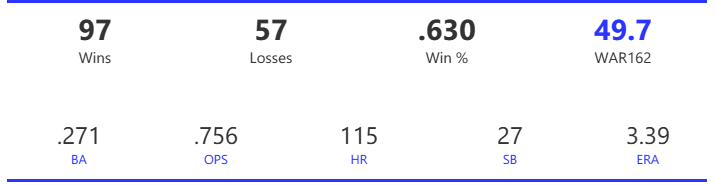
The Cardinals continued their strong decade with the 1946 NL pennant and World Series winners, who defeated the Red Sox in seven games in the fall classic. The Cards’ 98 regular-season wins edged the Dodgers by two games in a tight NL pennant battle.

The Cardinals’ 712 runs topped the NL during a period when scoring continued to decline from the inflated offensive numbers of the 1930s. They also topped the NL in BA and OPS, and finished second in home runs with a modest total of 81. Pitching was a strong point for the 1946 team, as they led the NL in ERA, shutouts, and strikeout-to-walk rate, while placing third in WHIP.

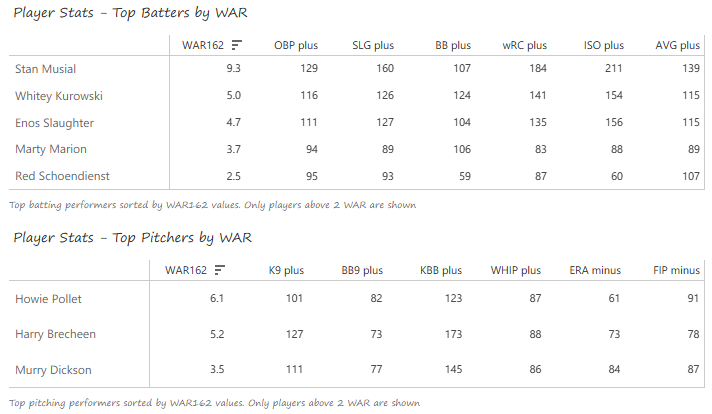
Stan Musial was the driving force of the offense, leading the NL in many offensive categories, including BA (.365), OPS (1.021), doubles (50), and triples (20). Whitey Kurowski batted .301 with 89 RBI, and Enos Slaughter led the NL with 130 RBI while compiling a .300 BA. Shortstop Marty Marion batted only .233, but was a strong defender at shortstop for the Cards. The pitching was led by the strong one-two combo of Howie Pollet and Harry Brecheen, both left-handers. Pollet led the league with 21 wins, a 2.10 ERA, and 266 innings pitched; Brecheen tossed a league-best 5 shutouts while posting 15 wins, a number matched by Murry Dickson, a combination starter and reliever.

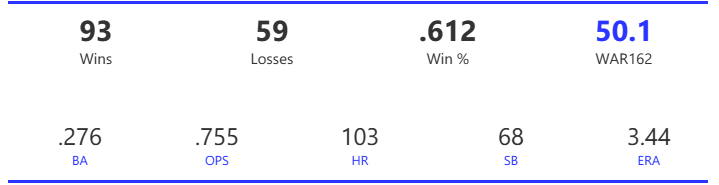
The 1947 Yankees cruised to the AL title, finishing 12 games ahead of the Tigers. The Yanks were armed with the best offense and pitching in the AL, and capped the season by defeating the crosstown Dodgers in a seven-game World Series.

The Yankees’ 794 runs easily topped the AL; they also led the league in BA, OPS, triples, and home runs. Their pitching was also strong, as they led the league in ERA and strikeouts, and finished second in WHIP behind the Indians.

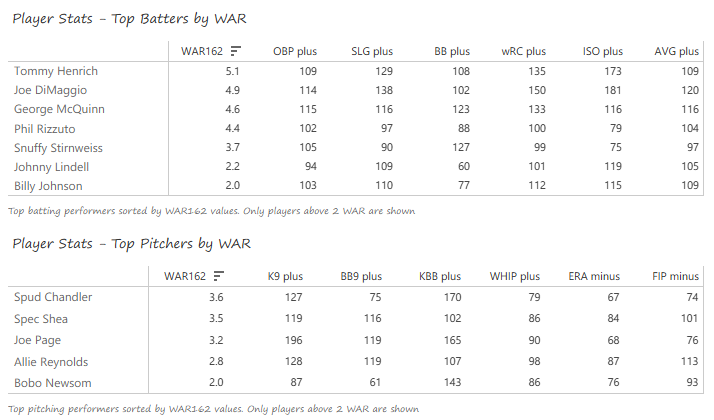
The Yankees’ offense was well distributed across multiple players, with 34-year-old Tommy Henrich leading the way. Henrich totaled 13 triples (AL-best), 109 runs scored, and 98 RBI; Joe DiMaggio had a quiet year (by his standards), batting .315 with 20 homers and 97 RBI, and 37-year-old George McQuinn batted .304 with a .397 OBP. Phil Rizzuto played his usual strong defense at shortstop while batting .273, with his infield partner Stuffy Stirnweiss picking up 89 walks, leading to a .358 OBP. Spud Chandler posted a fine 2.46 ERA as the fourth starter, and Spec Shea allowed the fewest hits per 9 innings from the second spot in the rotation. Reliever Joe Page saved an AL-best 17 games, and veteran righty Allie Reynolds posted a 19-8 mark.

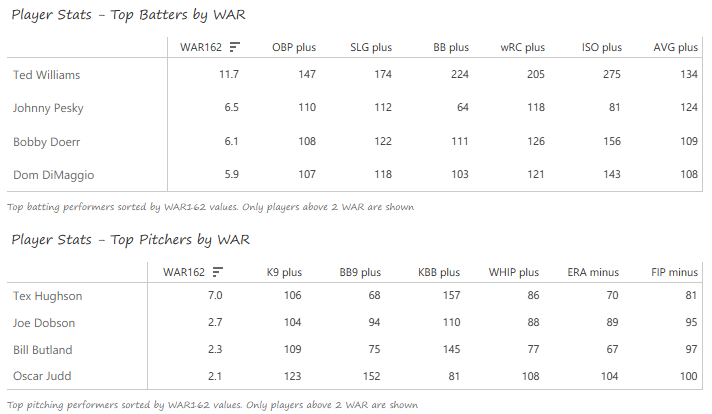
The Red Sox fielded a very solid team in 1942, but were no match for the Yankees, who won the pennant by a comfortable 9 games over the Red Sox. The Boston squad would have to wait four more years to break through for an AL pennant.

The Sox were a strong offensive team, but trailed the Yankees in several categories. Their 761 runs ranked second, as did their 103 homers, but they did lead the AL in BA, OBP, and OPS. If their offense was at a similar level to the Yankees’, their pitching was not. The staff ranked a distant third in ERA, second in WHIP, fourth in strikeouts, and fifth in strikeout-to-walk rate.

Ted Williams was indisputably the star for the Red Sox, leading the league in multiple categories. Williams batted .356, had a .499 OBP, .648 SLG, and 1.147 OPS, while swatting 36 homers, drawing 145 walks, scoring 141 runs, and amassing 137 RBI. His excellent supporting crew included shortstop Johnny Pesky (.331 BA, 205 hits), Bobby Doerr (.290 BA, 102 RBI), and Dom DiMaggio (.286 BA, 110 runs scored). On the mound, Tex Hughson was by far the most effective hurler, leading the league in wins (22), complete games (22), innings pitched (281), and strikeouts (113). Joe Dobson was the next most effective starter, but had just an 11-9 record for the season.

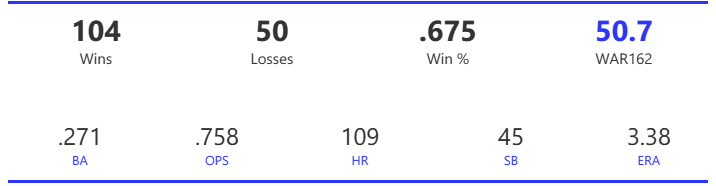
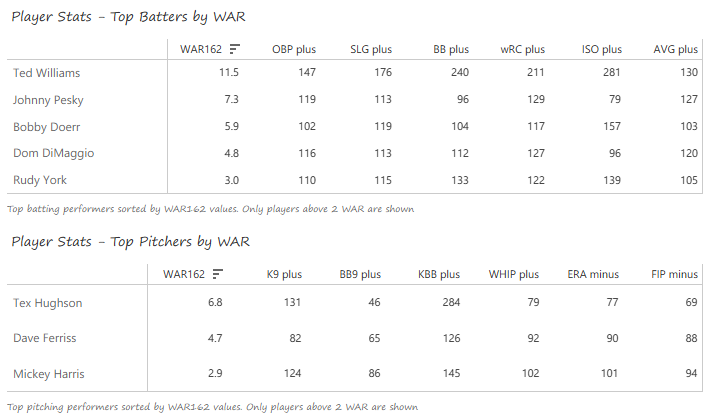
The Red Sox finally broke through for their first AL pennant in 28 years, winning 104 games (7 more than projected) to top the Tigers by 12 games. Unfortunately for the Sox, they fell short in the World Series, losing to the Cardinals in seven games.

The Sox topped the AL standings primarily via their high-scoring offense. Their 792 runs were 88 more than the Tigers could muster, and they easily led the league in BA, OBP, and OPS. The pitching was generally middle of the pack, ranking fourth in ERA, third in WHIP, fourth in strikeouts, and second in strikeout-to-walk rate.

Ted Williams again powered the offense with help from the supporting crew of Johnny Pesky, Bobby Doerr, and Dom DiMaggio. Williams led the AL in runs (142), walks (156), OBP (.497), SLG (.667), and OPS (1.164) while batting .342. Pesky batted .335 with an AL-best 208 hits, Doerr totaled 116 RBI, and DiMaggio batted .316. Tex Hughson (20-11, 2.75 ERA, 3.37 strikeout-to-walk rate) and Dave Ferriss (25-6) supplied a strong top of the rotation for the Boston squad.

Summary

That’s it for the first entry in our MLB Team Rankings for the 1940s decade! Stay tuned for the countdown from #15 to #11, arriving in a few days. As always, thanks for reading!