Welcome to the first countdown post in our series of MLB team rankings for the 1930s. As a reminder, the teams are ranked from #20 through #1 based on aggregate WAR162. For the 1930s (1930-1939), a total of 160 teams were eligible (16 teams x 10 seasons), so the top 20 teams are a fairly exclusive group. We’ll summarize each team, including portions of their team dashboard, and explain how they attained their ranking. So, without further ado, here are the teams ranked #20 through #16.
Here’s the interactive dashboard at Tableau Public: 1930s Top 20 MLB Teams Dashboard
#20: 1937 New York Giants, 47.8 WAR162
The Giants returned to the rankings after an extended absence. Their presence here does not resemble the dominant eras of prior Giants editions from the 1910s and 1920s; it is more of a single-season breakthrough. While the Giants did capture the NL pennant by two games over the Cubs, their Pythagorean projection had them as an 89-63 team with good fortune leading to the 95 wins they achieved. The Giants would go on to lose the World Series in 5 games to the crosstown Yankees.
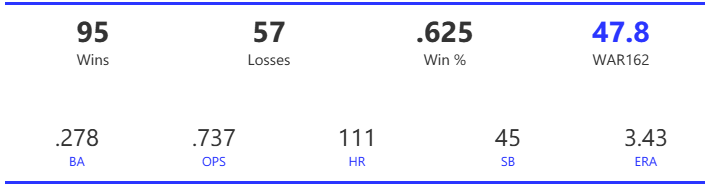
The Giants’ 732 runs scored placed them a distant third behind the Cubs and Cardinals. While they led the NL with 111 homers, their offense was otherwise just above average – fourth in BA, third in OBP, and second in OPS. The pitching staff posted good, but not exceptional numbers, finishing second in ERA and WHIP. They did lead the NL in strikeouts and strikeout-to-walk rate, edging the Pirates in both categories.
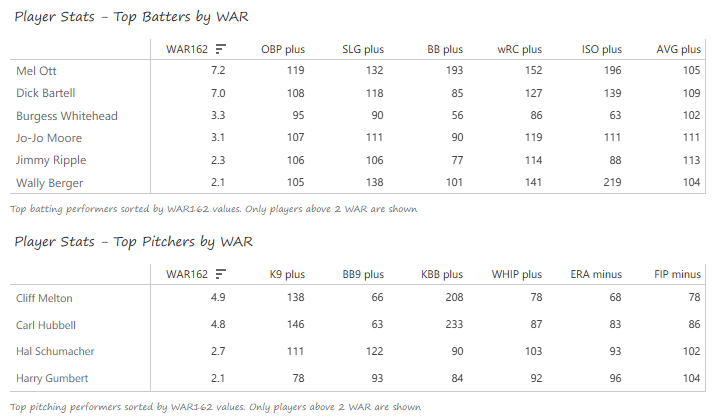
Mel Ott and Dick Bartell were the clear offensive leaders for the New Yorkers, with Ott leading the league in home runs (31) and walks (102), on his way to a .931 OPS. Bartell batted .306 with 38 doubles and a .306 BA, strong numbers for a shortstop. Burgess Whitehead (.286 BA) and Jo-Jo Moore (.310 BA, 37 doubles) provided additional support. The pitching staff was led by a pair of 20-game winners. Cliff Melton posted a 20-9 mark with a 2.61 ERA and NL-best 7 saves, while veteran lefty Carl Hubbell went 22-8 with a league-leading 159 strikeouts.
#19: 1939 Cincinnati Reds, 49.4 WAR162
The Reds continued their ascent to the top of the National League in 1939, culminating in a pennant just two years removed from a last-place finish. The Cincinnati club bested the Cardinals by 4.5 games, which allowed the Cardinals to be swept in the World Series by the 1939 Yankees, considered one of the best teams ever. Nonetheless, the 1939 team lifted the Reds into the NL’s first division for the next several seasons.
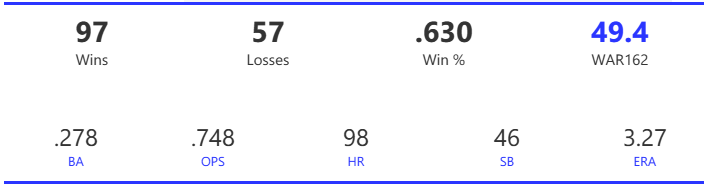
The Reds rose to the top through a combination of good hitting and excellent pitching. Their 767 runs scored were just 12 behind the Cardinals’ NL-best total, and their 98 homers tied for second behind the Giants. The Reds also placed second in BA, OBP, and OPS, trailing the Cardinals in each category. The pitching staff led the NL in ERA by a considerable margin and placed second in WHIP. The Reds also led the league in strikeouts and hits per 9 innings.
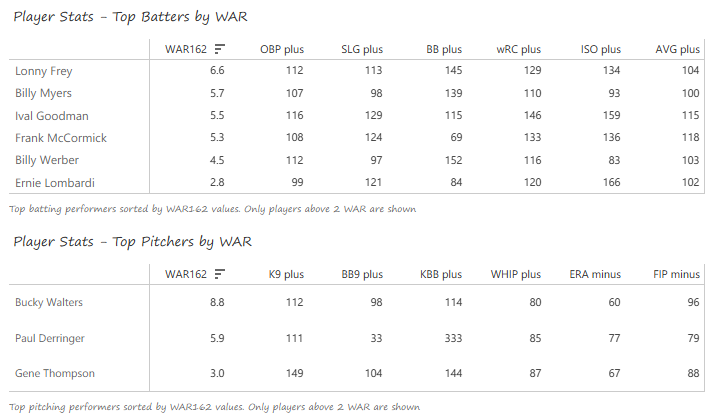
The Reds’ offense doesn’t feature many household names, but it did have four players top the 5.0 WAR162 mark. Lonny Frey batted .291 with a .388 OBP and 95 runs scored, while Billy Myers batted .281 from his shortstop position. Ival Goodman batted at a .323 clip, and Frank McCormick hit .332 with an NL-best 128 RBI. Billy Werber led the league with 115 runs scored and swiped a team-high 15 bases. On the mound, the Reds had a very effective one-two tandem in Bucky Walters and Paul Derringer. Walters won 27 with a 2.29 ERA and 1.125 WHIP across 319 innings, all NL-best numbers. Derringer tossed 301 innings, posting a 25-9 record with 5 shutouts. Gene Thompson won 13 games as the Reds’ primary reliever.
#18: 1936 Chicago Cubs, 49.8 WAR162
The 1936 edition of the Cubs finished tied for second in the NL behind the Giants, but were the best team on paper. Their Pythagorean projection had them winning 93 games (versus 87), while the Giants’ 92 wins exceeded their projection by three games. Instead of winding up five games back, they should have finished ahead of the New York club.
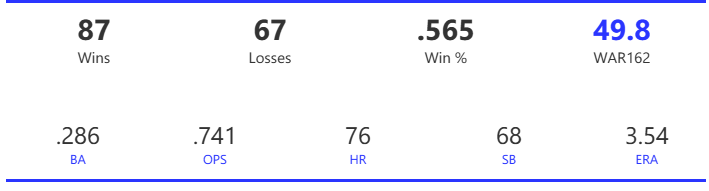
The Cubs had a balanced profile in 1936, featuring solid offensive and pitching metrics. The club finished in a virtual dead heat with the Pirates in BA and OBP, and placed third in OPS. Their 755 runs also placed third, trailing the Pirates and Cardinals. The team’s 3.54 ERA was behind only the Giants, and their 18 shutouts and 77 complete games both led the NL. The Cubs also placed second in WHIP and strikeout-to-walk rate.
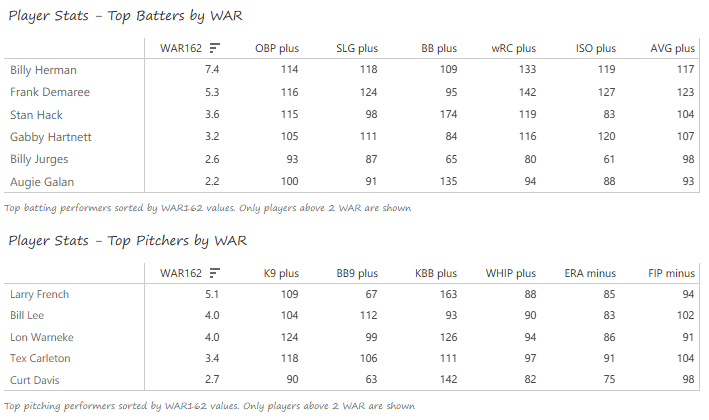
Billy Herman had an exceptional season from his second base spot, batting .334 with 101 runs scored, 57 doubles, and 93 RBI. Frank Demaree swatted 16 homers to go with his .350 BA and 96 RBI, and Stan Hack batted .298 with a .396 OBP. Veteran catcher Gabby Hartnett batted .307 in his age-35 season to round out the Cubs’ offense. Larry French and Bill Lee each won 18 games, while Lon Warneke (16) and Tex Carleton (14) added another 30 wins. Interestingly, each of the four tied for the NL lead with four shutouts apiece.
#17: 1939 St. Louis Cardinals, 50.2 WAR162
The Cardinals lost to the Reds in the 1939 NL pennant race, but placed slightly higher on a WAR162 basis. The 1939 campaign would turn out to be a springboard for the next decade, when the Cards would claim multiple pennants.
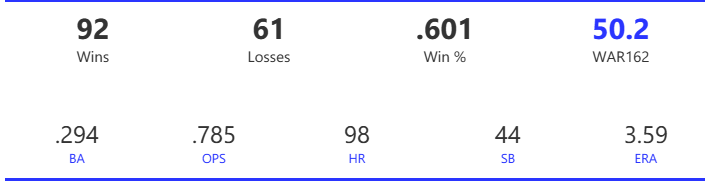
The Cardinals were a strong offensive club, leading the NL in multiple offensive categories, including runs, doubles, BA, OBP, and OPS. Their pitching numbers were quite solid, finishing second in ERA, first in shutouts, second in strikeouts, and third in WHIP.
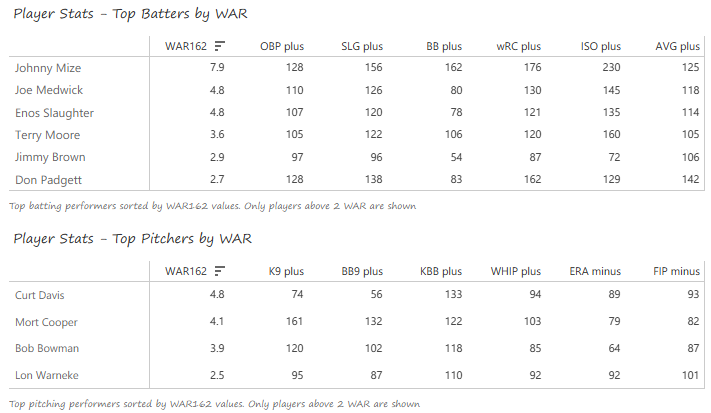
Johnny Mize powered the offense, leading the NL in homers (28), BA (.349), SLG (.626), and OPS (1.070). He also rapped 44 doubles and 14 triples. Joe Medwick (.332, 48 doubls, 117 RBI) and Enos Slaughter (.320 BA, NL-best 52 doubles) were Mize’s primary accomplices. The pitching staff was led by 35-year-old Curt Davis (22-16) and Mort Cooper (12-6, 3.25 ERA). Bob Bowman was effective from the bullpen, finishing 19 games and earning 8 saves with a 2.60 ERA.
#16: 1933 Washington Nationals, 50.7 WAR
The Nationals returned to the top of the AL for the first time since 1925, finishing 7 games ahead of the Yankees. They wound up losing a 5-game World Series to the Giants, putting a damper on a fine season.
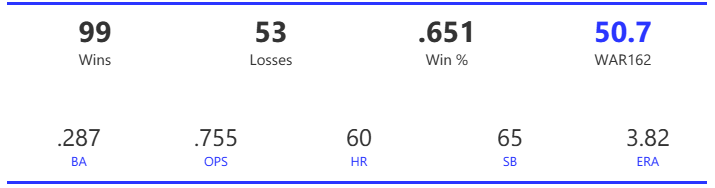
The Nationals were third in runs scored behind the high-powered Yankees and Athletics, although they did lead the AL in both triples and BA (.287). The team’s greater strength was in their pitching metrics, where they placed 2nd in ERA and first in WHIP, due to their AL-best walk rate.
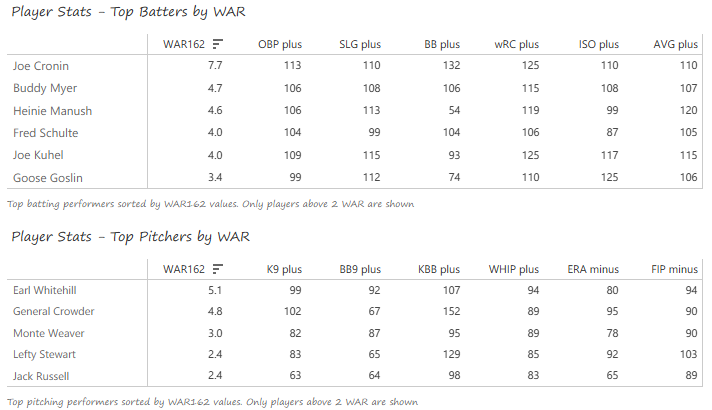
Shortstop Joe Cronin was the offensive star, batting .309 with a .398 OBP, 118 RBI, and an AL-best 45 doubles. Buddy Myer batted .302, and Henie Manush hit .336 while leading the league with 17 triples, and scoring 115 runs. Fred Schulte (.295, 98 runs, 87 RBI) and Joe Kuhel (.322 BA, 11 homers, 107 RBI) provided ample offensive support. The pitching was led by a pair of 20-game winners in Earl Whitehill (22-8, 3.33 ERA) and General Crowder (24-15).
Summary
That’s it for the first entry in our MLB Team Rankings for the 1930s decade! Stay tuned for the countdown from #15 to #11, arriving in a few days. As always, thanks for reading!