Welcome to the third countdown post in our series of MLB team rankings for the 1940s. As a reminder, the teams are ranked from #20 through #1 based on aggregate WAR162. For the 1940s (1940-1949), a total of 160 teams were eligible (16 teams x 10 seasons), so the top 20 teams are a fairly exclusive group. We’ll summarize each team, including portions of their team dashboard, and explain how they attained their ranking. So, without further ado, here are the teams ranked #10 through #6.
Here’s the interactive dashboard at Tableau Public: 1940s Top 20 MLB Teams Dashboard
#10: 1945 Chicago Cubs, 53.9 WAR162
The 1945 Cubs returned to the top of the National League for the first time since 1938, outpacing the Cardinals by 3 games. This would also be their last pennant until 1984. The Cubs lost the World Series in seven games to the Tigers, their nemesis from the 1935 series.
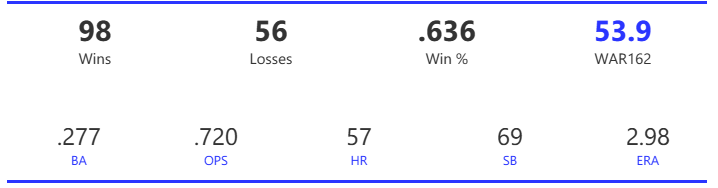
The 1945 edition of the Cubs succeeded despite a rather ordinary offensive output. The Chicagoans ranked just fourth in runs scored and were near the bottom in home runs. They did rank first in BA, and second in OBP and OPS behind the Dodgers. Pitching is what carried the Cubs to the top of the NL, led by a 2.98 team ERA, far ahead of their rivals. They easily led the NL in WHIP, yielded the fewest walks, and sported the best strikeout-to-walk rate.
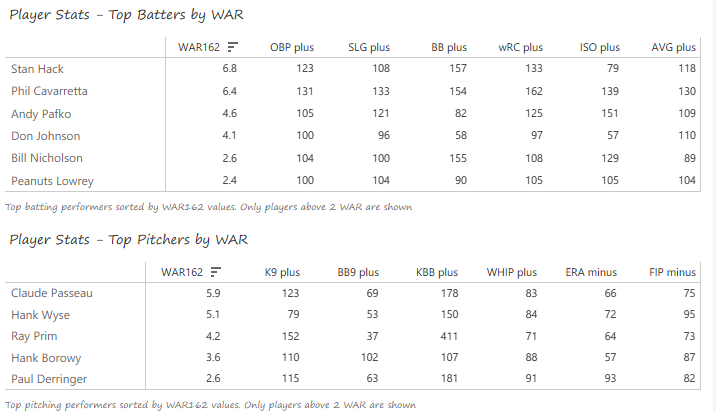
Veteran third baseman Stan Hack had a fine age-35 campaign, batting .323 with 110 runs scored. Phil Cavaretta led the league with a .355 BA and .449 OBP, and Andy Pafko provided further support with 12 triples, 12 homers, and 110 RBI. Don Johnson batted .302 from his second base pot, scoring 94 runs. Claude Passeau had an excellent age-36 season on the mound, winning 17 games with a 2.46 ERA and 5 shutouts, while Hank Wyse went 22-10 with a 2.68 ERA. Ray Prim (at age 38) led the league in both ERA and WHIP while adding 13 wins, and Hank Borowy posted an 11-2 mark in limited duty.
#9: 1940 Cincinnati Reds, 54.3 WAR162
The 1940 Reds ran away with the NL pennant before defeating the Tigers in a seven-game World Series. The Reds were a bit fortunate to win 100 games (their projection was 96), but they were easily the best club in the NL for the season, besting the Dodgers by 12 games.
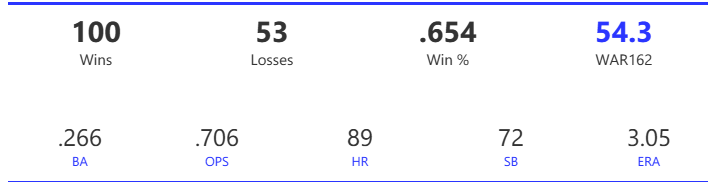
The Reds were the third-best run-scoring team in the NL, finishing 102 runs behind the Pirates. They finished in the middle of the pack in almost all offensive categories, but were saved by their pitching. The pitching staff led the NL in ERA and WHIP, and had solid metrics in other categories.
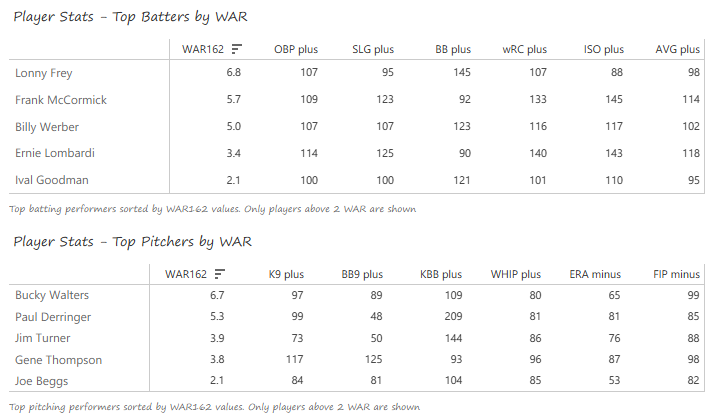
The Reds’ offense was a collection of relative unknowns, led by Lonny Frey, their second baseman. Frey led the NL with 22 steals and drew 80 walks with 102 runs scored. Frank McCormick led the league with 44 doubles and batted .309 with 127 RBI. Third Baseman Billy Werber was the third wheel of the offense, scoring 105 runs with 35 doubles and 12 homers. Bucky Walters led the pitchers with 22 wins, a 1.092 WHIP, and a 2.48 ERA across 305 innings, all tops in the NL. Paul Derringer posted a 20-12 mark, and Jim Turner (14) and Gene Thompson (16) combined for an additional 30 wins.
#8: 1949 Brooklyn Dodgers, 54.9 WAR162
The 1949 Dodgers had a fine season, at least until they ran into the Yankees in the World Series, where they lost in five games.
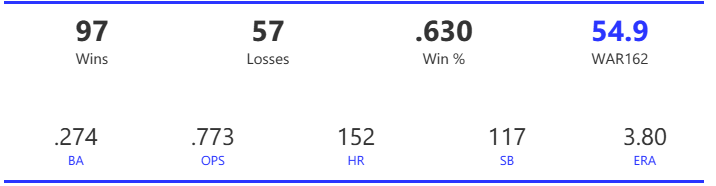
The Dodgers were by far the most prolific offensive team in the league in 1949. Their 879 runs were 113 ahead of their closest rival, and their 152 homers also ranked first. The Dodgers also had speed on the basepaths, stealing 117 bases; their closest competitor stole 53 bases. The team ranked second in BA and first in both OBP and OPS. The pitching was also good, albeit not the equal of the offense. The Dodgers ranked second in ERA and WHIP, and led the NL in strikeout-to-walk rate.
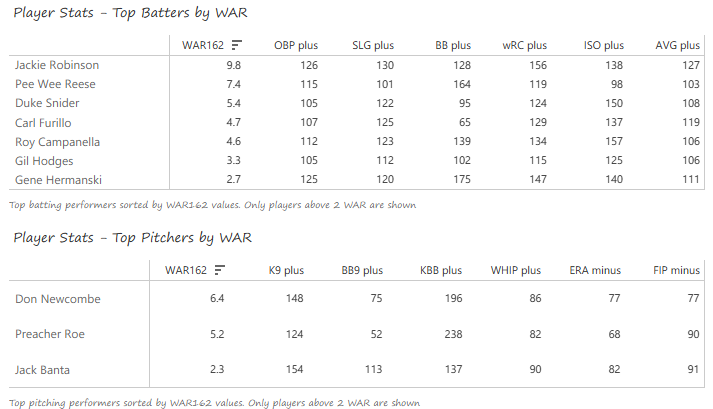
Jackie Robinson had a sensational year, leading the NL with a .342 BA and 37 steals. He also scored 122 runs. His double-play partner Pee Wee Reese led the NL with 132 runs scored and drew 116 walks on the season. The 22-year-old Duke Snider batted .292 with 23 homers, and outfield mate Carl Furillo batted .322 with 18 homers and 106 RBI. Catcher Roy Campanella batted .287 with 22 homers to round out the top position performers. On the mound, Don Newcombe assembled a 17-8 record with five shutouts at age 23, while veteran lefty Preacher Roe won 15 games with a 2.79 ERA.
#7: 1948 Boston Braves, 56.9 WAR162
The 1948 Braves make a rare appearance for the Boston club, which more often was relegated to the lower depths of the NL. The Braves outlasted the Cardinals by 6.5 games to win the NL pennant before losing a six-game World Series to the Indians.
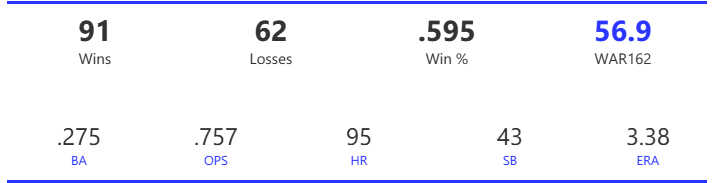
The Braves were a solid offensive team, ranking fourth in runs scored, fifth in home runs, but first in doubles, BA, OBP, and OPS. Pitching was their real strength, with ERA and WHIP numbers far ahead of their NL rivals. They also ranked first in strikeout-to-walk rate, largely due to an NL-best walks level.
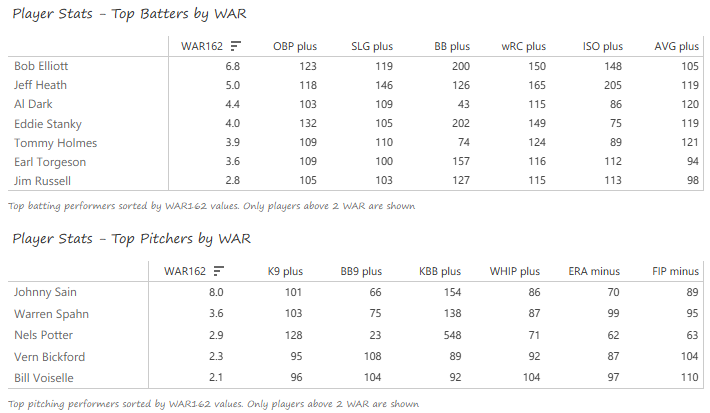
The Braves’ offense lacked star power, but received strong performances from Bob Elliott, Jeff Heath, Alvin Dark, and Eddie Stanky. Elliott drew an NL-best 131 walks, leading to a .423 OBP, while belting 23 homers and driving in 100 runs. Heath added 20 homers and a .319 BA, and Dark batted .322 from his shortstop position. Stanky added a .320 BA with a .455 OBP in just 67 games. The pitching was led by Johnny Sain, who won 24 games, tossed 314 innings, and completed 28 games, all NL-best numbers. Lefty Warren Spahn added 15 wins, and Nels Potter, Vern Bickford, and Bill Voiselle provided solid support behind the Braves’ big two of Sain and Spahn.
#6: 1941 Brooklyn Dodgers, 57.2 WAR
The 1941 Dodgers fought off a challenge from the Cardinals, eventually taking the pennant by 2.5 games. However, their World Series drought continued after a five-game defeat at the hands of the Yankees.
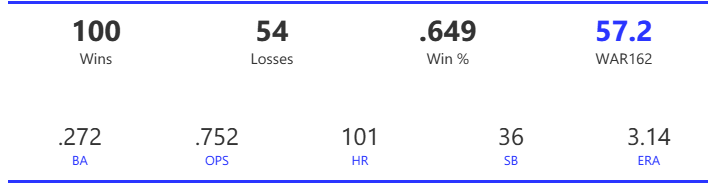
The Dodgers’ offense was the class of the NL in 1941, scoring 800 runs versus the Cardinals’ 734. They also swept the BA, OBP, and OPS rankings, and led the NL in both walks and triples. The pitching was also very good, leading the league in both ERA and WHIP.
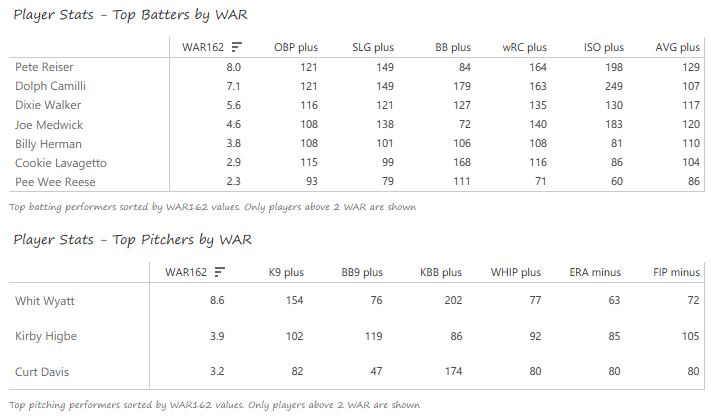
Outfielder Pete Reiser paved the way for the offense, scoring 117 runs with 39 doubles, 17 triples, and a .343 BA, all topping the NL. Dolph Camilli led the league in homers (34) and RBI (120), and posted a .407 OBP. Dixie Walker batted .311 with just 18 strikeouts in 606 plate appearances, and Joe Medwick batted .318 with 100 runs scored and 88 RBI. Whit Wyatt had a career year at age 33, winning 22 games with 7 shutouts, a 2.34 ERA, and topping the NL in WHIP. Kirby Higbe also posted 22 wins, and Curt Davis added 13 more.
Summary
That’s it for the third entry in our MLB Team Rankings for the 1940s decade! Stay tuned for the final countdown from #5 to #1, arriving in a few days. As always, thanks for reading!