Welcome to the next countdown post in our series of 1910s MLB Team Rankings. As a reminder, the teams are ranked from #20 through #1 based on aggregate WAR162. For the 1910s (1910-1919), a total of 160 teams were eligible (16 teams x 10 seasons), so the top 20 teams are a fairly exclusive group. We’ll summarize each team, including portions of their team dashboard, and explain how they attained their ranking. So, without further ado, here are the teams ranked #5 through #1.
Here’s the interactive dashboard at Tableau Public: 1910s Top 20 MLB Teams Dashboard
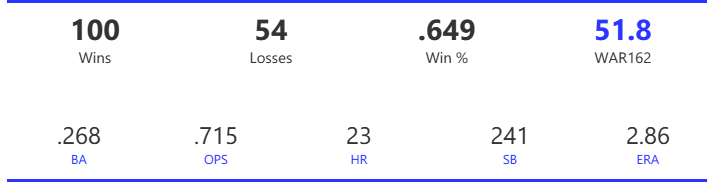
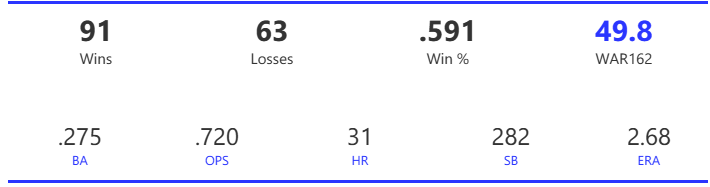
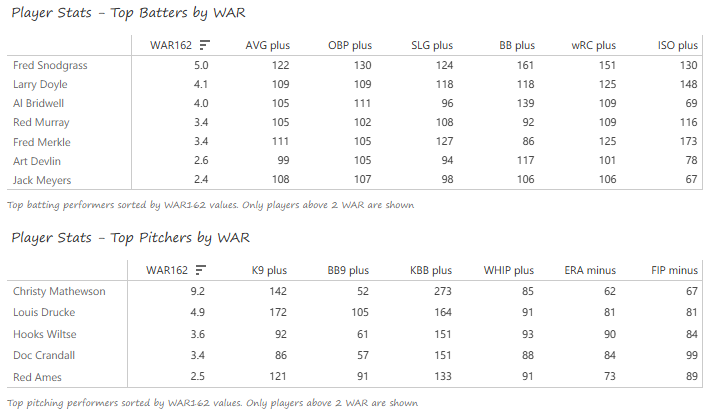
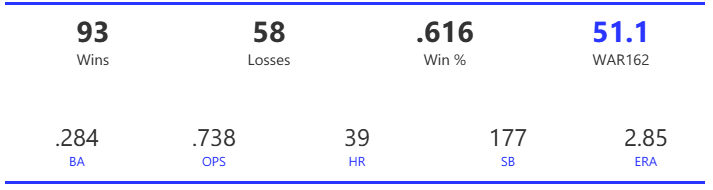
#5: 1915 Chicago White Sox, 54.8 WAR162
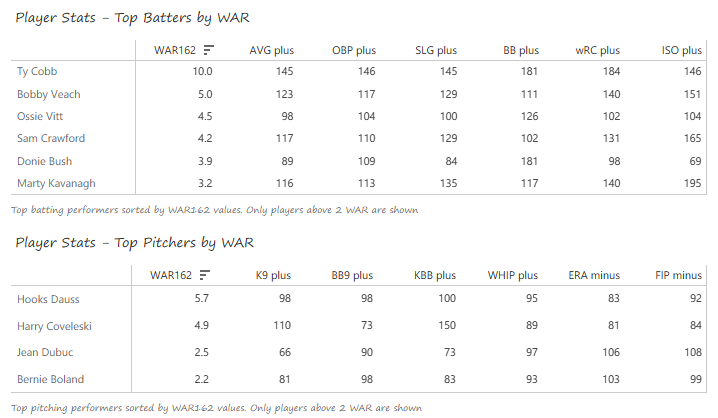
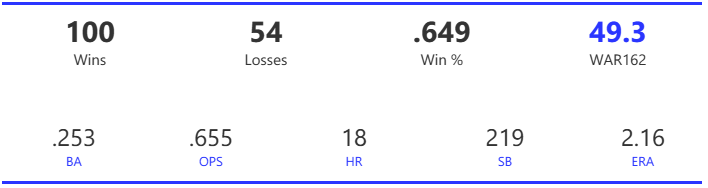
The 1915 White Sox rank ahead of two teams that finished above them during the season – the Tigers and Red Sox. Not only were the Tigers and Red Sox lucky relative to their projected wins, but the White Sox were very unlucky at seven wins below their projected 100-54 record.
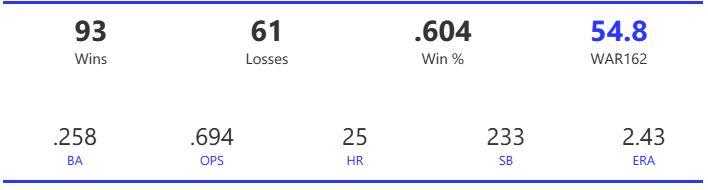
The White Sox had the top run differential in the AL in 1915, the result of a very good offense paired with excellent pitching. Offensively, they ranked 2nd in multiple categories, including OBP, OPS, stolen bases, and doubles, and ranked first in triples. On the pitching side, their staff ranked first in both WHIP and strikeout-to-walk rate, and third in ERA.
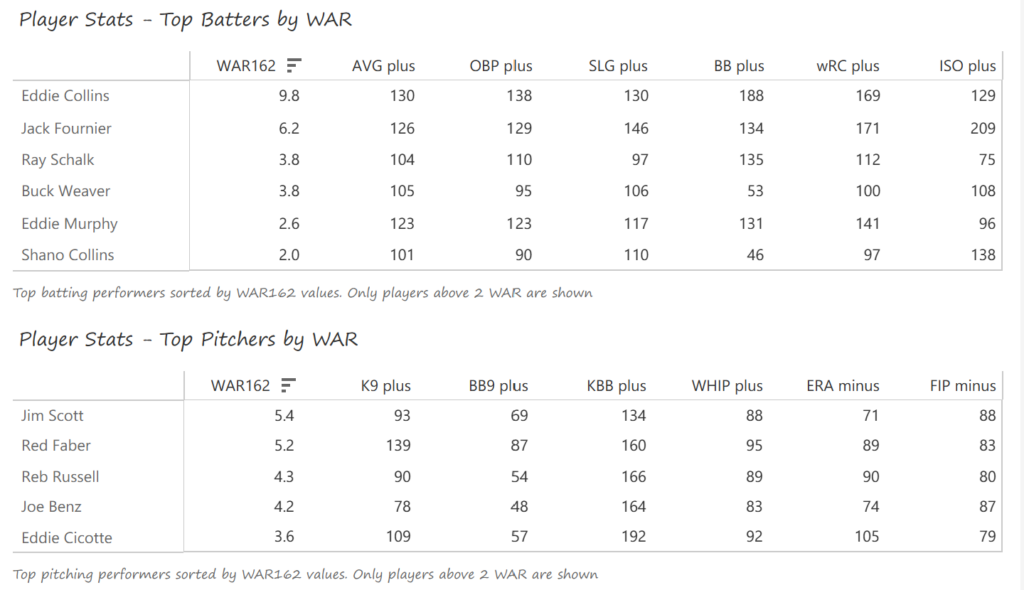
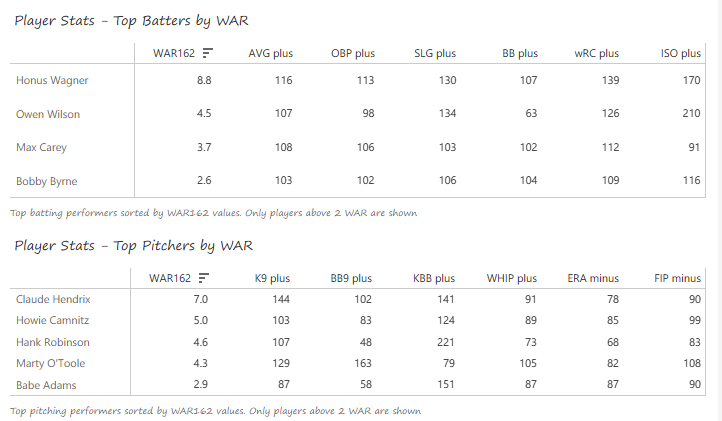
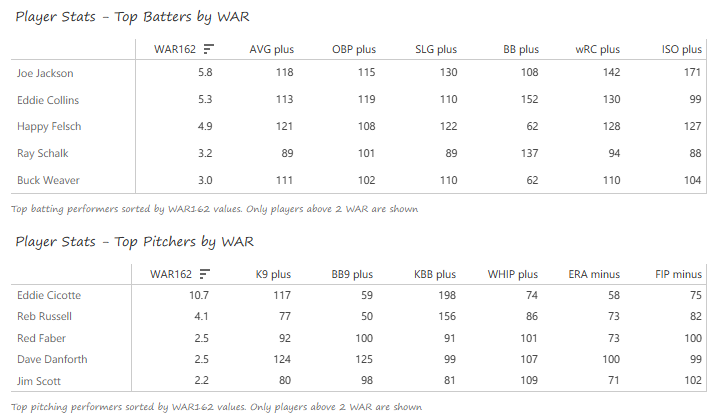
Standout second baseman Eddie Collins posted one of his best seasons after coming over from the Athletics, batting .332 with 119 walks, 118 runs scored, a .460 OBP, and .896 OPS. Jack Fournier batted .322 and led the AL with a .491 slugging percentage, fueled by his 18 triples. Ray Schalk (.366 OBP) and Buck Weaver (11 triples, 83 runs scored) provided additional support. Jim Scott and Red Faber were the cornerstones of a strong pitching staff. Scott led the AL with 7 shutouts and compiled a 24-7 record and 2.03 ERA; Faber also won 24, and the trio of Reb Russell, Joe Benz, and Eddie Cicotte combined for 39 more wins. All five of these pitchers logged between 223 and 300 innings, pitching as both starters and in relief.
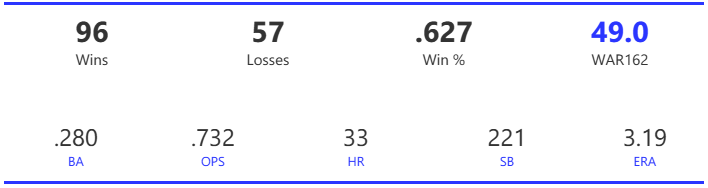
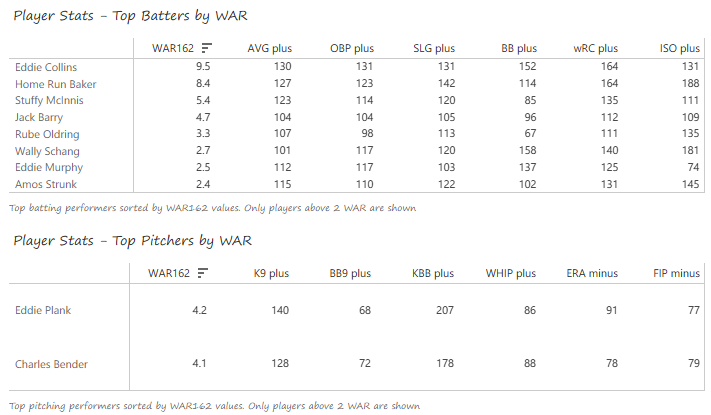
#4: 1911 Philadelphia Athletics, 55.0 WAR162
The 1911 version of the Athletics dominated the American League, rolling to the pennant, 13.5 games ahead of the runner-up Tigers. Their run differential was massive – they averaged 1.7 runs per game, scoring at the highest rate while holding opponents to the fewest runs.
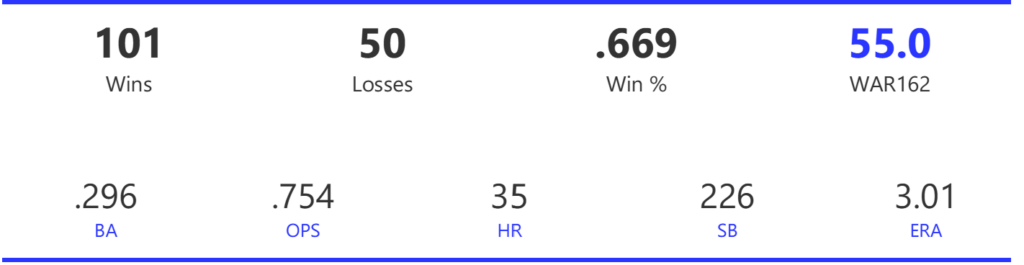
The A’s led the AL in BA, OBP, and OPS ahead of the Ty Cobb-led Tigers. They were also near the top in doubles, triples, home runs, and stolen bases. The pitching numbers were also very good, although not tops in the league. The A’s ranked in the top three in most categories, including hits per 9 innings, ERA, and shutouts.
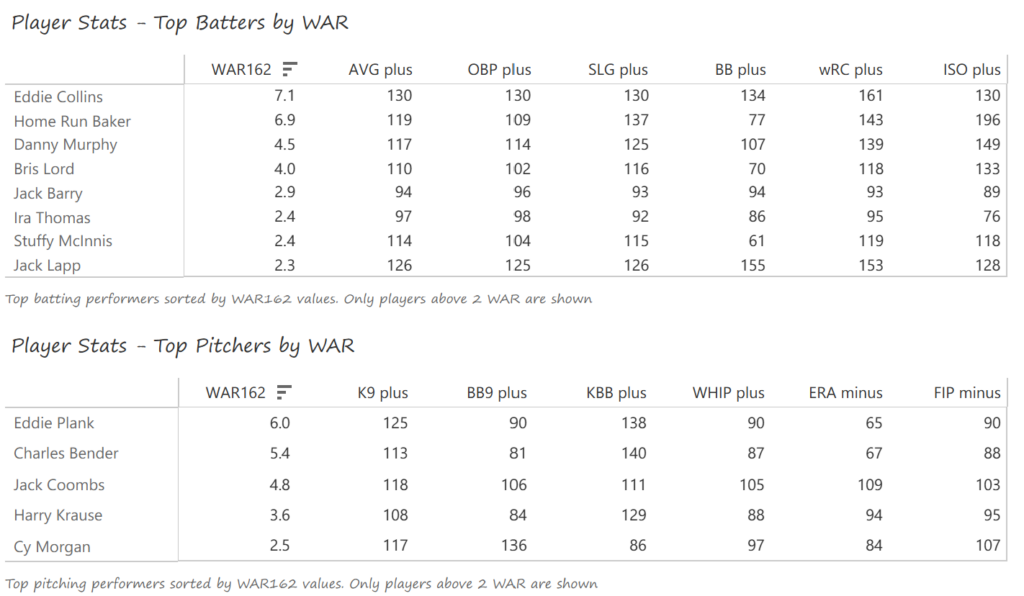
The A’s leveraged their usual 1-2 punch offensively, with Eddie Collins (.365 BA, 38 steals, .932 OPS) and Home Run Baker (115 RBI, NL-best 11 homers, .334 BA) leading the team in WAR162. Danny Murphy was solid, with a .329 BA, and Bris Lord batted .310. On the mound, it was Eddie Plank and Charles Bender combining for 40 wins, with 2.10 and 2.16 ERAs, respectively. Jack Coombs was the workhorse, pitching 336 innings on his way to a 28-12 mark, despite a rather high 3.53 ERA.
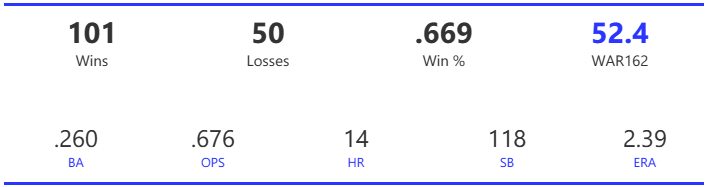
#3: 1912 Boston Red Sox, 56.6 WAR162
The 1912 Red Sox broke the stranglehold the Tigers and Athletics had on the top spot in the AL. They breezed to 105 wins and a 14-game margin over the Nationals, but would relinquish the top spot to the Athletics in 1913.
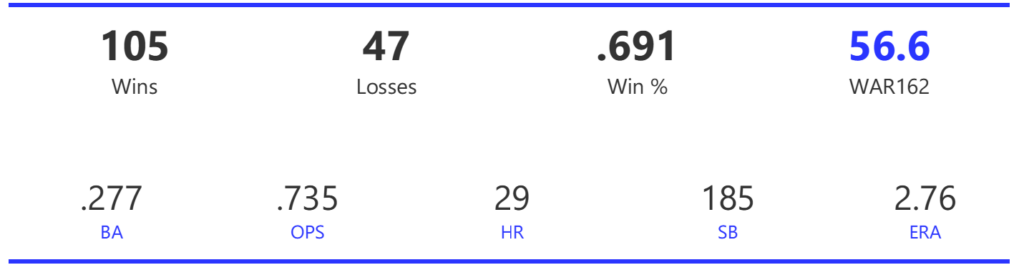
The Sox led the league in runs, doubles, OBP, and OPS, and ranked near the top in every category except stolen bases. The pitching staff led the league in complete games, shutouts, WHIP, and strikeout-to-walk rate. They ranked second in ERA behind the Nationals. It was easy to see why they toyed with their rivals over the course of the 1912 season.
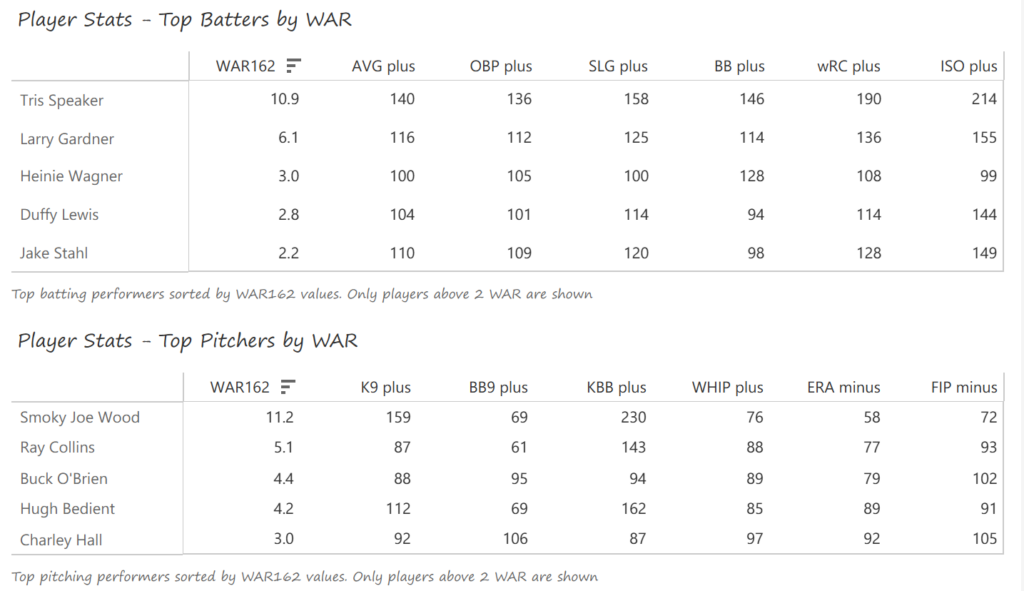
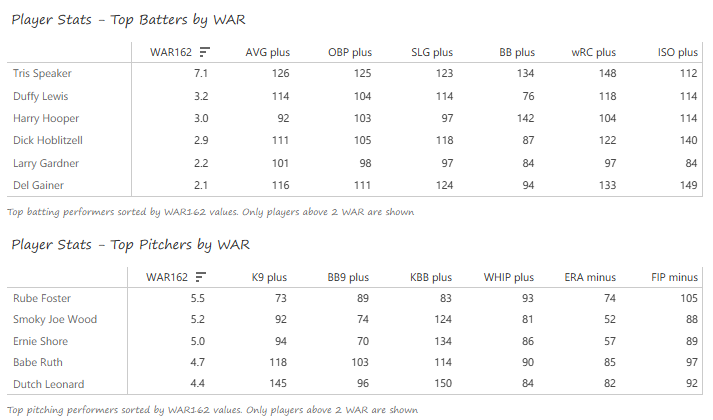
The 1912 Red Sox had two players achieve WAR162 values greater than 10, one as a position player (Tris Speaker) and the other on the mound (Smoky Joe Wood). Speaker had a fabulous season, batting .383 with a 1.031 OPS, leading the AL with 53 doubles, 10 homers, and a .464 OBP while excelling defensively in center field. Larry Gardner was the primary support behind Speaker, batting .315 with 86 RBI and 18 triples. Smoky Joe Wood had a career season, pitching his way to a 34-5 record with a 1.91 ERA, 10 shutouts, 258 strikeouts, and 35 complete games. While Wood was the main act, he received strong support from Ray Collins (13-8, 2.53 ERA), Buck O’Brien (20-13), and Hugh Bedient (20-9 as a starter and reliever).
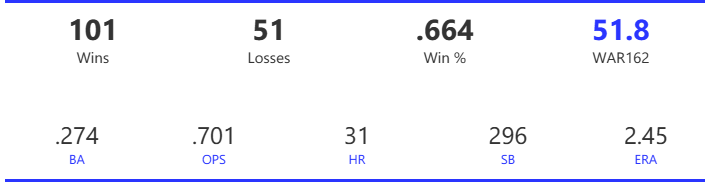
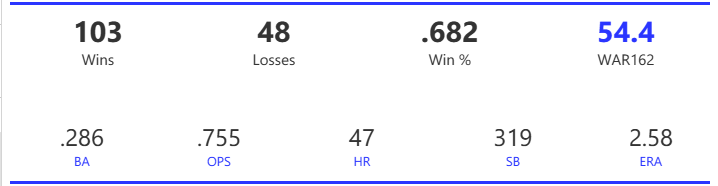
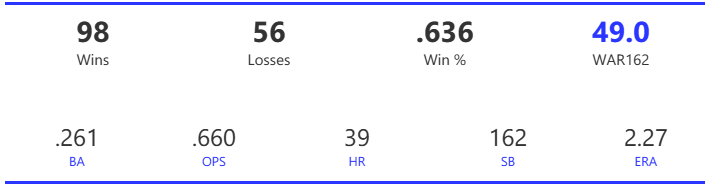
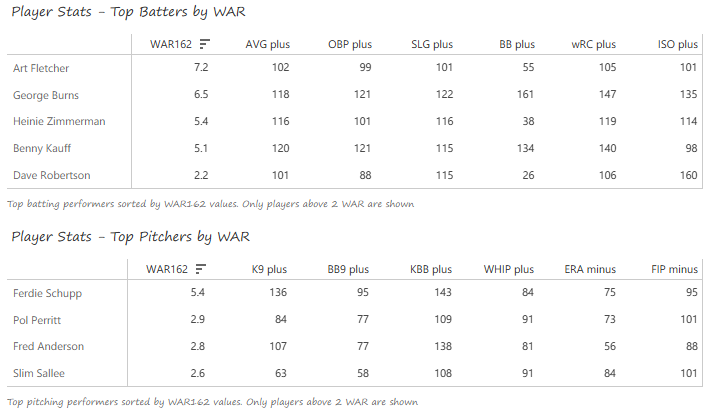
#2: 1911 New York Giants, 57.4 WAR
The 1911 Giants were one of several pennant-winning squads in the decade, 1911-1913 and 1917, as the New Yorkers made a claim as the dominant NL club for the period. Based on the WAR162 metrics, the 1911 edition was their finest team of the decade, leading the NL in both scoring (runs per game) and run prevention.
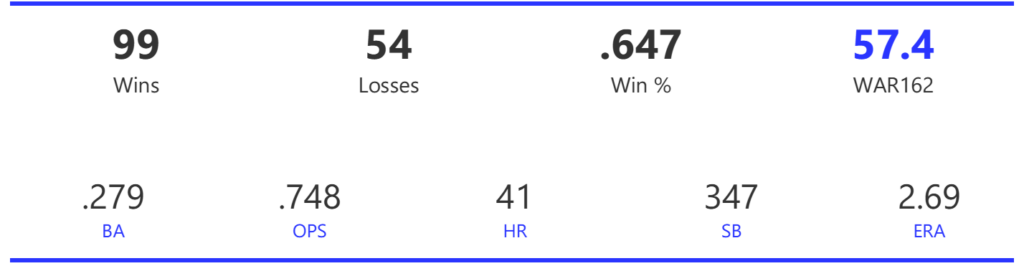
The Giants’ power numbers don’t impress too much – second in doubles, third in triples, fourth in homers. However, they could hit for average (NL-best .279) and run – their 347 steals were 57 ahead of the Reds, and more than double the thefts of a few teams. The pitching staff was a strength, with an NL-best 2.69 ERA and 95 complete games. They also ranked second in shutouts and WHIP, and led the NL in strikeout and strikeout-to-walk rates.
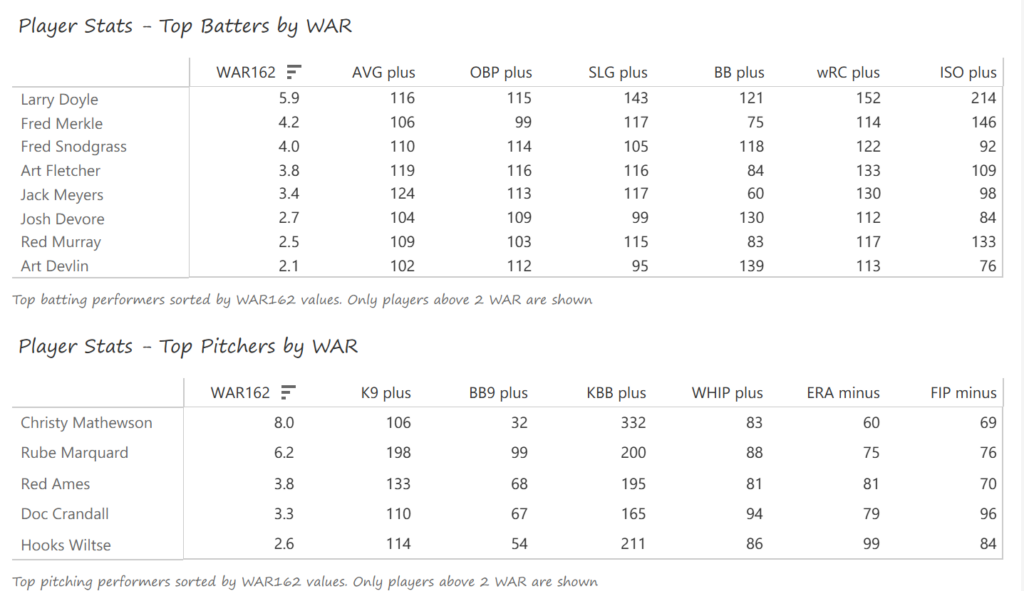
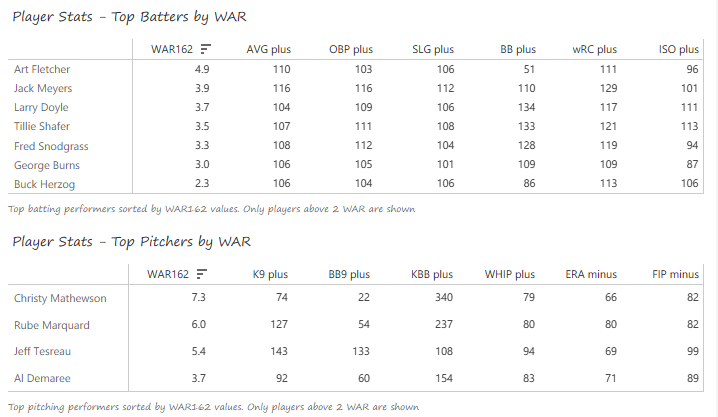
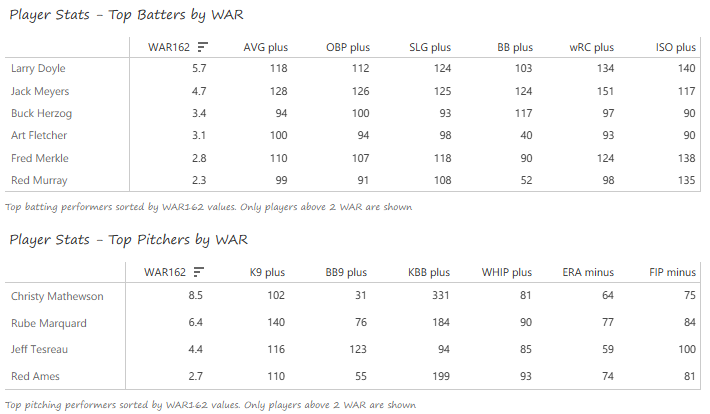
As usual for this era of Giants teams, there were no marquee positional stars at the level of a Ty Cobb, Eddie Collins, or Tris Speaker. What they lacked in star power, they made up for with a roster of above-average contributors at nearly every position. Larry Doyle was the best of this group in 1911, rapping an NL-best 25 triples to go with 13 homers, 38 steals, a .310 BA, and .924 OPS. Fred Merkle slugged 12 homers with a .283 BA and 49 steals, Fred Snodgrass batted .294 with 51 stolen bases, and Art Fletcher batted .319 in a part-time role at shortstop. Pitching was a strength, with the dynamic tandem of Christy Mathewson (26-13, NL-best 1.99 ERA) and Rube Marquard (24-7, league-leading 237 strikeouts) dominating opponents. Red Ames and Doc Crandall combined for 26 wins, with Crandall finishing a league-high 26 games in a closer role.
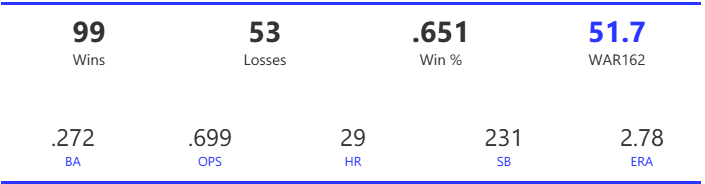
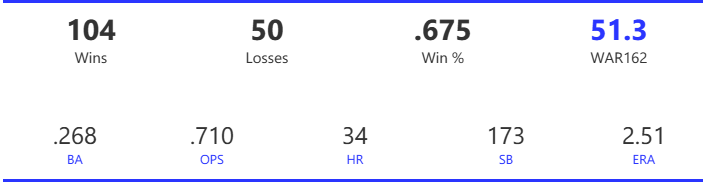
#1: 1910 Philadelphia Athletics, 62.3 WAR
The 1910 Athletics were a dominant squad that ran away with the AL, finishing 14.5 games ahead of the second-place Highlanders. This team would be the first in a 5-year span where the Athletics would claim four pennants before Connie Mack would break up the team. They would not return to a similar level of success until the late 1920s.
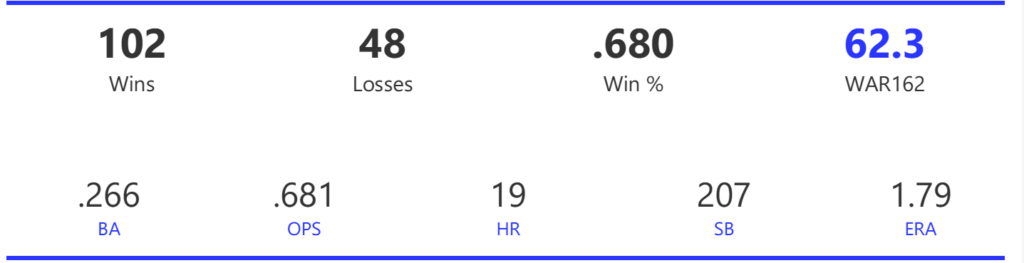
The Athletics were challenged by the 3rd-place Tigers in many offensive categories, with the Tigers ranking first in runs scored. However, the A’s were very consistent – 2nd in runs, 1st in doubles and triples, first in BA, 2nd in OBP, and first in OPS. The difference maker for the A’s was their exceptional pitching, which led the AL in ERA (1.79), shutouts (24), and complete games (123). They ranked near the top in several other categories, competing against a very good White Sox staff.
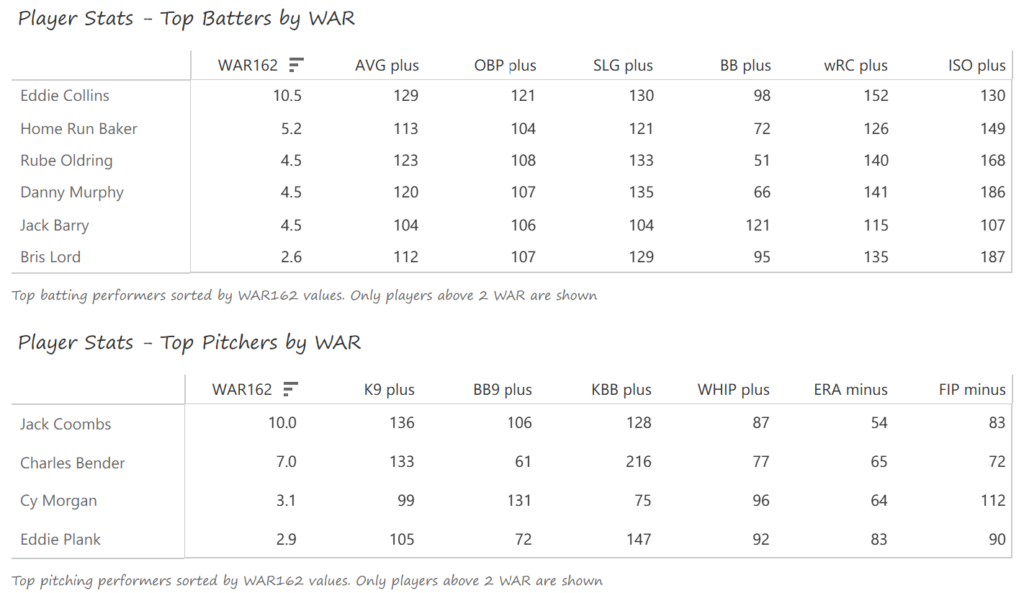
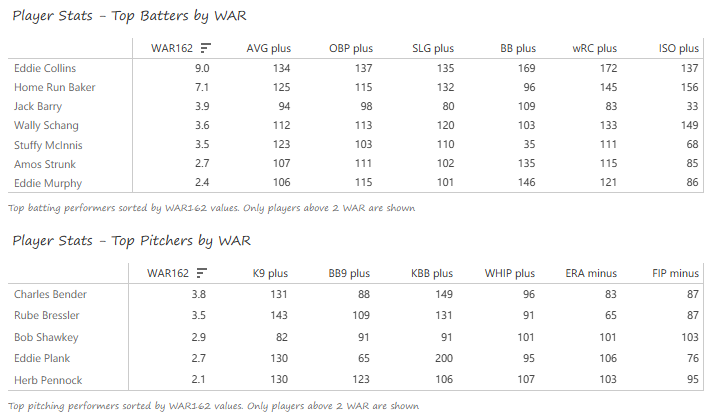
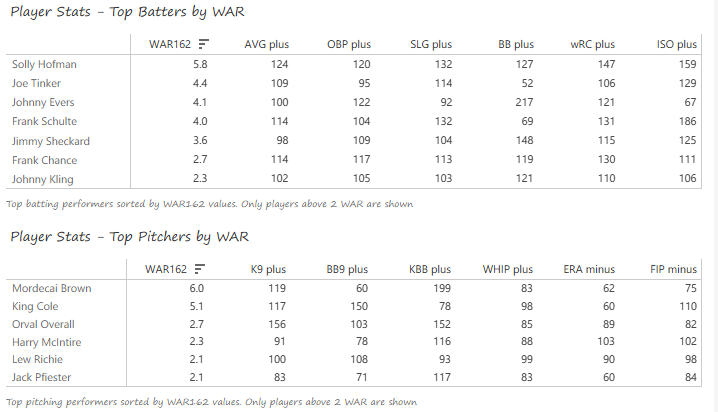
Eddie Collins had a sensational 1910 season, batting .324 with 81 steals (AL-best), 81 runs, and 81 RBI while playing very strong defense at second base. Home Run Baker batted .283 with 15 triples, Rube Oldring hit .308 with 79 runs scored, and Danny Murphy batted an even .300. Jack Barry contributed from his shortstop position with a .259 BA and 60 RBI. On the mound, Jack Coombs had a career year with a 31-9 record and a 1.30 ERA. Charles Bender was his typically consistent self, pitching his way to a 23-5 record with a 1.58 ERA, and Cy Morgan went 18-12 with a 1.55 ERA. The veteran Eddie Plank chipped in with 16 wins as a third option on the hill.
Summary
That’s it for this entry in our MLB Team Rankings for the 1910s decade! Here’s a quick summary of which franchises dominated the decade:
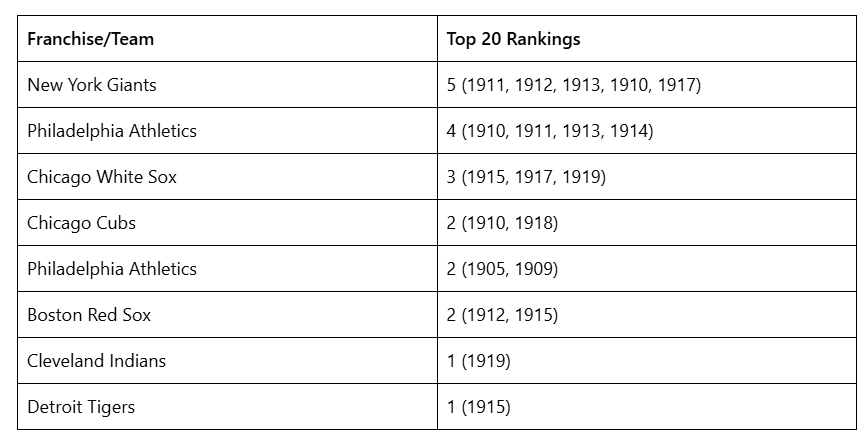
We’ll start visiting the 1920s next week. As always, thanks for reading!