Welcome to the first countdown post in our series of MLB team rankings by decade. As a reminder, the teams are ranked from #20 through #1 based on aggregate WAR162. For the 1910s (1910-1919), a total of 160 teams were eligible (16 teams x 10 seasons), so the top 20 teams are a fairly exclusive group. We’ll summarize each team, including portions of their team dashboard, and explain how they attained their ranking. So, without further ado, here are the teams ranked #20 through #16.
Here’s the interactive dashboard at Tableau Public: 1910s Top 20 MLB Teams Dashboard
#20: 1919 Cleveland Indians, 48.1 WAR162
The Indians finished the 1919 season in second place in the AL, 3.5 games behind the White Sox (the infamous Black Sox team). Each team outperformed its Pythagorean projections by 4 games, so there was no unlucky aspect to this Indians team; the White Sox were simply better.
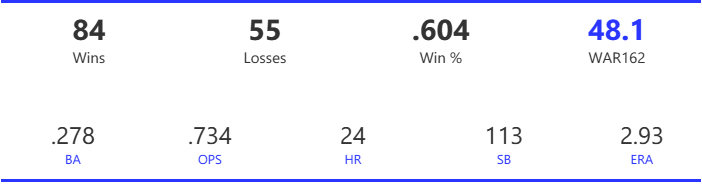
The Indians’ 634 runs trailed only the White Sox, while their .278 BA ranked third in the AL. The team led the AL in doubles, OBP, and OPS, while placing closer to league average in home runs, triples, and steals. The team ERA ranked second, trailing only the Yankees, but they placed third or lower in most other pitching categories.
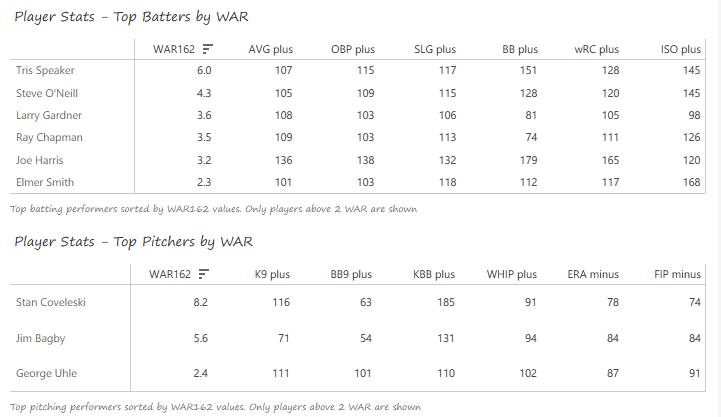
Tris Speaker topped a solid offensive core with his 6.0 WAR value, featuring a .395 OBP, .828 OPS, and 38 doubles. Steve O’Neill provided strong numbers from his catcher spot, batting .289 with 35 doubles, and Larry Gardner batted an even .300. Ray Chapman also hit .300, while Joe Harris was an effective backup, hitting .375 with a .962 OPS in his 228 plate appearances. Stan Coveleski was the mound star, posting a 24-12 mark across 286 innings, followed by Jim Bagby, wh won 17 games from the second spot in the rotation.
#19: 1918 Chicago Cubs, 48.7 WAR162
The 1918 Cubs won the NL by 10.5 games over the Giants, and their run differential was more than double that of any other club. Their win projection was 83 games, so they weren’t especially lucky, just far better than their rivals.
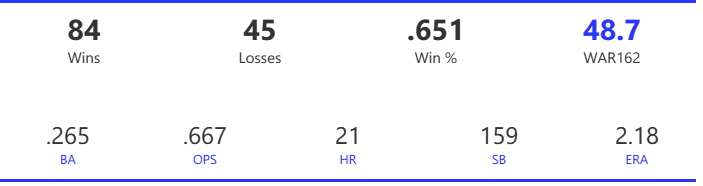
Offensively, the Cubs .265 BA was a distant second to the Reds, as were OPS and OBP. Similarly, their 159 steals trailed the Pirates; in short, the Cubs were good, but not great, with the bats. Pitching was a different story. Their 2.18 ERA was far ahead of the second-ranked Pirates, and their strikeout-to-walk ratio and walks per 9 innings topped the NL. The team also ranked second in WHIP for the 1918 season.
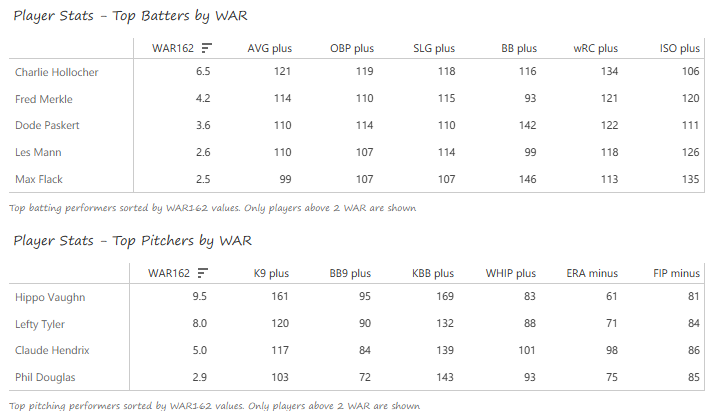
Charlie Hollocher led a productive yet little-known group of position players, batting .316 with an NL-best 161 hits. Fred Merkle batted .297, and 36-year-old Dode Paskert hit .286 to lead the offense. On the mound, Hippo Vaughn topped the NL in wins (22), ERA (1.74), shutouts (8), strikeouts (148), and WHIP (1.006). Lefty Tyler was a strong second starter, winning 19 with a 2.00 ERA, and Claude Hendrix went 20-7 as the third man in the rotation.
#18: 1917 New York Giants, 49.0 WAR162
The 1917 Giants were the runaway NL champs, finishing 10 games out front of the Phillies. This would be their last pennant-winning team of the decade, as the Cubs and Reds rose to the top in 1918-1919. The 1917 team was also the fifth Giants team to place in the top 20 for the decade, a very impressive feat.
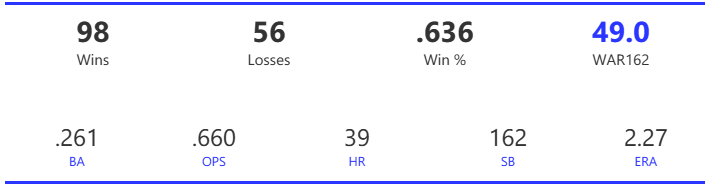
The Giants topped the NL with 635 runs, 39 homers, a .317 OBP, and 162 steals. They placed second in BA and OPS to the Reds. Their pitching staff recorded a 2.27 ERA, 7.7 hits per 9 innings, and 1.085 WHIP to top the league. This was a team with great offensive and defensive balance, despite the lack of prominent star players.
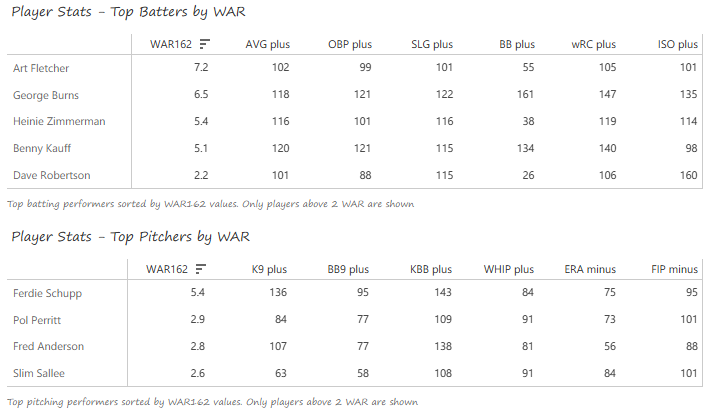
Art Fletcher and George Burns provided the positional spark for the Giants – Fletcher with a .260 BA and strong defense at shortstop, and Burns with 103 runs, 75 walks (both NL-best) and a .302 BA. Heinie Zimmerman led the league with 100 RBI and batted .297, and Benny Kauff batted .308. Ferdie Schupp was the ace, posting a 21-7 mark with a 1.95 ERA and an NL-best 6.7 hits per 9 innings. Pol Perritt went 17-7 with a 1.88 ERA, and Fred Anderson sported a league-best 1.44 ERA. Slim Sallee won 18 games, walking just 34 batters in 215 innings.
#17: 1913 Philadelphia Athletics, 49.0 WAR162
The A’s won 96 games to claim the AL pennant by 6.5 games over the Nationals. Most of their work was done on offense, as we’ll see in a moment.
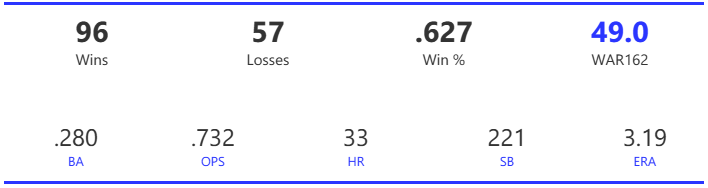
The A’s led the league by an astounding 162 runs – more than 1 run per game. Unsurprisingly, they also led the AL in BA, OBP, and OPS, home runs, and doubles, while placing second in stolen bases. This team was a bit of an offensive juggernaut for the 1913 season. Pitching was a different story – 6th in ERA, 8th in complete games, third in WHIP and hits per 9 innings, and 8th in walks per 9 innings. This was a team that simply outscored the opponent on a regular basis.
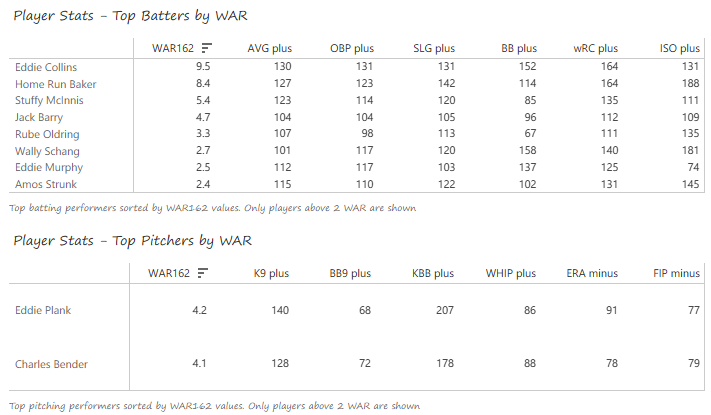
Eddie Collins and Home Run Baker were the biggest offensive stars for the A’s. Collins batted .345 with an .894 OPS, stole 55 bases, and led the NL with 125 runs scored. Baker led the NL with 12 home runs and 117 RBI while batting .337. Stuffy McInnis (.324 BA, 90 RBI) and Jack Barry (.275 BA, 85 RBI) were also strong contributors to this dynamic offense. Eddie Plank and Charles Bender were the staff standouts, albeit with modest seasons by their standards. Plank authored an 18-10 mark with a 2.60 ERA, while Bender led the NL with 13 saves (saves were rare in this era) and a 21-10 record.
#16: 1917 Chicago White Sox, 49.3 WAR
The White Sox ran away with the 1917 AL pennant, finishing 9 games ahead of the Red Sox. This team was largely comprised of the same players who would go down in infamy two seasons later as the Black Sox, after being accused of fixing the 1919 World Series.
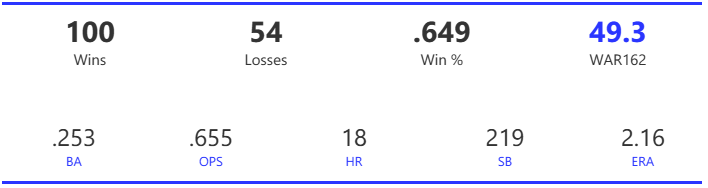
The 1917 version of the White Sox led the AL in runs scored, with only the Tigers close behind. The Chicagoans also led the AL in triples, stolen bases, and OBP in a scrappy sort of offensive attack. Pitching was the real strength of the club, with AL-best marks in ERA (2.16), shutouts (22), and walks per 9 innings (2.6). The pitching staff also performed well on WHIP (2nd) and strikeout-to-walk ratio (2nd).
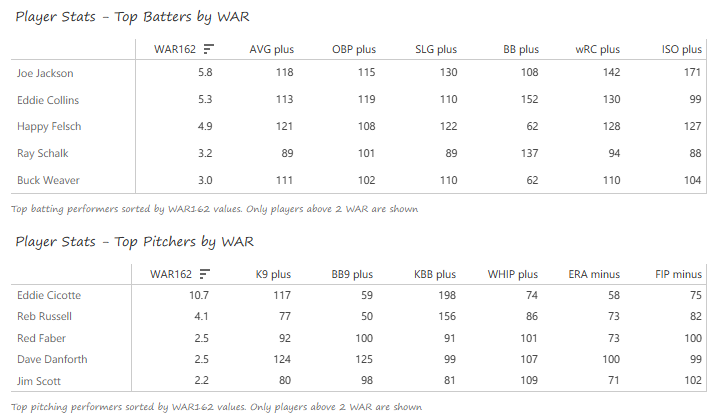
Three position players stood out for the 1917 White Sox – Joe Jackson, Eddie Collins, and Happy Felsch. Jackson had one of his lesser seasons, but still batted .301 with 82 RBI and an .805 OPS, while Collins posted a .389 OBP with 53 stolen bases. Felsch paired a .308 BA with 99 RBI and 26 steals. The pitching was led by veteran Eddie Cicotte, who had a career year with a 28-12 record, 1.53 ERA, and 0.912 WHIP, leading the NL in each category. Reb Russell won 15 games with a 1.95 ERA, while Red Faber (16 wins) and Dave Danforth (9 saves) also contributed.
Summary
That’s it for the first entry in our MLB Team Rankings for the 1910s decade! Stay tuned for the countdown from #15 to #11, arriving in a few days. As always, thanks for reading!