Welcome to the third countdown post in our series of MLB team rankings for the 1970s. Expansion continued in the 1970s, with four new teams added for the 1977 season, adding to the four that started play in the 1969 season. As a reminder, the teams are ranked from #20 through #1 based on aggregate WAR162. For the 1970s (1970-1979), a total of 252 team-seasons were eligible, so the top 20 teams are a rather exclusive group – the top 8% for the decade. We’ll summarize each team, including portions of their team dashboard, and explain how they attained their ranking. So, without further ado, here are the teams ranked #5 through #1.
Here’s the interactive dashboard at Tableau Public: 1970s Top 20 MLB Teams Dashboard
#5: 1975 Cincinnati Reds, 57.4 WAR162
The Reds and Orioles own the top five spots in our 1970s rankings. The list starts with the 1975 Reds, who posted a gaudy 108 wins before sweeping the Pirates in the NLCS. They then defeated the Red Sox in a classic seven-game World Series.
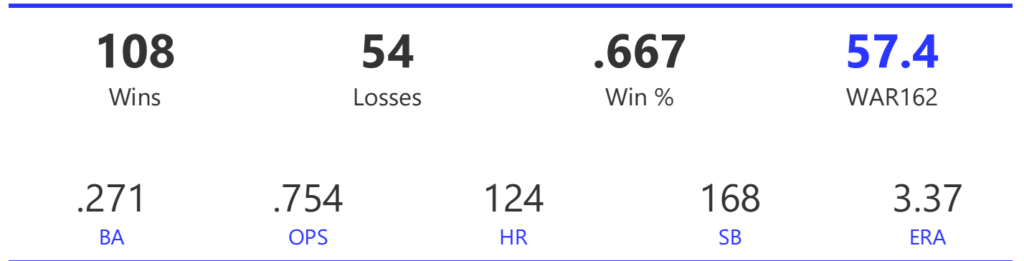
The Reds had an impressive offense in 1975, scoring 840 runs, 105 more than their closest rival. Their 124 homers ranked third, and their 168 stolen bases topped the NL. The team ranked second in BA and first in OBP and OPS. The Reds’ pitching staff was less notable, but still quite effective, ranking third in ERA, fourth in WHIP, and second in walks issued.
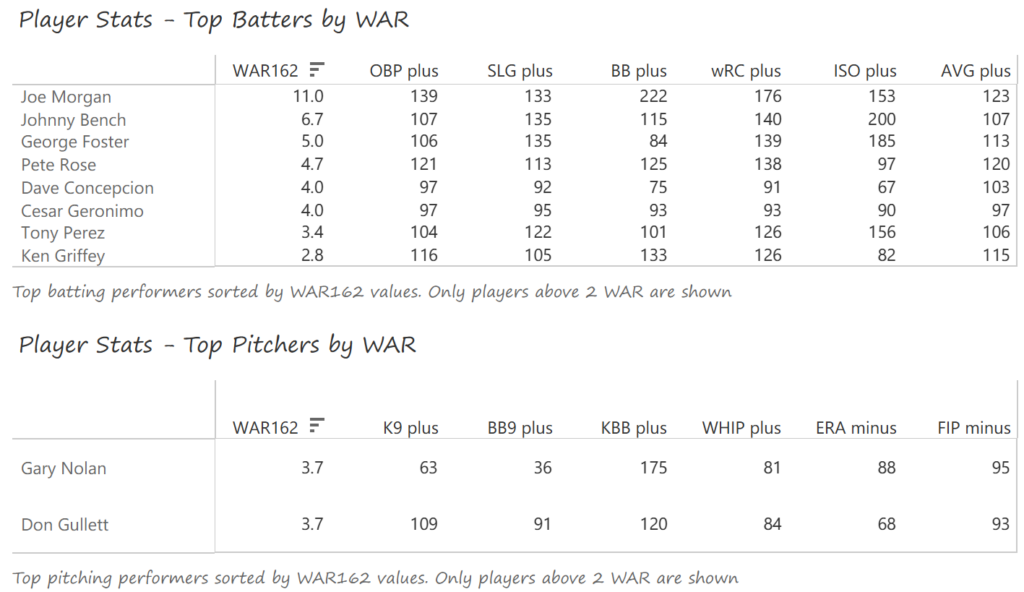
Joe Morgan had a sensational season en route to NL MVP honors. Morgan batted .327, and led the NL with 132 walks, a .466 OBP, and a .974 OPS. He also stole 67 bases, scored 107 runs, and earned a Gold Glove at second base. Johnny Bench assembled a big season as well, swatting 28 homers with 110 RBI and a Gold Glove. George Foster added 23 homers and a .300 BA, while Pete Rose batted .317 with NL-bests in doubles (47) and runs (112). Dave Concepcion (.274 BA, 33 steals, Gold Glove) and Cesar Geronimo (Gold Glove) were also major contributors for the Big Red Machine. Gary Nolan and Don Gullett (2.42 ERA) each won 15 games for a balanced Reds pitching staff.
#4: 1976 Cincinnati Reds, 58.5 WAR162
The Reds were back in 1976, once again claiming the NL West title and the NL pennant, before sweeping the Yankees in the World Series.
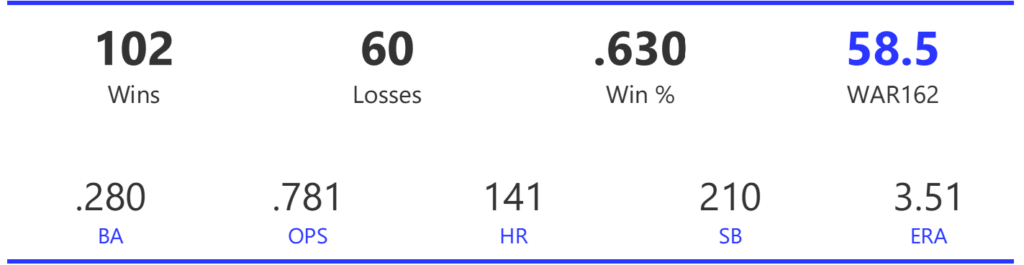
The Reds’ offense was again fearsome, scoring an NL-best 857 runs, 87 more than the Phillies. Their 271 doubles, 63 triples, and 141 homers all topped the NL; they also swept the BA, OBP, SLG, and OPS rankings. Once again, their pitching lacked big-name stars, but was up to the task. The Reds’ staff ranked fifth (out of 12) in both ERA and WHIP.
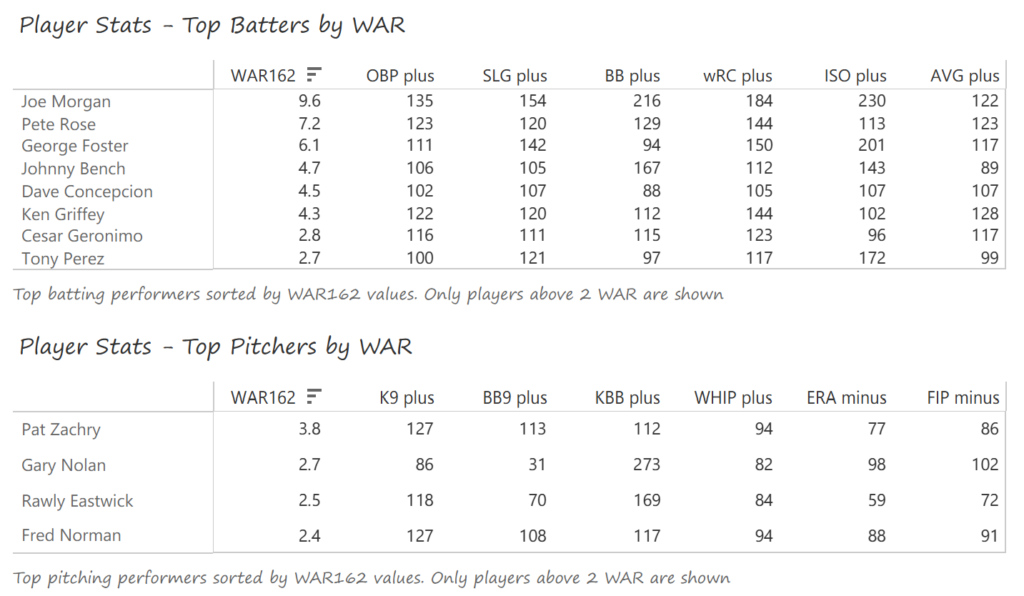
Joe Morgan repeated as the NL MVP, batting .320 and leading the league in OBP, SLG, and OPS. He also stole 60 bases, scored 113 runs, and had 11 RBI, plus another Gold Glove Award. Pete Rose had a fine age-35 season, batting .323 and leading the NL in runs, hits, and doubles. George Foster belted 29 homers, had a .306 BA, and topped the NL with 121 RBI. Johnny Bench’s offensive output dipped from prior seasons, but he still managed 74 RBI, a .348 OBP, and another Gold Glove Award. Dave Concepcion (.281 BA, Gold Glove) and Ken Griffey (.336 BA, 34 steals) added offensive and defensive efficiency to the team. Pat Zachry posted a 14-7 record with a 2.74 ERA to capture NL Rookie of the Year honors, while the rest of the pitching staff was solid rather than spectacular.
#3: 1971 Baltimore Orioles, 59.3 WAR162
The 1971 Orioles cruised to the AL East title, leaving the Tigers 12 games behind. They then swept the Athletics in the ALCS before falling to the Pirates in a seven-game World Series.
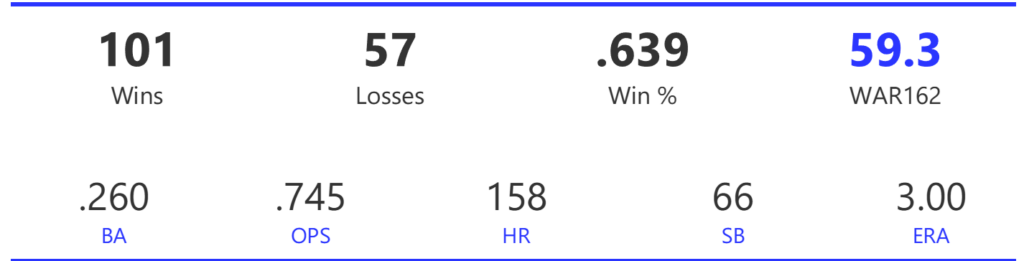
The Orioles topped the AL in BA, OBP, and OPS while scoring a league-leading 742 runs (despite playing four fewer games). They ranked fourth in homers, but only the Tigers hit more per game. Pitching was an Orioles strength in the 1969-73 era, and 1971 was no exception. The Birds led the AL in ERA and placed second in WHIP.
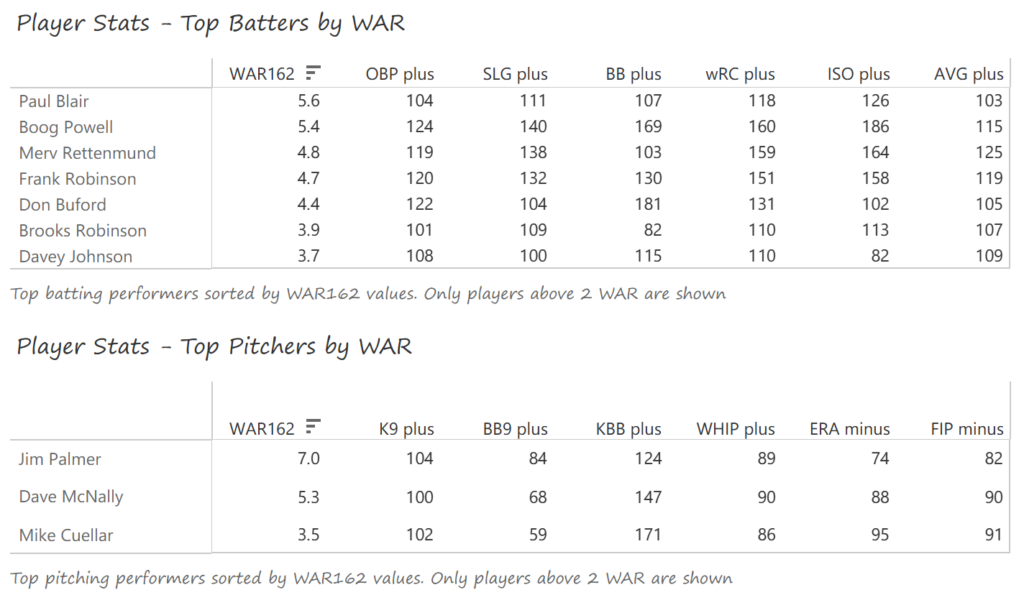
Paul Blair and Boog Powell led the Orioles in positional WAR162 in 1971, albeit via very different means. Blair batted .262 while playing exceptional Gold Glove defense, and Powell belted 22 homers with 92 RBI and drew 82 walks. Merve Rettenmund batted .318 with 15 steals as a fourth outfielder, while veteran star Frank Robinson had 28 homers and 99 RBI in his age-35 season. Don Buford (.413 OBP, AL-best 99 runs), Brooks Robinson (20 homers, 92 RBI, Gold Glove), and Davey Johnson (.282 BA, Gold Glove) all provided significant offensive and defensive support for the Orioles. On the mound, the Orioles had four 20-game winners, led by Jim Palmer (20-9, 2.68 ERA) and Dave McNally (21-5, 2.89 ERA). Veteran lefty Mike Cuellar posted a 20-9 mark, and Pat Dobson also won 20 games.
#2: 1970 Baltimore Orioles, 59.4 WAR162
The 1970 Orioles easily won the AL East, finishing 15 games ahead of the Yankees. They then dominated the postseason, sweeping the Twins and the ALCS and beating the Reds in a five-game World Series.
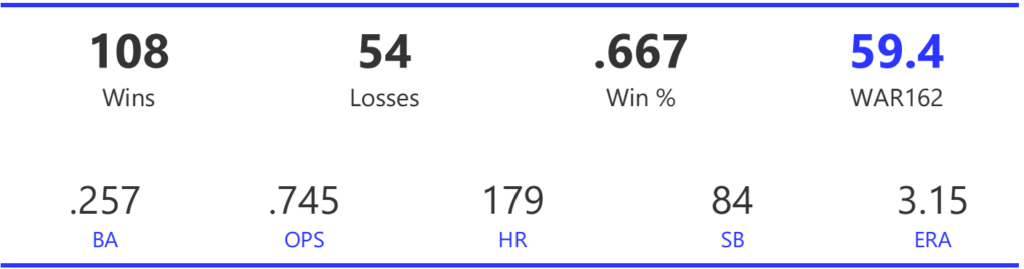
The Orioles featured a potent offense that ranked first in the AL in runs, third in BA, first in OBP, and second in OPS. Their pitching staff led the AL in ERA, WHIP, and strikeout-to-walk rate. This team could win either with offense or by shutting down the opposition.
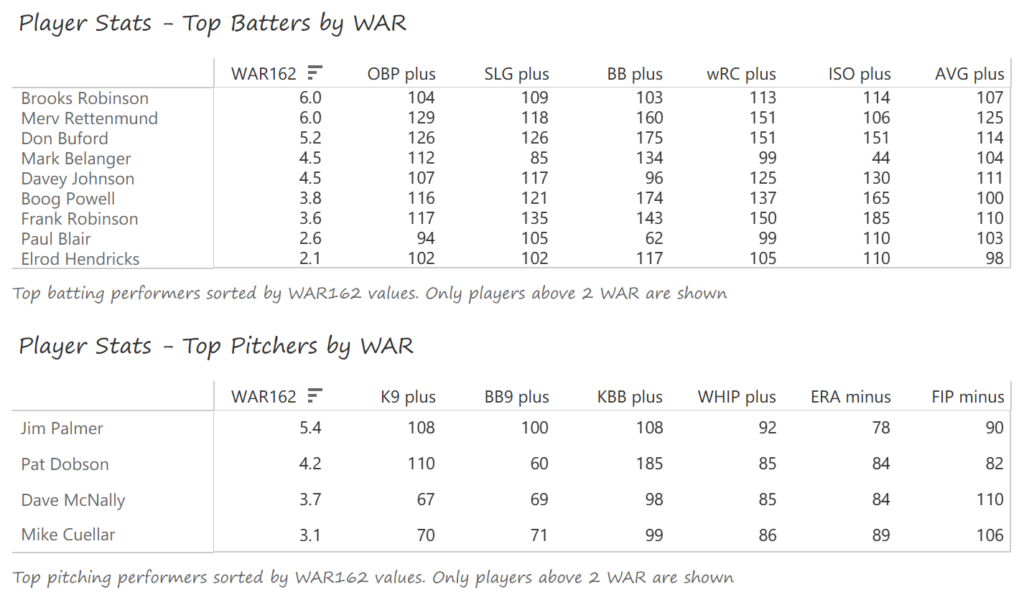
Brooks Robinson (18 homers, 94 RBI, Gold Glove Award) and Merv Rettenmund (.322 BA, 18 home runs in just 385 plate appearances) led the way for the Orioles. Don Buford had another fine season with a .406 OBP and 99 runs scored, and Mark Belanger played his usual exceptional defense at shortstop. Davey Johnson batted .281 and earned a Gold Glove Award at second base, and Boog Powell slugged 35 homers with 114 RBI to claim AL MVP honors. Jim Palmer went 20-10 with 5 shutouts to lead the mound corps, backed by Pat Dobson (
#1: 1973 Baltimore Orioles, 60.32 WAR
The 1974 Dodgers defeated the Reds by 4 games in a competitive NL West race before defeating the Pirates to claim the NL pennant. The World Series was a different story, with the Athletics defeating the Dodgers in five games.
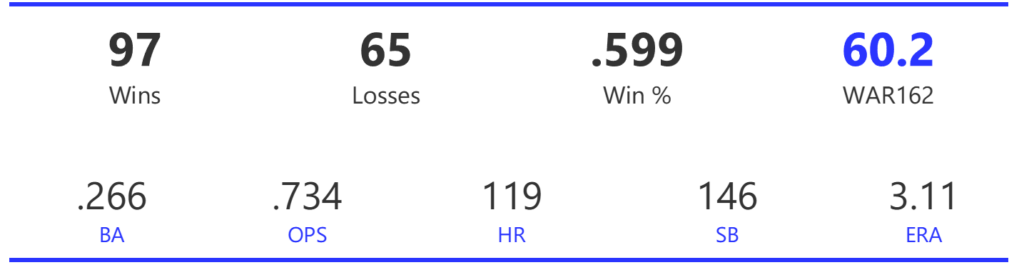
The Dodgers had a potent offense that led the NL in runs, home runs, and OPS, while ranking second in BA and OBP. Pitching was also a relative strength, with 2nd-place rankings in WHIP, strikeout-to-walk rate, and strikeouts. The team also featured a strong pitching staff that led the NL in ERA, WHIP, walks, strikeouts, and strikeout-to-walk rate.
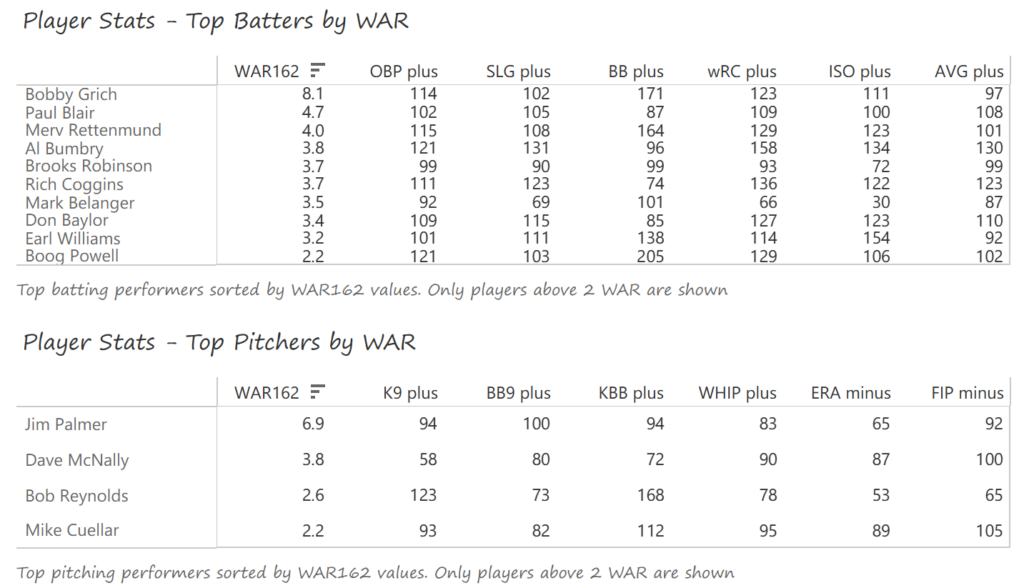
Veteran Jim Wynn had a terrific season, batting .271 with a .387 OBP (108 walks), 32 homers, 108 RBI, and 104 runs scored. Ron Cey (18 homers, 97 RBI), Steve Garvey (.312 BA, 21 homers, 11 RBI, NL MVP), and Davey Lopes (59 steals, 95 runs) led a deep supporting cast. Andy Messersmith posted a 20-6 mark with a 2.59 ERA to lead the Dodgers pitchers. Mike Marshall won the Cy Young Award with 15 wins, 21 saves, and a 2.42 ERA in an incredible 106 games. Don Sutton went 19-9 with five shutouts as an effective second starter in the rotation.
That’s it for the final entry in our MLB Team Rankings for the 1970s decade!