Our next entry in the MLB Radial Axis Series features the Cubs, one of the National League teams dating back to 1901. In total, we’re talking about 125 seasons from 1901 through 2025. We’re going to walk through some highlights from the network, and then provide the link so you can explore it in detail. For some background on how the network graphs work, select this link – Anatomy of MLB radial axis graphs.
The Cubs Network
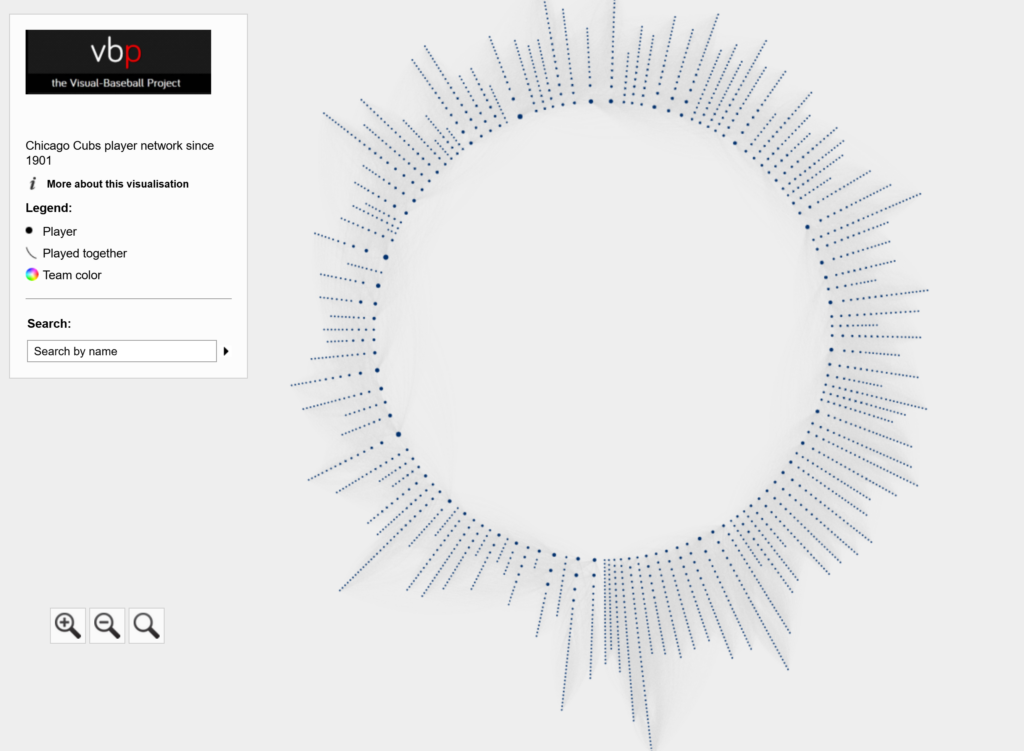
The Cubs’ radial axis network reflects the connections among all players who spent time with the franchise from 1901 to 2025. The 1901 season is found at the bottom center of the graph. Subsequent seasons are arranged clockwise, eventually returning to the bottom center with the 2025 season. Player nodes are sized by the number of seasons spent with the team, and the gray lines between nodes reflect connections to other players. The interactive version of the network is here – Cubs Network.
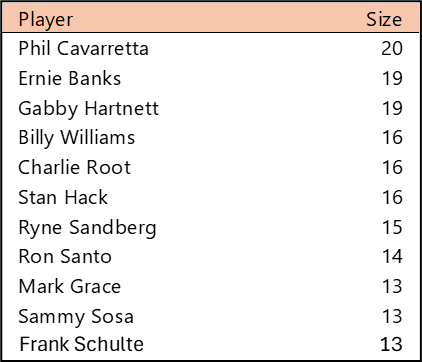
Top 10 by Seasons Played (Size)
Phil Cavaretta (1934-1953) tops the Cubs with 20 seasons played, winning NL MVP honors in 1945 courtesy of a .355 BA. A trio of Hall of Famers follows Cavaretta, led by Mr. Cub, Ernie Banks (1953-1971), and Gabby Hartnett (1922-1940). Banks spent his entire career with the Cubs, while Hartnett played his final season with the Giants. Billy Williams (1959-1974) led the NL with a .333 BA in 1972, before finishing his career with the Athletics. Other Hall of Famers on the list include Ryne Sandberg (1982-1994, 1996-1997) and Ron Santo (1960-1973).
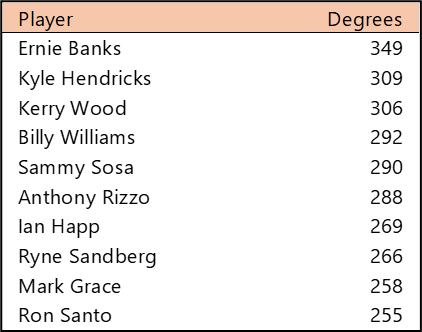
Top 10 by Degree (the number of connections)
Ernie Banks is the runaway leader in the number of connections as a Cub, having rostered with 349 other players. Kyle Hendricks (2014-2024) and Kerry Wood (1998, 2000-2008, 2011-2012) are the only other Cubs with 300+ teammates during their tenure. The remainder of the list includes several players known for their Cubs career, including Billy Williams, Sammy Sosa (1992-2004), Anthony Rizzo (2012-2021), Ryne Sandberg, Mark Grace (1988-2000), and Ron Santo.
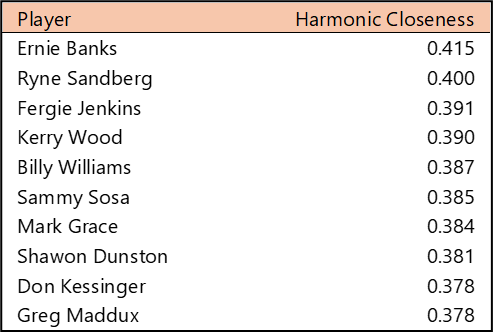
Top 10 by Harmonic Closeness Centrality
With Harmonic Closeness Centrality, we measure how closely an individual player is related to all other players in the network. This number (scaled from 0 to 1) often indicates a player’s importance to the network and may also note that they played with influential teammates. Ernie Banks and Ryne Sandberg top the list, followed closely by star pitcher Fergie Jenkins (1966-1973, 1982-1983). New players appearing in the list include Shawon Dunston (1985-1995, 1997), Don Kessinger (1964-1975), and pitching ace Greg Maddux (1986-1992, 2004-2006).
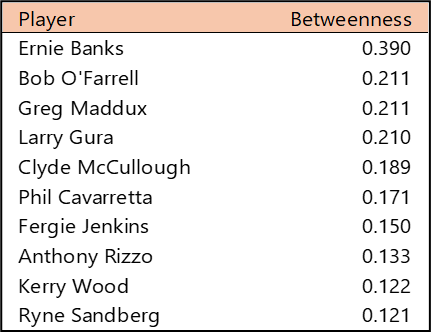
Top 10 by Betweenness Centrality
Betweenness Centrality measures which players rank highest in their ability to connect all other players. In simple terms, which player provides the most efficient path through the network (scaled from 0 to 1). Ernie Banks is the clear leader here; Mr. Cub provides the most efficient path through the network. Bob O’Farrell (1915-1925, 1934) is a strong connector for an earlier era of Cubs players, while Greg Maddux scores highly due to his separate Cubs tenures. Larry Gura (1970-1973, 1985) is another player who provides an efficient path despite playing less than five full seasons as a Cub. He and Maddux each wound up with two very different sets of teammates based on their early or late career stints.
Summary
That’s it for our overview of the Cubs network. Be sure to visit the interactive graph to discover additional insights about the Cubs players over the last 125 seasons. We’ll be back shortly with our next franchise entry. Thanks for reading!