Tag: Gephi

Anatomy of MLB Radial Axis Graphs

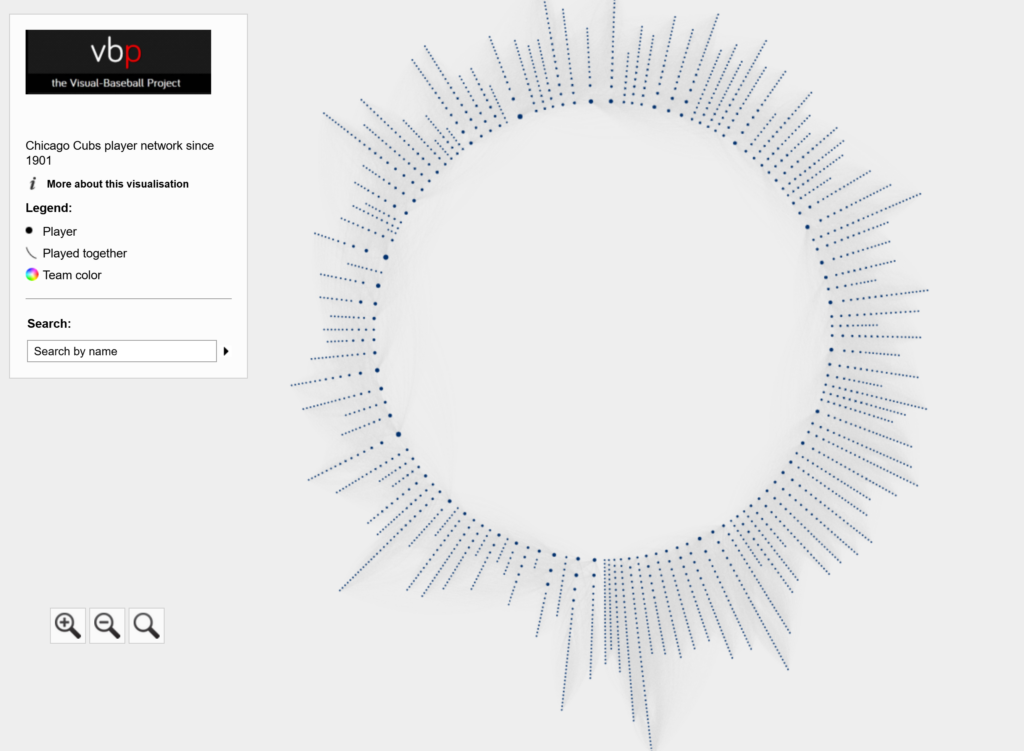
This post will introduce you to an upcoming series of MLB radial axis graphs, where we examine the connections between all players at a franchise level. The plan is to feature two teams per week, with an overview of each graph’s structure and highlights within the graph. Each graph will have the same general appearance and functionality; only the underlying data and team color will change. Every post will provide a link to the interactive graph, allowing you to explore freely. One caveat – the graphs are best explored on tablets, laptops, or large monitors; phone screens will not work well.

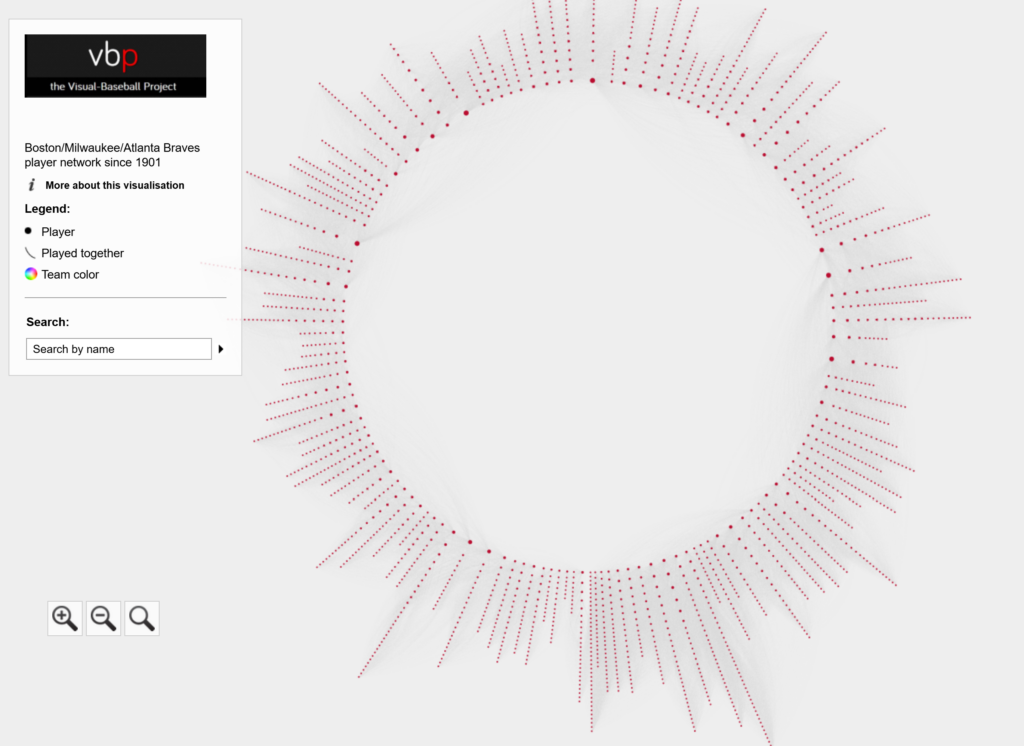
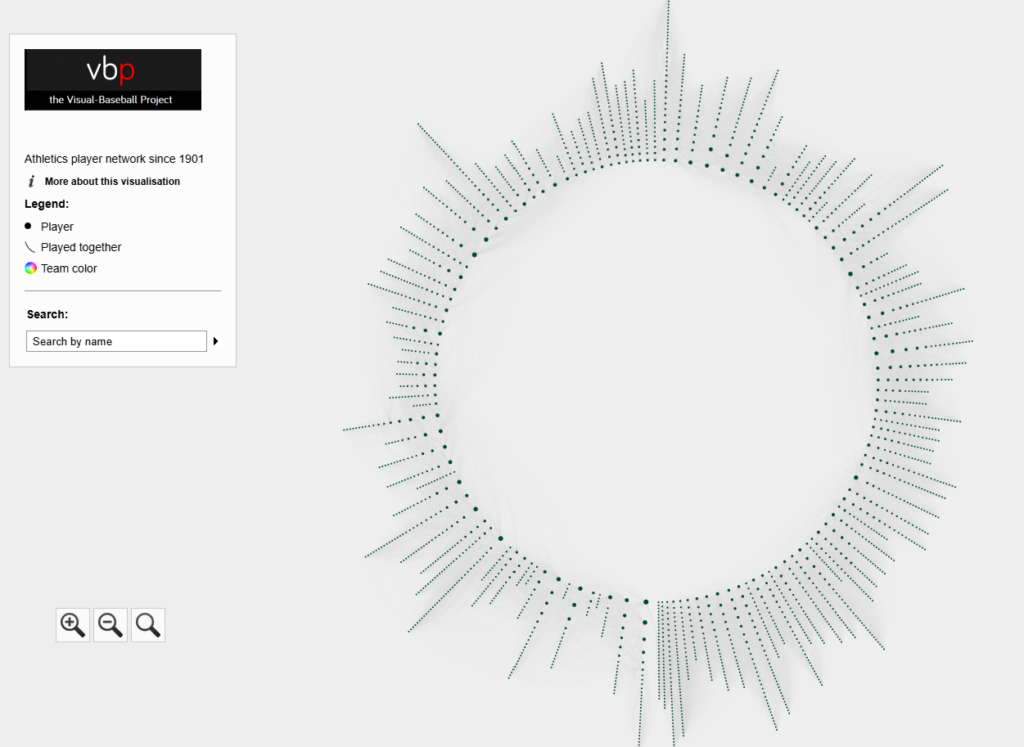
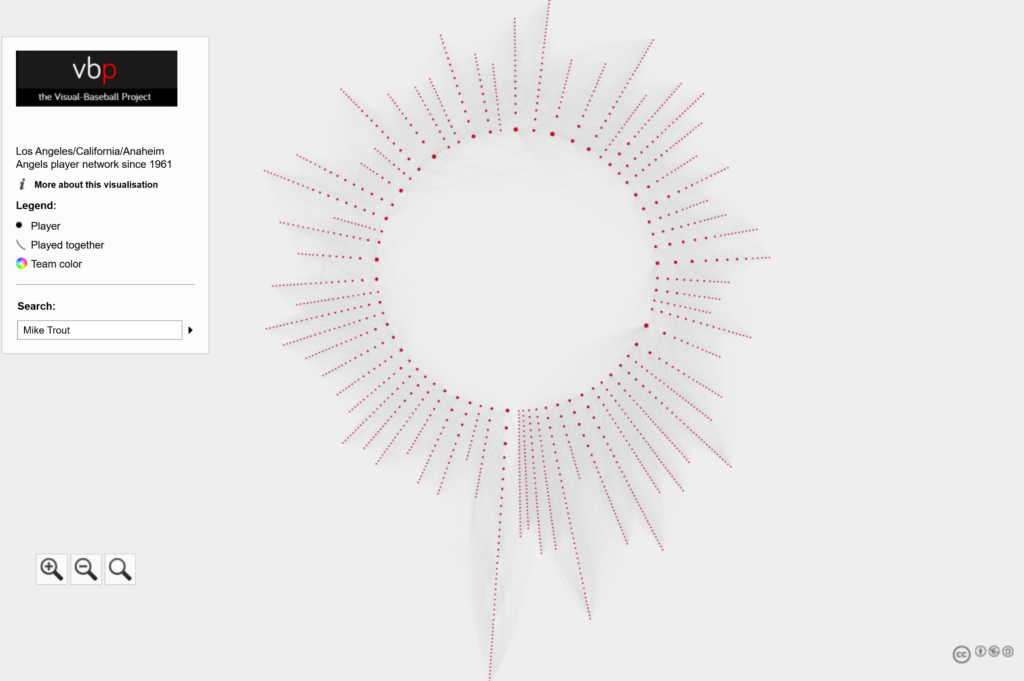
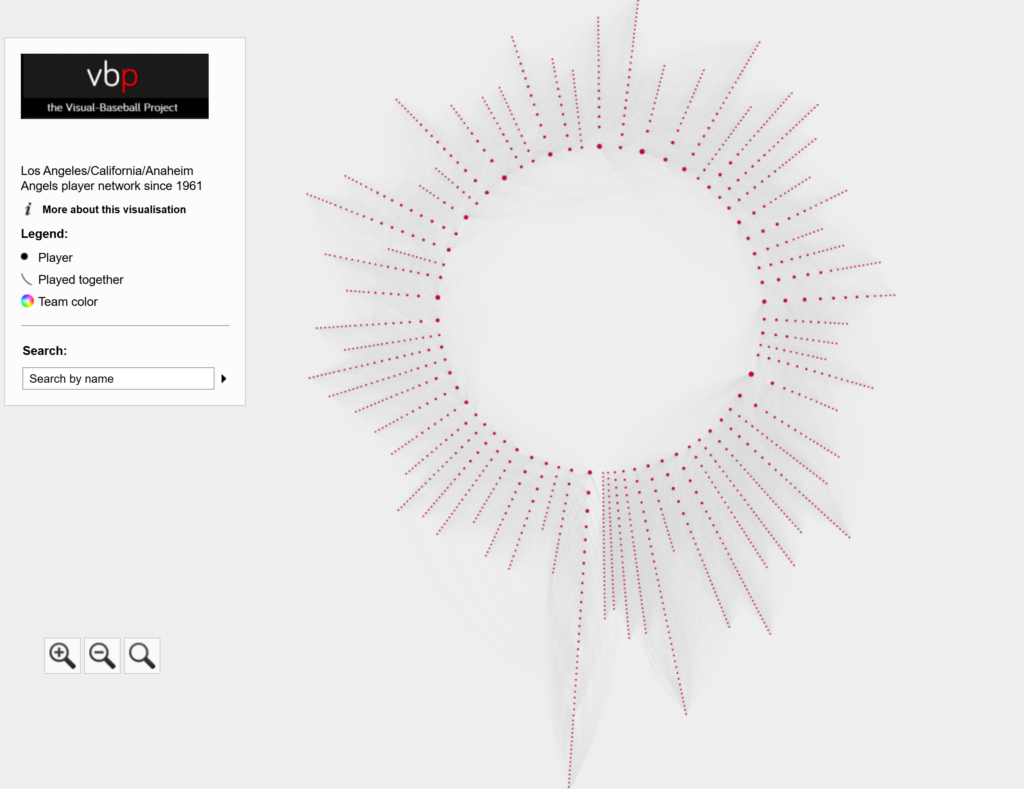
Let’s begin with the general concept behind the radial axis approach. I selected this layout (using Gephi) to provide an intuitive graph that is both easy to understand and navigate. Using a radial axis graph, we can arrange the data points (nodes) based on the first season a player was with a franchise (e.g., 1964). Players starting in the same season will be arranged in a radian originating near the center of the display. In addition, the players’ nodes are then arranged based on the number of seasons spent with a franchise. Let’s have a quick look, using the Anaheim Angels graph:

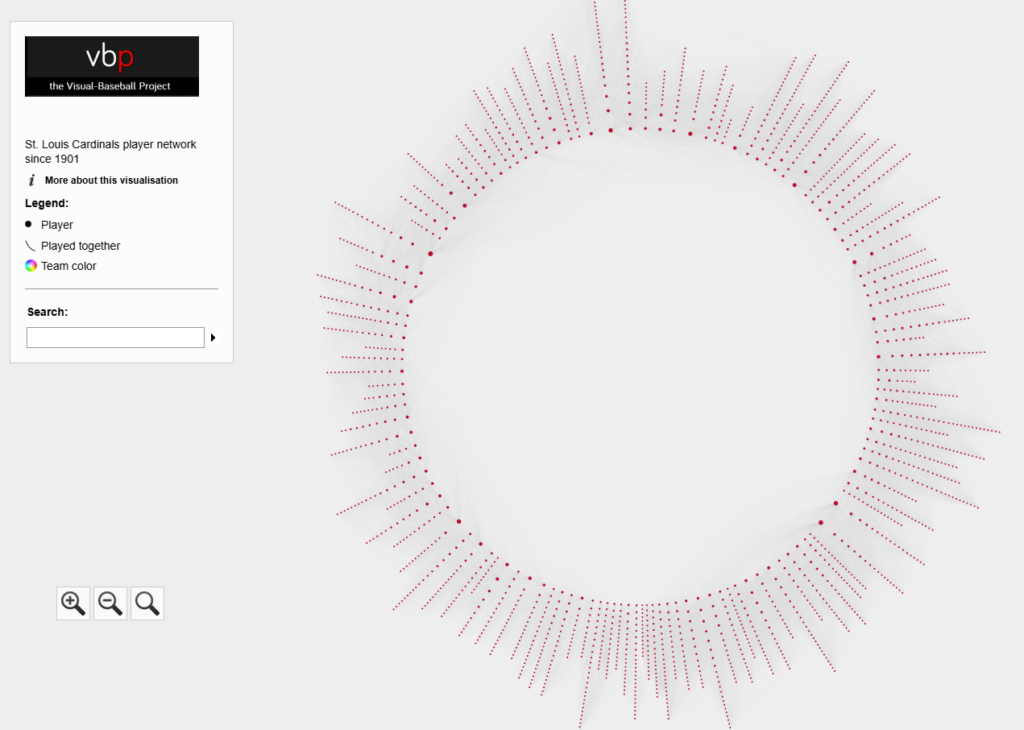
There’s a lot going on here, but we’ll explain it in the next few sections. First, you can see the structure of the graph, with each season radiating out from the center. The first season for each franchise is located near the bottom center; this will be the longest radian, as every player is new to the team that season. For the Angels, that season is 1961. The seasons are arranged clockwise from there, eventually wrapping back around to the 2025 season:

The title, legend, and search function are all contained within a static window to the left of the graph. This window provides simple information about the graph; selecting the More about this visualization option opens a new window that provides greater detail about the graph:

Specific players and their connections can be found using the Search function:

Each node in the graph represents a specific player. We can hover over any node to see who the player is, and we can click on any node to find out more information about that player, in this case Jered Weaver:

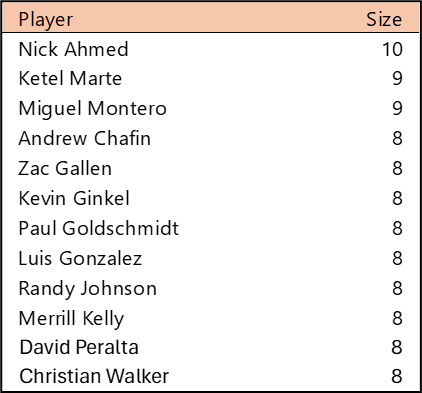
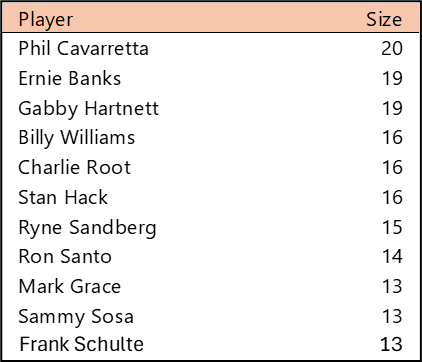
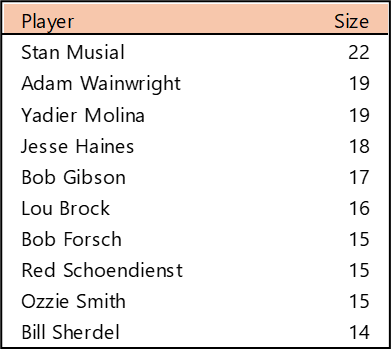
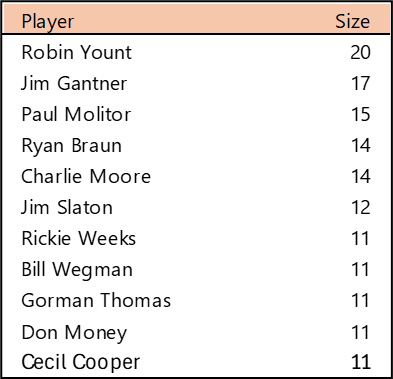
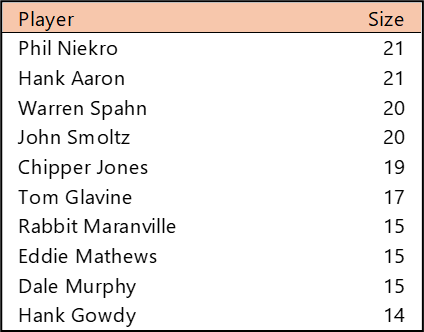
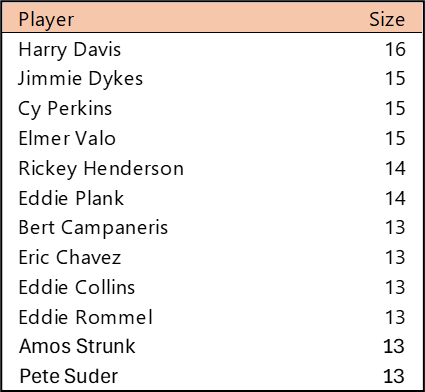
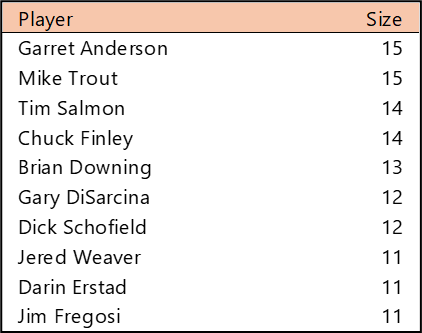
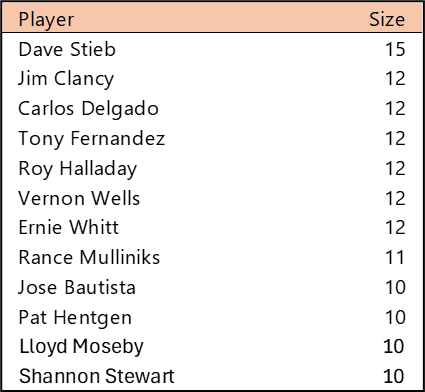
We now have detailed information about Jered Weaver in the Information Pane to the right of the graph. Later in this post, we’ll walk through the graph statistics, but for now, we can see the first and last seasons played, the size (# of seasons), and at the bottom, all of the players Weaver played with for one or more seasons. Each of these Connections can be clicked on to update the display. The size attribute is reflected in the graph; players with more seasons will have larger nodes than those with just a season or two.

The thin gray lines between graph nodes represent the connections between players. The Connections section contains this information, as we just discussed. As you might expect, these connections (edges) aid us in viewing the overall structure of the graph.

Network graph analysis uses several calculations to help summarize a graph. These measures can seem rather technical and difficult to interpret. We will simplify things in our upcoming posts for each franchise. In this section, I’ll provide a simple overview of each metric displayed in the Information Pane.

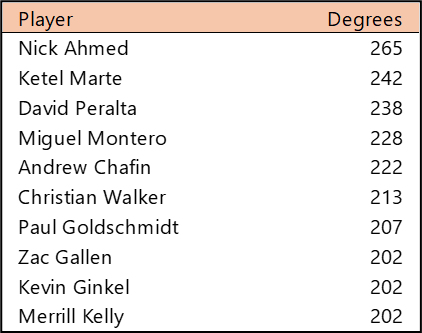
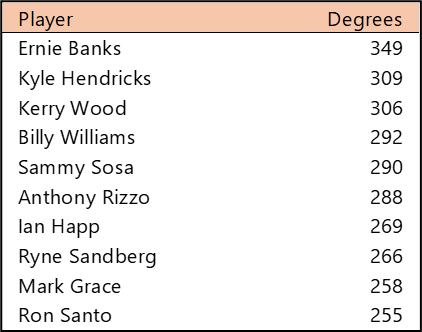
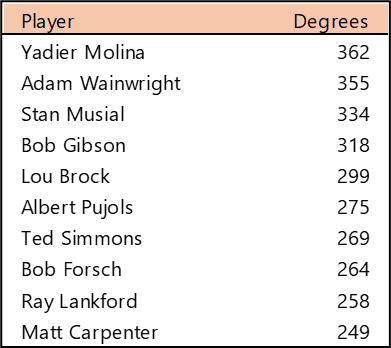
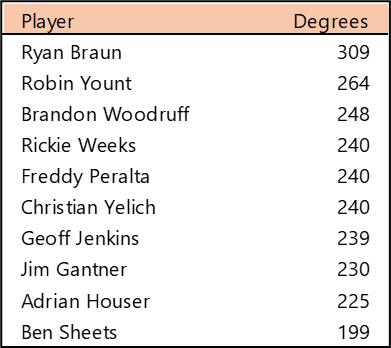
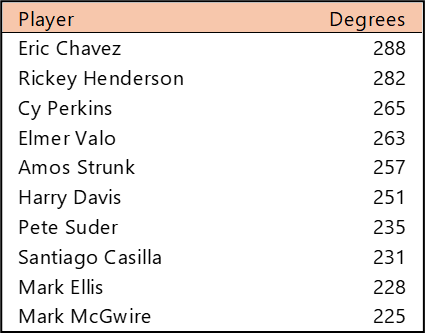
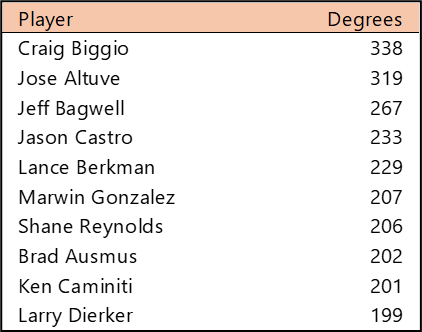
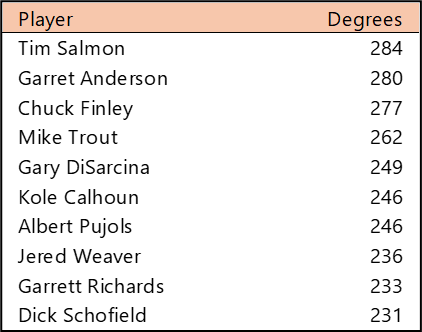
The Degree statistic measures the number of connections a selected player has. Typically, players with lengthy careers have the most connections, but players with multiple shorter stints may also have high degree numbers.

The Eccentricity statistic measures the number of steps required to connect to the most distant node in the graph. This number will be higher (on average) for original franchises dating to 1901.

The Closeness Centrality statistic measures the relative importance (from 0 to 1) of any player within the network. Higher scores indicate an individual who is close to many other players in the network. In practical terms, players who were with a franchise near the middle of all seasons will tend to have higher scores; they may connect to players from both earlier and later eras.

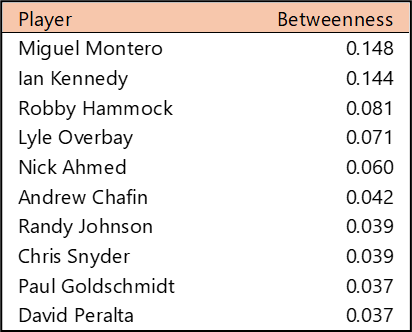
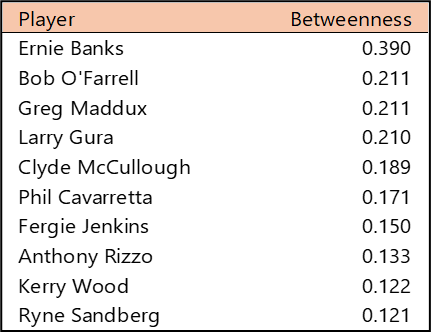
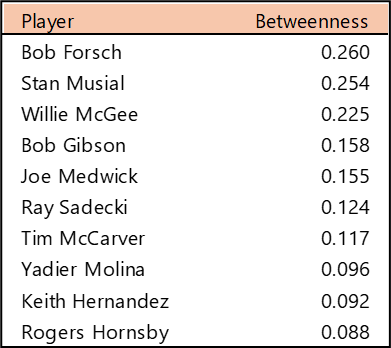
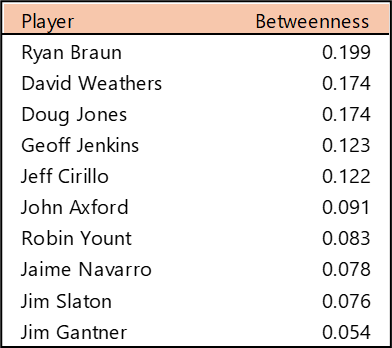
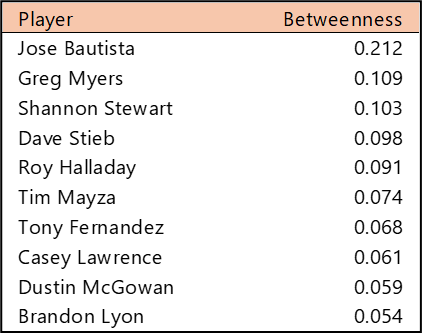
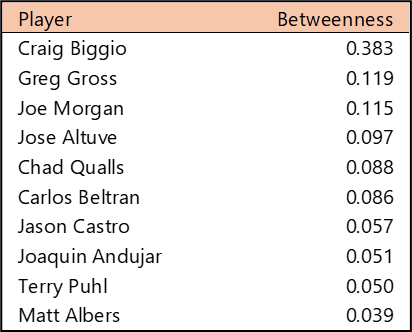
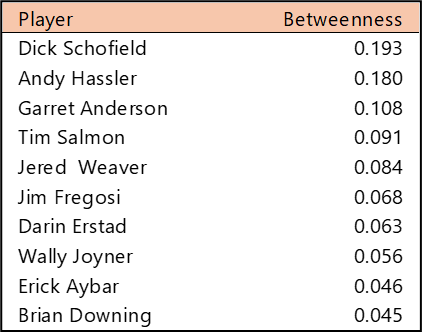
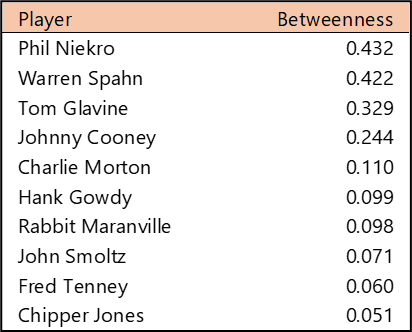
The Betweenness Centrality statistic measures how important an individual node is (from 0 to 1) for traversing the network. Players with many connections are most likely to score high on this statistic.

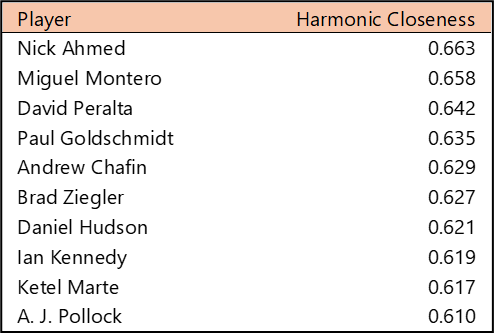
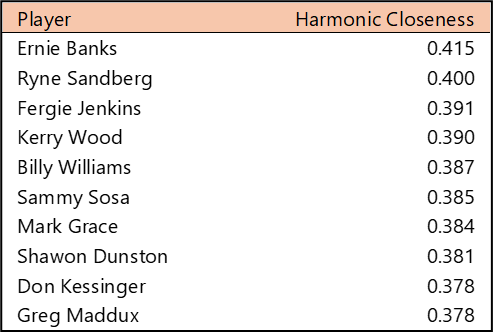
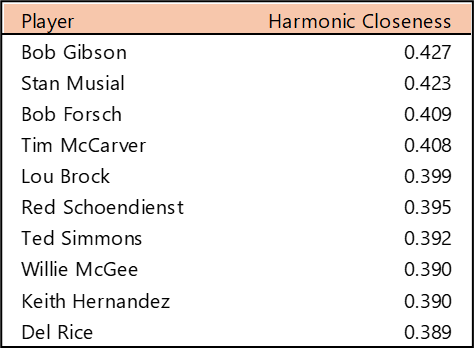
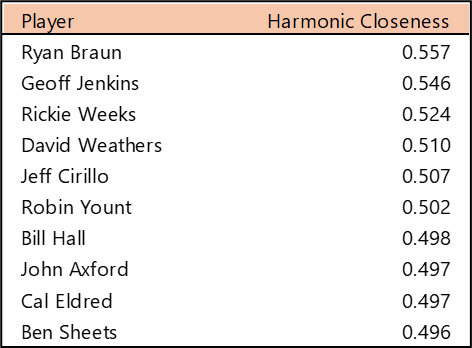
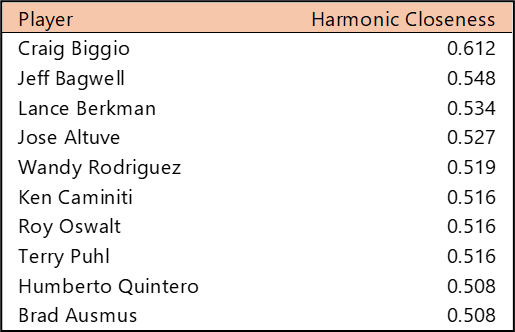
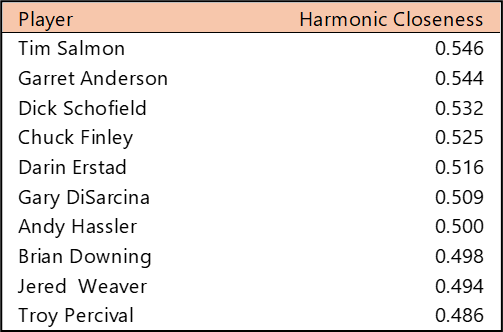
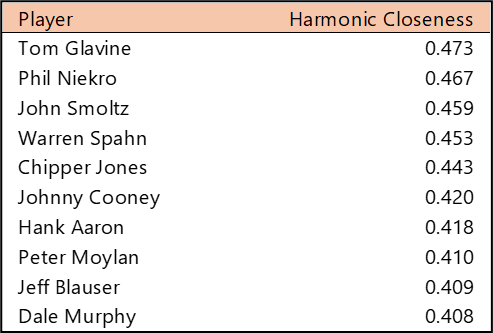
The Harmonic Closeness Centrality statistic also measures the relative importance of a player (from 0 to 1) in the network. It is a variation on the original Closeness Centrality statistic. We will use this version in our series of franchise summaries.

That’s it for our overview of MLB radial axis graphs. We’ll start with individual franchises (alphabetized by name) in a couple of days, and will include summaries and a link to the interactive graph. As always, thanks for reading!

Bad Trades, Red Sox Edition

This is the first in a series of posts where I take a look at notoriously one-sided baseball trades, using the baseball trade networks published on this site earlier in 2022. I won’t necessarily rank these deals in any sort of order; rather I will pick out a few from the network trade graphs and provide some analysis and context for some of the most notorious transactions.

If you haven’t seen the trade networks previously, here’s a link.

The networks were built using data from Retrosheet and Neil Paine, loaded into Gephi, a network analysis and visualization tool, and ultimately pushed to the web where I could finish styling the graphs. Graph nodes (the circles in the networks) are sized based on the total future WAR (Wins Above Replacement) accrued by the teams involved in the trade. All values must occur at the major league level (MLB), so players involved in the deal who don’t reach the MLB level with their new team will have a zero value. Only the cumulative WAR value while playing for the new team is included; we are not calculating WAR once a player leaves one of the teams involved in the transaction.

Finding a bad trade by scanning the networks is more an art than a science; the key is to look for large nodes (indicating a lot of future WAR value), and then dissecting the trade to see how much value each team received. The other alternative is if we already know the player(s) we are looking for; in these cases we can perform a simple search to find the trade. Here’s a classic example that Red Sox fans would love to forget – trading future Hall of Famer Jeff Bagwell for journeyman reliever Larry Anderson. Let’s go to the Red Sox trade network and search for Jeff Bagwell.

Red Sox trade network

Typing in Jeff Bagwell locates him quickly within the trade network. Note that even if a player is involved in multiple trades to or from the same team (rare but possible) the search will locate each transaction. Here’s the Bagwell transaction, showing his player node and future WAR value connected to the transaction node; every player involved in that transaction will be connected to the trade node, as long as there is some future WAR value. If a player in the trade did not play in the majors for the receiving team, they will not be reflected in the graph. Here’s a view of Jeff Bagwell relative to the trade:

Jeff Bagwell transaction

We can also click on the transaction node to see the value provided to each team by all of the players involved in the trade, again assuming they spent time with the team and were not limited to the minor leagues. Clicking on that node will display the respective WAR values in the sidebar on the left of the screen:

WAR values of the trade

Here’s where we get to the details of the trade, and specifically the direct benefits accrued to each team. The Red Sox received 1.1 future WAR from Larry Anderson; to put this in perspective, we might expect this sort of value for an average player for a single season. The Astros, on the other hand received an incredible 93.8 WAR from Jeff Bagwell, or close to 6 WAR per season for 16 years! That is a Hall of Fame level performance, and it eventually led to his selection to Cooperstown in 2017. Here’s a profile that mentions the one-sided trade.

While we have the Red Sox network open, let’s see if there are any other disastrous transactions (other than the cash sale of Babe Ruth to the Yankees, technically not a trade). After scanning the network, we find this one from 1928:

Transaction 59324 – Buddy Myer

This one is clearly not a Bagwell-level disaster, but was still quite negative for the Red Sox, with a WAR differential of 30 points. The primary villain here is Buddy Myer, a solid infielder who hit .300 or better seven times for the Senators. Not a major star, but the owner of a very nice career, including leading the American League in batting average in 1935.

Let’s try to find one more before closing this piece, this time favoring the Red Sox. We zero in on this deal:

Transaction 59403 – Jimmie Foxx

The Red Sox netted nearly 45 future WAR value while surrendering just 0.1; most of the benefit was generated by slugging future Hall of Famer Jimmie Foxx, but they also received a nice three season contribution from pitcher Johnny Marcum. Note how we also removed nodes not involved in the trade by clicking on the edges icon on the bottom left of the display area; this makes it easier to focus on the details.

Feel free to try your hand at finding more of these one-sided deals in the Red Sox or any other trade networks. I’ll be back with some other teams before long. Thanks for reading!
Final WAR Trade Networks Published

The final 10 MLB WAR Trade Networks have now been published, bringing the total number of graphs to 31 – 30 teams and one overall network with all teams and transactions. For more information on the trade networks, click here. Here are the remaining networks:

Find your favorite teams and enjoy!

More WAR Trade Networks Published

I’ve added 11 new MLB WAR Trade Networks to the site, bringing us to 21 in all. One more round of updates should get us to the full complement of graphs. For more information on using the graphs, see here.

Here are the new adds:

All the networks can be found here. Enjoy!

First 10 WAR Trade Networks Published!

The first 10 WAR (Wins Above Replacement) Trade Networks are now available for exploring! This initial group includes nine team networks and one overall graph with all teams included. Here’s a list of the 10 graphs:

Each of these and any upcoming WAR trade networks can be found on this page.

Let’s walk through how the graphs work, using the Detroit Tigers network as an example. We’ll begin with an anatomy of the graph display:

As the image shows, the primary focus will be the main graph area in the center of the window. This is where all nodes (transactions, teams, and players) will reside, connected by edges based on common relationships. Transaction nodes will vary in size based on the total value of a trade with the largest nodes indicating a trade that created significant future WAR for one or both teams. Team and player nodes are set to constant sizes so that the initial visual focus will be on the transaction nodes. The size differences become more noticeable when we zoom in to the network. More on that shortly.

Edges are also sized based on WAR value; this is where we see the value provided to a team and by specific players. Edge sizes (weights) will be more easily seen when we zoom in to the network.

On the left are some graph controls to assist in navigating the graph. We can zoom in using the slider control or the plus/minus buttons adjacent to the slider. Zooming can also be done with a mouse scroll if you prefer that option. The fisheye lens can be toggled on or off and can be used to highlight certain areas of the graph by hovering over a selected region. Finally, the edges button will enable showing or hiding edges and connected nodes. This is useful when you wish to reduce surrounding nodes and focus on specific transactions. We can also pan the graph by dragging it using a mouse – this is helpful in centering a network or viewing specific regions of the graph.

At the upper left of the window is a color legend for each node type, and hidden on the left (not shown in our image) is an information pane that will show specifics about the network. More on that in a bit.

Now let’s examine the information window – this is what makes the network truly powerful. When the network is first displayed or the browser window is refreshed the information pane displays information about the graph (open it by clicking on the arrows icon at the top left):

You can see the simple overview of the graph, the source data, and what it aims to accomplish. Here’s an enlarged version for easier reading:

If we zoom in and select a specific transaction the pane displays the relevant details for that selection:

Now we have the details for the transaction – the season, teams, and players involved. Here’s the enlarged view:

You can do this for any transaction in a graph, or you could choose to select a team or player to see how they fit into the network. The possibilities are nearly endless and it’s a fun way to understand the relationships between teams, players, and trades.

We’ll do more exploring of the networks in upcoming posts; I’ll also be adding more teams until we have a complete set of trade networks. In the meantime, feel free to explore the graphs to learn more about the best (and worst) trades your favorite team has made over the last 120 years. Enjoy, and thanks for reading!

MLB Trade Networks Part 3: Edges Code

In our previous post I shared the SQL code I created to pull data for our upcoming set of trade networks based on WAR (Wins Above Replacement) numbers from the Neil Paine 538 MLB data set. The prior post dealt with creating nodes for a network graph; this post will share code for edge creation. In simple terms, a graph needs edges that connect related nodes; for our case we need to connect transaction (trade) nodes to the teams and players involved in each transaction.

Part of what makes this case interesting is my desire to show edge weights based on the future WAR value each team received. Showing edges with varying weights will quickly help users to identify the relative importance of a trade. Wider edges will indicate a trade that involved high future value for one or both teams. In seeing the individual players involved in a common trade we can pinpoint where the future value (or lack thereof) comes from. This will become much clearer when the graphs are posted; I’ll do one or more posts on how to use and interpret each graph.

For now let’s examine the code. Gephi requires users to identify Source nodes and Target nodes whether the edges are Undirected (i.e.- it doesn’t matter which node leads to the other) or Directed. Our initial code is for transactions to teams:

SELECT CONCAT(tr.TransactionID, ‘-‘, tr.PrimaryDate) AS Source, t.franchID AS Target, CONCAT(‘The ‘, t.name, ‘ received ‘, ROUND(SUM(h.WAR162),1),
‘ wins in future WAR value’) AS Label,
IF(ROUND(SUM(h.WAR162),1) = tr.season and tr.Type = ‘T’ AND tr.Season >= 1901 and LENGTH(tr.TeamTo) = 3 AND LENGTH(tr.TeamFrom) = 3
AND tr.Season = t.yearID
GROUP BY tr.TransactionID, tr.PrimaryDate, t.franchID, t.name;

With this code we are linking every transaction to the teams receiving one or more players in a trade. Note that we are summing the WAR value to create an edge weight based on the total value received by each team. If four players were involved (two to each team) these edge weights will reflect the combined values of these players. Note that we are setting edge weight = 1.0 if the future WAR is less than 1 (some will actually be negative so we need a minimal edge to show). Here’s a sample of results:

In contrast, the edges linking a transaction to individual players are based solely on that one player’s value. In the case cited above we will wind up with four lines of varying weights. Otherwise the code is quite similar:

SELECT CONCAT(tr.TransactionID, ‘-‘, tr.PrimaryDate) AS Source, p.playerID AS Target, CONCAT(p.nameFirst,’ ‘, p.nameLast, ‘ provided ‘, ROUND(SUM(h.WAR162),1),
‘ wins in future WAR value for the ‘, t.name) AS Label,
IF(ROUND(SUM(h.WAR162),1) = tr.season and tr.Type = ‘T’ AND tr.Season >= 1901 and LENGTH(tr.TeamTo) = 3 AND LENGTH(tr.TeamFrom) = 3
AND tr.Season = t.yearID AND t.franchID = h.franch_ID
GROUP BY tr.TransactionID, tr.PrimaryDate, p.nameFirst, p.nameLast, p.playerID, t.name;

The same logic on edge weights applies but now at the player level. Here are a few results:

I hope this makes sense – it will all become much more clear when the network graphs are produced. The good news is that I already have three graphs created and many more to come shortly. I’ll have some of them available on the site later this week. As always, thanks for reading.

Trade Network Updates, Part 2 (node code)

Over the last 10 days I’ve been playing around with code that will enable some new versions of the MLB trade networks I premiered way back in 2015. The goal this time around is to factor in the future value of a trade to each of the participating teams. There are multiple measures that could be used for this assessment but I’m going with the WAR162 value from Neil Paine’s 538 github data source. Here’s how the site describes the War162 measure: JEFFBAGWELL WAR per 162 team games. Now you may ask why Jeff Bagwell? While he was a talented hitter for many years, his name is used as an acronym for this:

“The file “jeffbagwell_war_historical.csv” contains wins above replacement (WAR) data — according to JEFFBAGWELL (the Joint Estimate Featuring FanGraphs and B-R Aggregated to Generate WAR, Equally Leveling Lists), which averages together WAR from Baseball-Reference.com and FanGraphs — plus various other metrics for MLB since 1901.” Fun stuff, right?

The bottom line from my perspective is that this measure provides a robust way of assessing the value of a trade based on performance after the trade date. Did one team benefit while another team received a player who added no future value? Or did both teams make out equally well? Or was the trade of minimal value for both sides? These are the questions I’m attempting to visually address using network analysis and visualization.

Now comes the technical aspect for all you database and code lovers. First step is to create the network nodes; in this case we need to display the individual trade transactions, teams, and players. Let’s look first at the transactions using the Visual-Baseball MySQL source data:

SELECT CONCAT(a.Id, ‘-‘, a.PrimaryDate) as Id, CONCAT(‘Transaction ‘,a.Id,’ is from the ‘, a.Season, ‘ season’) AS Label,
‘Trade’ AS Type, SUM(a.Size) AS Size
FROM
(SELECT tr.TransactionID AS Id, tr.Season, tr.PrimaryDate, ROUND(SUM(h.WAR162),1) as Size
FROM historical_WAR_and_more h
INNER JOIN People p
ON h.key_bbref = p.bbrefID
INNER JOIN trades2021 tr
ON p.retroID = tr.Player
INNER JOIN Teams t
ON tr.TeamTo = t.teamID

WHERE tr.Season >= 1901 and h.year_ID >= tr.season and tr.Type = ‘T’ and tr.TeamTo = t.teamID and LENGTH(tr.TeamFrom) = 3
AND tr.Season = t.yearID and t.franchID = h.franch_ID

GROUP BY tr.TransactionID, tr.season, tr.TeamFrom, tr.TeamTo, tr.PrimaryDate) a

GROUP BY a.Id, a.PrimaryDate, a.Season;

Here we are simply creating a node for each trade transaction, a label showing the teams involved and the trade date, and summing up the previously mentioned WAR162 to size the nodes. This will be an important part of the graph – trades that created large future values (for one or both teams) will be more prominent in the graph. Small value trades will be represented by very small nodes indicating their relative lack of importance. This one was a challenge, but finally got the code to deliver the expected results.

The next step is to create team nodes; in this case we’ll provide a constant size:

SELECT t.franchID AS Id, tf.franchName AS Label, 15 AS Size

FROM historical_WAR_and_more h
INNER JOIN People p
ON h.key_bbref = p.bbrefID
INNER JOIN trades2021 tr
ON p.retroID = tr.Player
INNER JOIN Teams t
ON tr.TeamFrom = t.teamID
INNER JOIN TeamsFranchises tf
ON t.franchID = tf.franchID

WHERE tr.season >= 1901 and h.year_ID >= tr.season and tr.Type = ‘T’ and h.team_ID = tr.TeamTo and LENGTH(tr.TeamFrom) = 3

GROUP BY t.franchID, tf.franchName;

By applying a constant node size of 15, each team will have a similar appearance in the graph which will not distract us from the trade values (some will be much larger than 15).

Our third and final node step is to provide information on all players involved in one or more trades:

SELECT Id, Label, ‘Player’ AS Type, 5 AS Size
FROM
(SELECT p.playerID AS Id,
CONCAT(h.player_name, ‘ (‘, p.birthYear,’-‘,p.deathYear,’)’,’ played from ‘,LEFT(p.debut,4),’ to ‘,LEFT(p.finalGame,4)) AS Label

FROM historical_WAR_and_more h
INNER JOIN People p
ON h.key_bbref = p.bbrefID
INNER JOIN trades2021 tr
ON p.retroID = tr.Player

WHERE tr.season >= 1901 and h.year_ID >= tr.season and tr.Type = ‘T’ and LENGTH(tr.TeamFrom) = 3
and LENGTH(tr.TeamTo) = 3
AND p.deathYear > 1900

GROUP BY h.player_name, p.playerID, p.birthYear, p.deathYear, p.debut, p.finalGame

UNION ALL

SELECT p.playerID AS Id,
CONCAT(h.player_name, ‘ (‘, p.birthYear,’-‘,’ )’,’ played from ‘,LEFT(p.debut,4),’ to ‘,LEFT(p.finalGame,4)) AS Label

FROM historical_WAR_and_more h
INNER JOIN People p
ON h.key_bbref = p.bbrefID
INNER JOIN trades2021 tr
ON p.retroID = tr.Player

WHERE tr.season >= 1901 and h.year_ID >= tr.season and tr.Type = ‘T’ and LENGTH(tr.TeamFrom) = 3
and LENGTH(tr.TeamTo) = 3
AND ISNULL(p.deathYear)

GROUP BY h.player_name, p.playerID, p.birthYear, p.deathYear, p.debut, p.finalGame) a
GROUP BY Id, Label;

Here we are running a UNION query so we can gather information about the players moving in each direction of a trade (from one team to another). We then combine that information and apply a fixed size of 5 since there are far more players than teams. We’ll have the ability in the finished networks to zoom in and see more about each player.

Each of these 3 outputs (trades, teams, and players) is combined into a single input file that will feed Gephi. We should wind up with between 10k and 20k nodes which we’ll be able to filter
and zoom on in the network graph. I have high hopes for this set of networks (there may be one for each team as well as a comprehensive one) as it should really help display the most important trades in MLB history.

That’s it for our node creation process; the next post will share how we create the edges that will connect trades to teams and teams to players. Thanks for reading!
Trade Network Updates, Part 1

A few years back (2016 o be specific) I created network graphs displaying the history of trades made for each MLB franchise, using transactions data from the wonderful Retrosheet project. These graphs presented more than a few challenges in how to present the data but I wound up with what I consider to be a very interesting set of results, which you can find here. I also created some posts on the process at that time, found here and here.

Here’s a snapshot within a graph:

Six seasons have elapsed since I created those graphs, so I thought it was beyond time to update them, but this time with a twist. Last fall I came across a great dataset that captures an array of advanced sabermetric statistics which I hope to use on a regular basis. These statistics can be used to assess a player’s true value relative to his peers each season. What if I could incorporate those into the trade network updates to show the post-trade value of each player to their new team? Ideally, this will help to show the value of each trade and which team wound up getting the better part of the deal.

Of course this would involve adding a degree of complexity to the MySQL code for pulling the data and shaping it for use in creating network graphs. However, the end result could be very revealing and worthwhile. Today I’m at the start of the process, tinkering with SQL code to extract the data in a proper format. Here’s an example:

SELECT h.player_name, p.playerID, tr.season, tr.TransactionID, tr.TeamFrom, tr.TeamTo, ROUND(SUM(h.WAR162),1) as WAR

FROM historical_WAR_and_more h
INNER JOIN People p
ON h.key_bbref = p.bbrefID
INNER JOIN trades2021 tr
ON p.retroID = tr.Player

WHERE tr.season >= 1901 and h.year_ID > tr.season and h.team_ID = tr.TeamTo AND tr.Type = ‘T’

GROUP BY h.player_name, p.playerID, tr.season, tr.TransactionID, tr.TeamFrom, tr.TeamTo

In this case, I’m looking at the cumulative WAR (Wins Above Replacement) for each traded player with their new team. This could be a single season total or the sum of many years in some cases. Here are some results:

We now have post-trade results (starting if the season following the trade) as measured by WAR for each traded player. We see one fairly substantial figure – the second Aaron Harang trade which netted 16.9 WAR points for his new team, the Cincinnati Reds (CIN in the results). Given that a single season WAR above 3 or 4 is considered substantial, it’s clear that his new team probably benefited from a few of those high-value seasons. What we can’t see yet is what they gave away in their half of the trade.

Fortunately, we can access this using the TransactionID field, which provides all the information for each party within the trade. But we’ll save that for another day as I figure out the next progression of the code. As always, thanks for reading!
Radial Franchise Networks for all MLB Franchises

All 30 MLB Radial Networks are now complete, and available for you to explore. One thing to notice is that each network will have a slightly different (or radically different) shape, depending on how many (or few) players started in a single season. If the team was in the midst of a successful run, the radians will tend to be short, as fewer rookies or acquired players will debut. On the other hand, teams that are retooling will tend to have long radians, as there are many new players making the team. This could also be reflected in the number of players getting a September call-up from the minors.

While these networks are pretty attractive to view as static images (IMHO), the real fun comes from the interactivity, where you can click, zoom, pan, and see all the details for who played with whom over the course of a franchise’s history. Note that this is based on seasonal rosters, so not all connections actually played together at the same time of the season.

Anyhow, check out a handful of examples, and then try them out yourself at the Franchise Radial Networks 1901-2019 page.

Team Franchise Radial Axis Network Anatomy

A few years back, I created network graphs for many MLB franchises, using data from the Lahman Baseball Database. These graphs displayed the connections between teammates throughout the history of a given franchise from 1901-2013. Any players who were on a roster within the same season (or seasons) were connected to one another, with each node in the network representing a single player. These were then sized to reflect the number of seasons played with that franchise. Every graph was customized by using one or more of their official team colors, resulting in a visualization like this:

A full roster of the live versions can be found here.

Now that 2019 data is available, I thought it was about time to update the graphs, but this time with a new look that might make the graphs a bit more intuitive and perhaps even more visually attractive. Out of this was born the radial axis franchise graph, as shown for the 1901-2019 Detroit Tigers:

I’m pretty excited about the look the Radial Axis layout provides for this sort of data, and I think you’ll see why it is an effective method for visualizing all the players over the course of 119 seasons. Let’s have a look at the anatomy of this graph.

The graph runs in a counter-clockwise manner, starting with 1901 at the bottom of the graph, and working all the way around until we get to 2019, also at the bottom of the graph. Each set of nodes along the way represents the collection of players with their first Tigers season in that radian. We can see some years where there were many new players (1912 has an exceptional number), while other years had very few new players, 1915 being an example. Here’s a general diagram to help with this concept:

We can also identify a handful of players with especially large nodes, which indicate the number of seasons with the Tigers. These are sorted to make the graph clean and easy to interpret; players with the most seasons will all be closest to the center of the graph, with teammates from the same starting year sorted from longest to shortest tenure. The perimeter of the graph will be populated almost exclusively with one-season players.

For context, let’s examine a few of the large nodes, and identify who they are:

I hope this is starting to make sense. Each radian represents a season, and each node on a radian depicts a player, sized by their longevity with the team. The third critical aspect of the graph is the connectivity between players, represented by the thin gray lines running between them. These are called edges, and are at the heart of a network graph. Let’s have a closer look at the edges for Alan Trammell, as one example.

If we click on the Alan Trammell node, the graph is reduced to him and the players he played with over his career – or at least those who were on the roster in those seasons. This is the fun part of the graphs, as it facilitates exploration and pattern discovery. Here is a portion of the Trammell network, zoomed in so we can see the connections:

Now the edges are a bit more visible, and the graph detail begins to reveal itself. Notice the multiple large nodes in line behind Trammell; it turns out that this is the celebrated 1977 class, many of whom would ultimately be members of the great 1984 World Series champs. So while the 1977 Tigers were not a good team, they were beginning to see the fruits of a strong minor league pipeline. In order, here are the players in that group, and their connection to the 1984 team:

  • Alan Trammell (20 seasons, WS Champ)
  • Lou Whitaker (19 seasons, WS Champ)
  • Jack Morris (14 seasons, WS Champ)
  • Lance Parrish (10 seasons, WS Champ)
  • Milt Wilcox (9 seasons, WS Champ)
  • Dave Rozema (8 seasons, WS Champ)

Trammell is obviously connected to many other players who started in different seasons, given his 20 years with the team. In fact, he has a degree measure of 333, representing the number of players with a connection to Trammell. Thus, we can also see many connections to players who started their Tigers journey in other seasons. The three large nodes to the upper right of Trammell are interesting – who are they?

  • Closest to Trammell is John Hiller (1965-80)
  • Next is Mickey Stanley (1964-78)
  • Followed by Willie Horton (1963-77)

What we have here are the three remaining holdovers from the 1968 World Series champs, finishing up their careers just as Trammell was starting his long tenure with the Tigers. Discovering patterns like this make network graphs very interesting for me, and I hope you will also find them interesting. I’m currently in the process of refining the Tigers graph, which will be followed by graphs for each MLB franchise, once again using their team colors to provide some visual context. Hope you found this informative, and we’ll see you soon.