Welcome to the second countdown post in our series of MLB team rankings for the 1960s. After decades with eight teams per league, the 1960s brought two waves of expansion – two new AL teams in 1961, two new NL teams in 1962, and two more for both in 1969. As a reminder, the teams are ranked from #20 through #1 based on aggregate WAR162. For the 1960s (1960-1969), a total of 198 teams were eligible, so the top 20 teams are a rather exclusive group – the top 10% for the decade. We’ll summarize each team, including portions of their team dashboard, and explain how they attained their ranking. So, without further ado, here are the teams ranked #15 through #11.
Here’s the interactive dashboard at Tableau Public: 1960s Top 20 MLB Teams Dashboard
#15: 1963 New York Yankees, 48.2 WAR162
The 1963 Yankees won 104 games to cruise to the AL pennant by 10.5 games over the White Sox. The two teams were more evenly matched than the numbers suggest; Pythagorean projections have the Yankees just 2.5 games better than the Sox. The Yankees went to the World Series, only to be stunned by the Dodgers in a 4-game sweep.
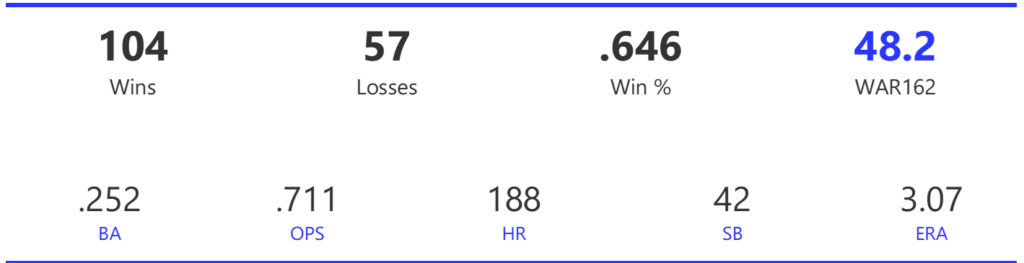
The New Yorkers had a good offense, but not a dominant one. They ranked 2nd in runs, home runs, and BA, but just 7th in OBP and 3rd in OPS. The Yankees ranked dead last in walks, a dramatic departure from tradition. Pitching kept the Yankees at the top, as they led the AL in WHIP and ranked second behind the White Sox in ERA.
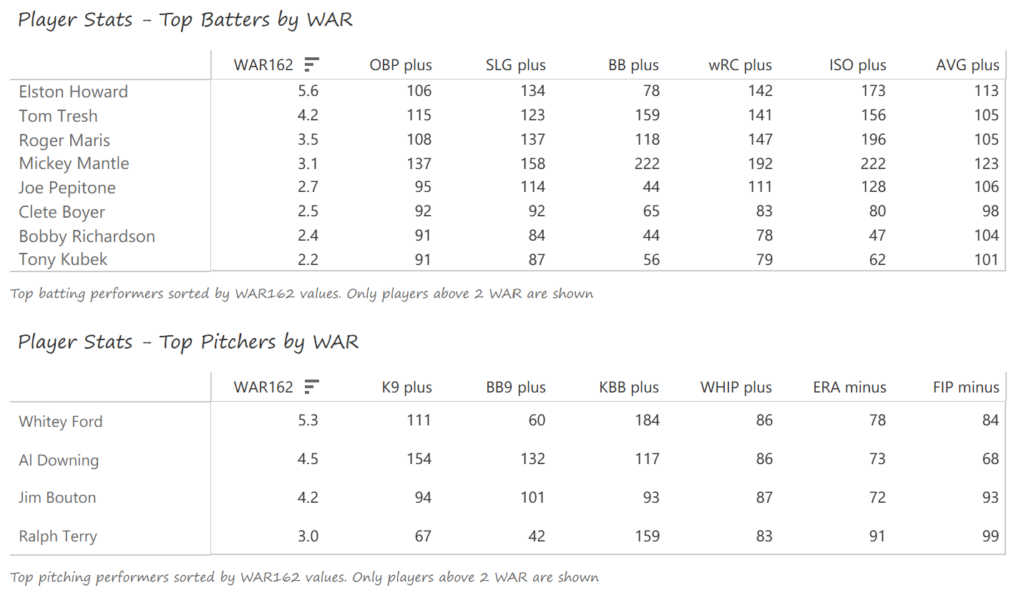
Elston Howard was the most effective position player for the Yankees, batting .287 with 28 homers and 85 RBI from his catcher position. Tom Tresh had 25 home runs and a .371 OBP as one of the few Yankees who would accept a walk (83 on the season), and Roger Maris added 23 homers. Mickey Mantle managed just 213 plate appearances due to injury, batting .314 with a 1.063 OPS. Joe Pepitone hammered 27 homers at age 22, but had just a .304 OBP. The Yankees benefited from an excellent age-34 season assembled by Whitey Ford (24-7, 2.74 ERA). Al Downing had the top hits and strikeout rates per 9 innings in the league with a 13-5 record, and Jim Bouton recorded a 21-7 record with a 2.53 ERA. Ralph Terry led the league in WHIP (1.063) and complete games (18) on the way to 17 wins.
#14: 1965 Cincinnati Reds, 48.4 WAR162
The Reds finished fourth in the NL, 8 games behind the Dodgers, despite winning 89 games. Pythagorean projections suggest that the Dodgers were quite lucky (+5 wins over expected) and the Reds were rather unlucky (-4 wins below expected). The Reds were good enough to win the NL pennant, but fortune had other ideas.
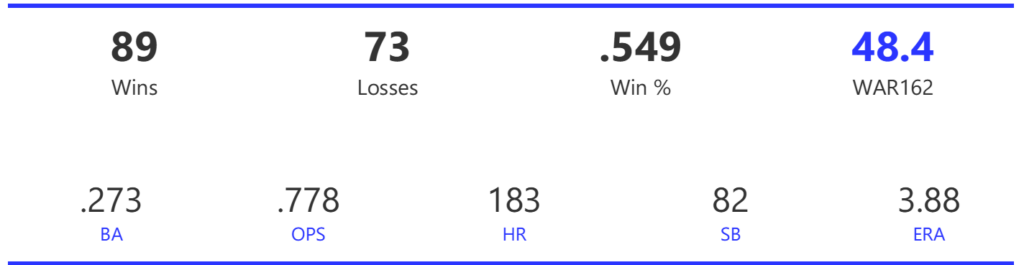
The Reds led the league in runs by a whopping 117-run margin over the Braves, helped by cozy Crosley Field. They ranked first in doubles and triples, and second to the Braves in home runs. The Reds also led the NL in each percentage metric – BA (.273), OBP (.339), SLG (.439), and OPS (.778). Pitching was their downfall, as they ranked 9th in both WHIP and ERA. The Reds staff struck out the most batters in the league; unfortunately, they also issued the most walks. Some of these numbers were tied to their ballpark, some were not.
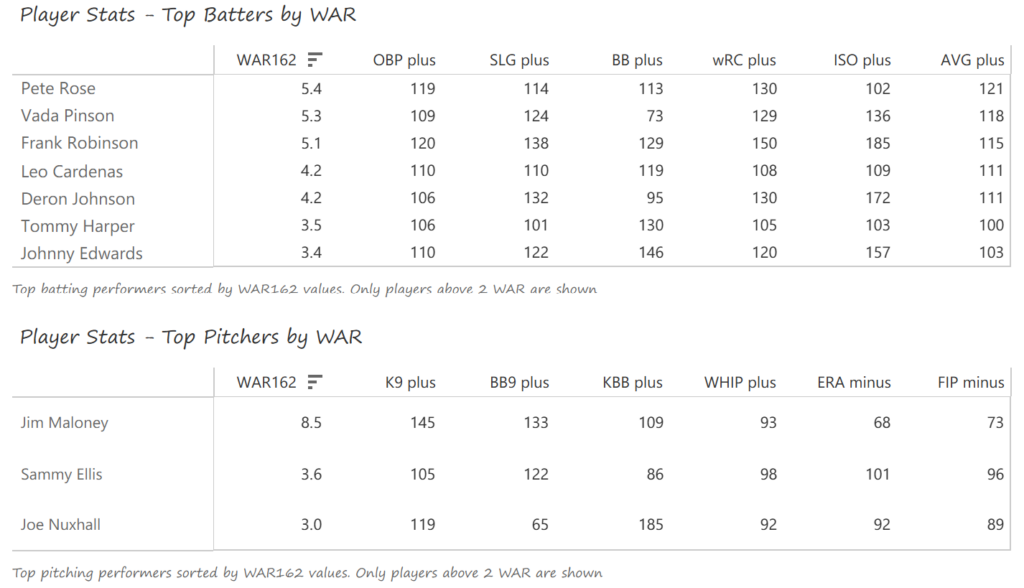
Pete Rose emerged as an offensive force for the Reds, batting .312, with an NL-best 209 hits. Rose also scored 117 runs and had 81 RBI. Vada Pinson had a fine season (.305 BA, 22 homers, 94 RBI, 21 steals), and Frank Robinson batted .296 with 33 homers, 113 RBI, and 109 runs scored in his final Reds season. Shortstop Leo Cardenas batted .287, and Deron Johnson belted 32homers with an NL-best 130 RBI. Tommy Harper led the NL with 126 runs scored and stole 35 bases, and catcher Johnny Edwards added 17 homers. On the mound, Jim Maloney had a great season, with a 20-9 record, 2.54 ERA, 244 strikeouts, and 5 shutouts. Sammy Ellis went 22-10, and 36-year-old Joe Nuxhall was effective as a starter and reliever, recording an 11-4 mark.
#13: 1967 St. Louis Cardinals, 48.9 WAR162
The 1967 Cardinals ran away with the NL pennant, defeating the Giants by 10.5 games. They were a bit lucky to win 101 (Pythagorean projection was 97 wins), but were still the best NL team. The Cards went on to defeat the upstart Red Sox in a thrilling 7-game World Series.
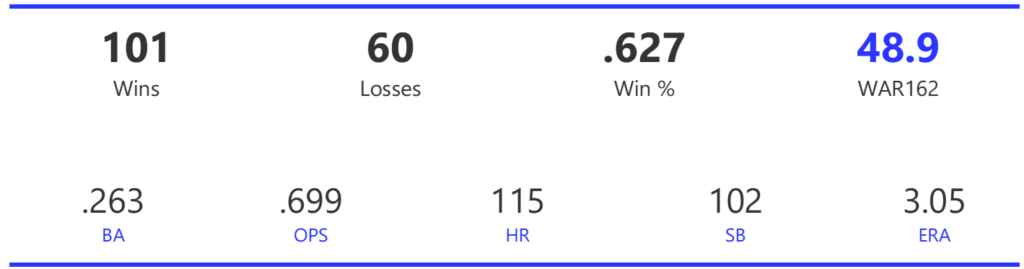
The Cardinals had a solid offense, finishing just 7 runs behind the Cubs, leading the NL in steals, and ranking second in OBP and OPS. The pitching staff was also solid, trailing only the Giants in ERA and WHIP, and tying for second with 17 shutouts on the season.
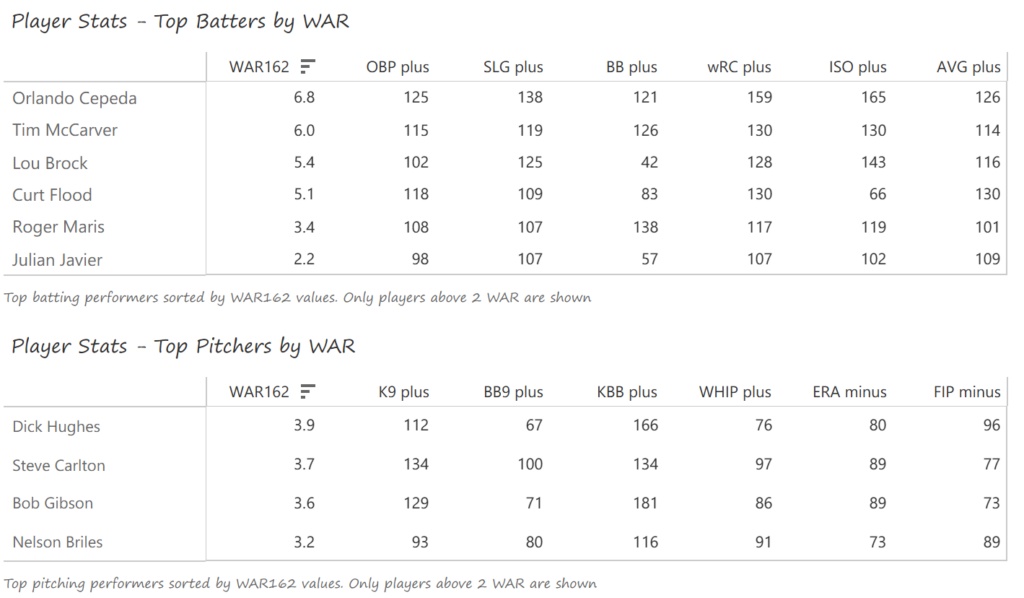
Orlando Cepeda earned NL MVP honors with a .325 BA, 25 home runs, 111 RBI (NL-best), and 37 doubles. Catcher Tim McCarver was second in MVP voting after a .295 BA with 14 homers and an excellent defensive season. Lou Brock led the league with 1123 runs and 52 stolen bases, and Curt Flood batted a robust .335 with Gold Glove defense in center field. Dick Hughes led a balanced pitching staff with a 16-6 mark and the top WHIP and hits per 9 innings marks in the NL. Steve Carlton (age 22) recorded a 14-9 campaign, and Bob Gibson posted a 13-7 record. Nelson Briles went 14-5 with a 2.43 ERA, working both in the rotation and out of the bullpen.
#12: 1966 Pittsburgh Pirates, 48.9 WAR162
The 1966 Pirates finished a close third in the NL pennant race, just 3 games behind the Dodgers, and 1.5 back of a very lucky (+7 wins over projection) Giants team. The Pirates had identical 46-35 records at home and on the road in their near-miss season.
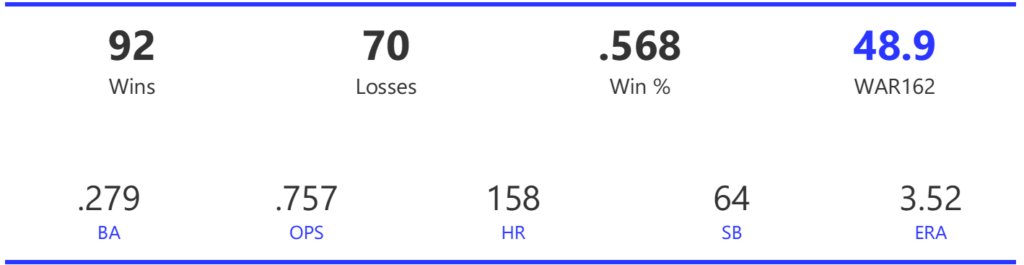
The Pirates had a very good offense, scoring 759 runs on the season, 2nd-most in the NL. They also led the league in doubles and triples. Their .279 BA was 16 points higher than the next-best mark, and they also led the league in OBP, SLG, and OPS. Unfortunately, the Pirates’ pitching was less effective than their hitting. The team ranked 4th in ERA and 7th in WHIP, and was no better than average in several other categories.
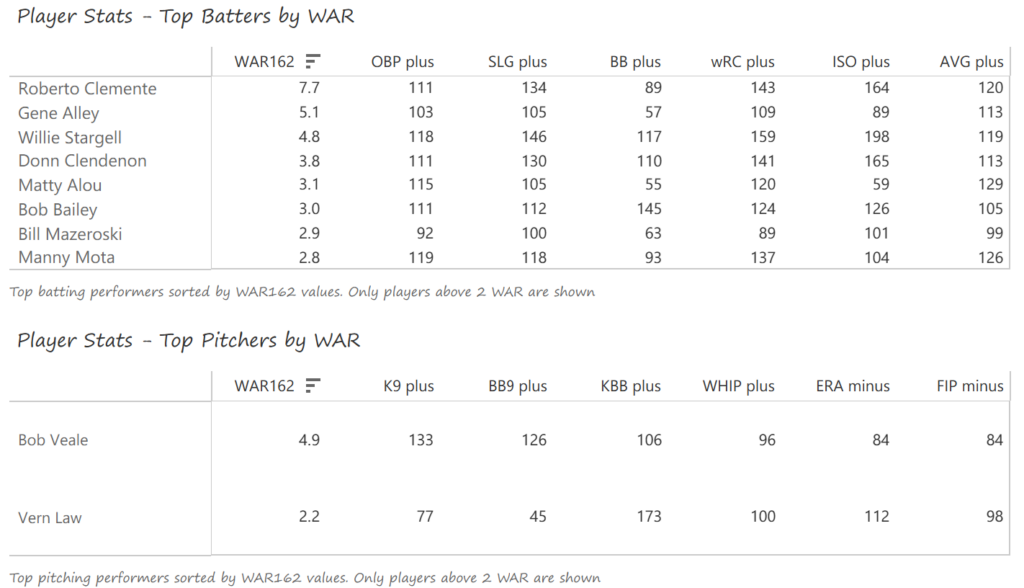
Right fielder Roberto Clemente was the clear leader of a deep offense, winning the NL MVP after a .317 BA, 29 homers, 119 RBI season. Clemente also scored 105 runs and claimed a Gold Glove. Gene Alley had a fine season at shortstop, batting .299 and winning a Gold Glove, and Willie Stargell belted 33 homers with 102 RBI and a .315 BA. Donn Clendenon batted .299 with 28 homers, and Matty Alou batted an NL-best .342. Bob Veale was the ace of a limited pitching staff, posting a 16-12 record with 229 strikeouts, aided by 36-year-old Vern Law, who added 12 wins.
#11: 1966 Los Angeles Dodgers, 49.9 WAR
The Dodgers edged out the Giants by 1.5 games and the Pirates by 3 games to claim the 1966 NL pennant. Their season ended on a low note when they were stunned in a World Series sweep at the hands of the Orioles.
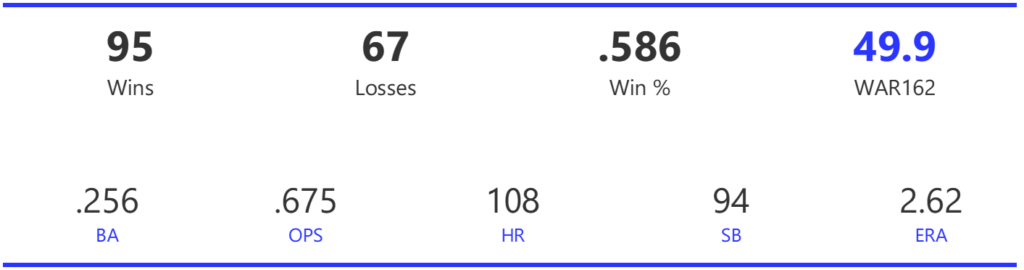
The Dodgers played home games at Dodger Stadium, notoriously known as a pitcher’s park. Even so, their offensive output was unimpressive, as they ranked 8th (out of 10) in runs scored, 7th in doubles, 10th in triples, and tied for 8th in home runs. Their .256 BA was 5th-best in the NL, as was their OBP, and they ranked a lowly 8th in OPS. Pitching was the Dodgers’ savior, with a 2.62 ERA and a 1.127 WHIP that ranked far ahead of their closest pursuers. They also led the league in strikeouts and strikeout-to-walk rate.
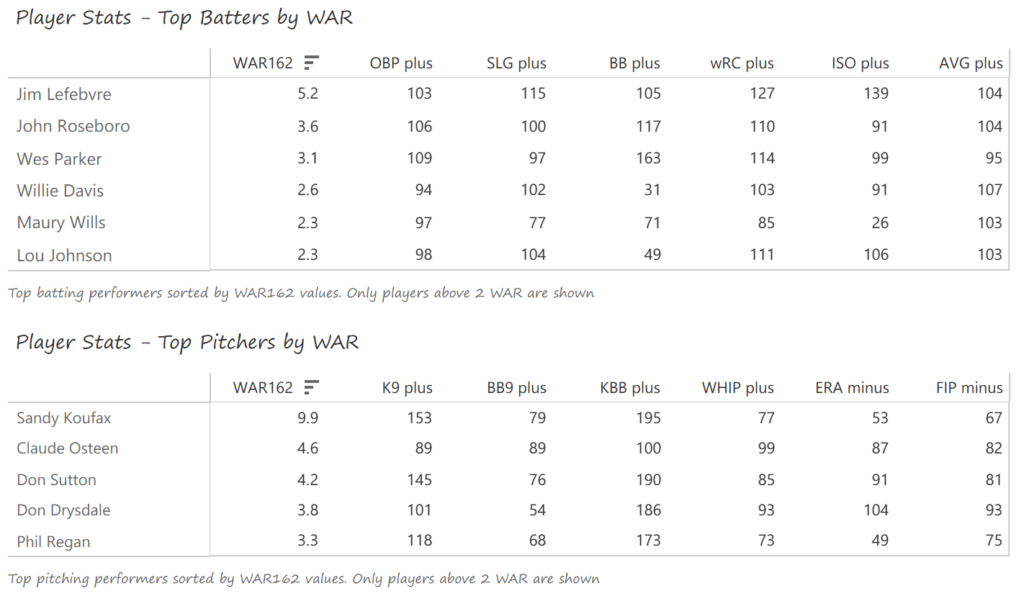
Jim Lefebvre led the offense with 24 homers, 74 RBI, and 69 runs scored, with catcher John Roseboro winning a Gold Glove and batting .276. Wes Parker was a solid presence at first base with a .351 OBP to help the Dodgers limited offense score often enough to win. On the mound, Sandy Koufax had a brilliant season, winning 27 games with a 1.73 ERA, 27 complete games, 317 strikeouts, and 5 shutouts, all best in the league. This performance earned Koufax the Cy Young Award for 1966. Claude Osteen won 17 games with a 2.85 ERA, Don Sutton had a fine age-21 season, winning 12 with a 2.99 ERA, and veteran Don Drysdale added another 13 wins. Phil Regan had a marvelous season out of the bullpen, posting a 14-1 mark with a 1.62 ERA and an NL-best 21 saves.
Summary
That’s it for the second entry in our MLB Team Rankings for the 1960s decade! Stay tuned for the countdown from #10 to #6, arriving in a few days. As always, thanks for reading!