Tag: 1950s

1960s MLB Team Rankings Countdown: 10 through 6

Welcome to the second countdown post in our series of MLB team rankings for the 1960s. After decades with eight teams per league, the 1960s brought two waves of expansion – two new AL teams in 1961, two new NL teams in 1962, and two more for both in 1969. As a reminder, the teams are ranked from #20 through #1 based on aggregate WAR162. For the 1960s (1960-1969), a total of 198 teams were eligible, so the top 20 teams are a rather exclusive group – the top 10% for the decade. We’ll summarize each team, including portions of their team dashboard, and explain how they attained their ranking. So, without further ado, here are the teams ranked #10 through #6.

Here’s the interactive dashboard at Tableau Public: 1960s Top 20 MLB Teams Dashboard

The 1964 White Sox lost the pennant by a single game to the Yankees, with the Baltimore Orioles another game back in a torrid race.
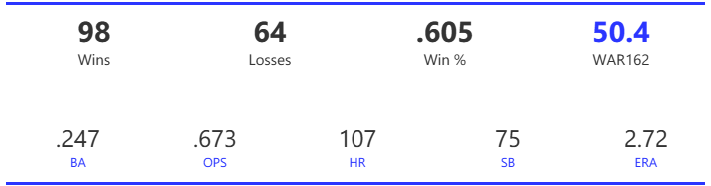
The Sox offense was limited, as their 642 runs ranked 7th in the league, and their 106 homers ranked 9th in the 10-team AL. Their best offensive categories were OBP (3rd), walks (1st), and strikeouts (1st). This was an offense that made contact and drew walks to compete with their AL rivals. Pitching was the major strength for the Chicagoans, with a 2.72 ERA and a 1.102 WHIP, numbers that easily topped the AL. The Chicago staff was very stingy with walks and also yielded the fewest hits of any team.
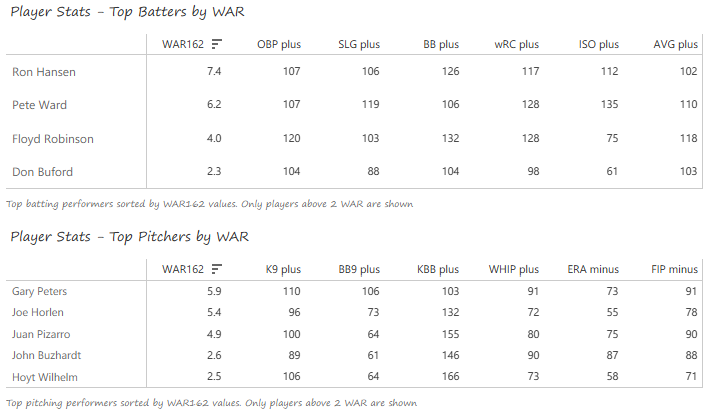
Ron Hansen and Pete Ward were the team’s offensive leaders, aided by Floyd Robinson. Hansen (20 homers, 85 runs) played well at shortstop, and Ward (23 homers, 94 RBI, .282 BA) added plenty of production from third base. Robinson batted .301 with a .388 OBP to round out the Sox’s top producers. On the mound, Gary Peters authored a 20-8 record and 2.50 ERA, while Joe Horlen won 13 with a sparkling 1.88 ERA and the AL’s top WHIP and hits per 9 innings numbers. Juan Pizarro went 19-9, John Buzhardt added 10 wins, and knuckleballer Hoyt Wilhelm saved 21 games at age 41.

The 1961 Tigers won 101 games but still finished 8 games behind a powerful Yankees squad in the AL pennant chase. The Tigers’ win projection was 98, so they had a bit of good fortune, but were still a strong team.
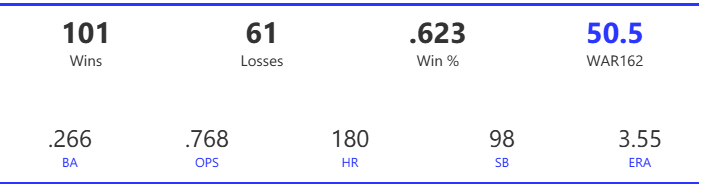
Offense powered the Tigers to their 101 wins, as their 841 runs led the AL. Their 180 homers trailed the slugging Yankees and Angels, but they led the league in BA and OBP while placing second in OPS. Detroit’s pitching was solid, with third-place rankings in ERA and WHIP, and the top spot in strikeout-to-walk rate, courtesy of issuing the fewest free passes in the AL.
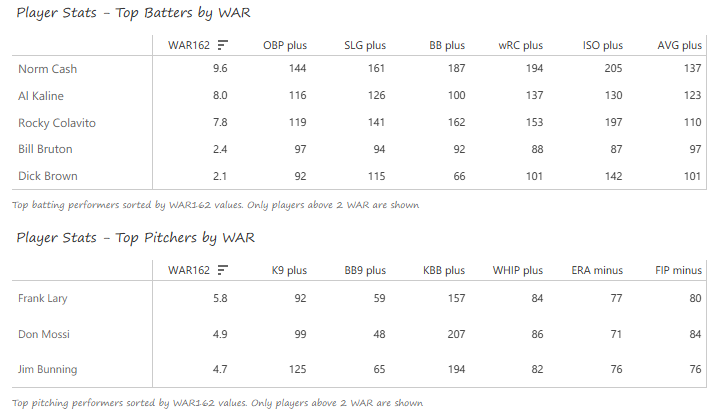
First baseman Norm Cash had a career year, leading the AL in BA (.361), OBP (.487), and OPS (1.148) while slugging 41 homers with 132 RBI and 119 runs scored. Al Kaline also had a fine season, batting .324 with a league-best 41 doubles and Gold Glove defense, and Rocky Colavito was close behind after slugging 45 homers with 140 RBI while batting .290. This trio accounted for more than 80% of the Tigers’ positional WAR. The pitching staff was led by Frank Lary (23-9), who tossed an AL-best 22 complete games. Don Mossi topped the AL in the fewest walks per 9 innings metric while winning 15, and Jim Bunning posted a 17-11 record.

The 1963 Twins finished third in the American League pennant race, 15.5 games back of the Yankees. However, the Twins were a very unlucky team for the season, finishing 7 games below their projected win figure. The Yankees were slightly lucky on the year (+4 wins over projection); put those together and the Twins were just two games worse than the Yanks.
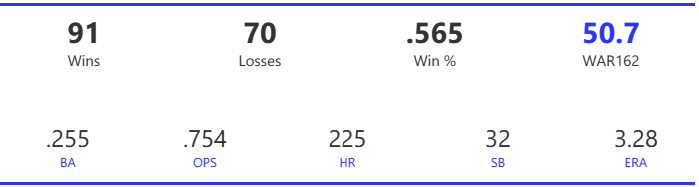
The Twins were a strong offensive club, leading the AL with 767 runs, 53 more than the Yankees. They clobbered 222 homers to easily top the AL, and they ranked first in BA and OPS, and a close second in OBP. Their pitching was above average, but not exceptional – third in ERA, WHIP, and strikeout-to-walk rate.
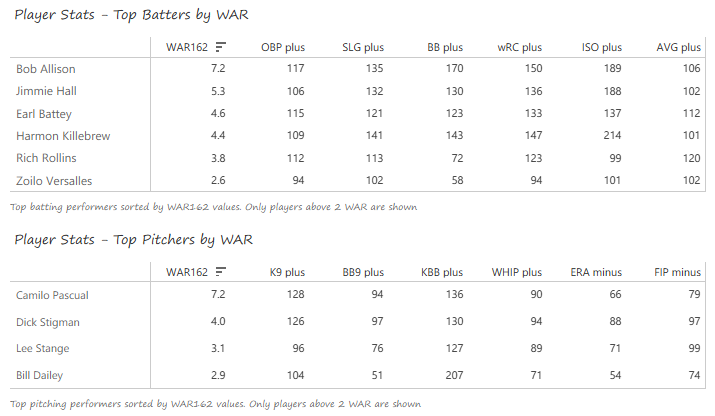
Bob Allison had a fine season, leading the AL in runs (99) and OPS (.911) after a 35-homer season. Jimmie Hall added 33 homers in his rookie year, and catcher Earl Battey added 26 more round-trippers. Harmon Killebrew led the AL with 45 homers, and Rich Rollins batted .307. Camilo Pascual was the ace of the pitching staff, going 21-9 and leading the league with 18 complete games and 202 strikeouts. Dick Stigman (15) and Lee Stange (12) combined for 27 wins.

The 1963 Cardinals were the runner-up to the Dodgers in the NL, as the Dodgers were 7 games over their win projection, and the Cardinals were one below their projected 94 wins.
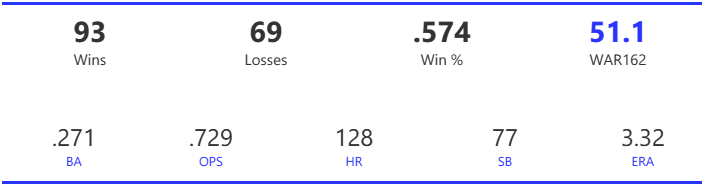
The Cardinals led the NL with 747 runs, and also led the league in doubles and triples. They also topped the league in BA and OBP, and finished a single point behind the Giants in OPS. The pitching staff was rather average, finishing 7th in ERA, 5th in WHIP, and 6th in strikeout-to-walk rate.
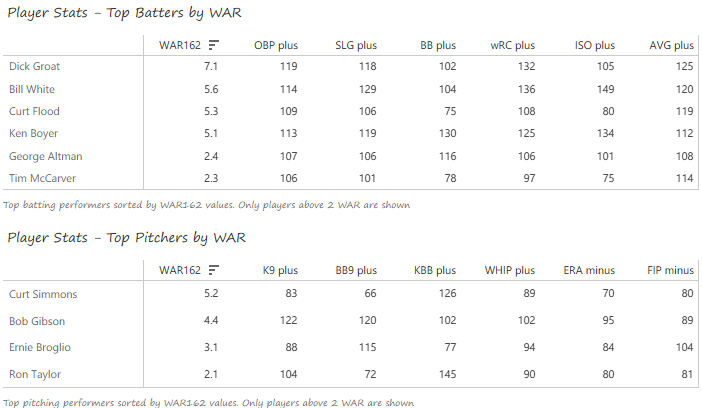
Dick Groat, Bill White, Curt Flood, and Ken Boyer all provided offensive firepower as well as defensive skill. Groat led the way (.319 BA, 43 doubles (NL-best), 85 runs), while White picked up a Gold Glove in addition to slugging 27 homers with 109 RBI. Flood was also a Gold Glove winner, while batting .302 with 112 runs, and Ken Boyer picked up a Gold Glove to go with 24 homers and 111 RBI. On the mound, it was primarily Curt Simmons and Bob Gibson leading the way. Simmons posted a 15-9 record with 6 shutouts and a 2.48 ERA, and Gibson racked up 18 wins.

The 1962 Giants defeated their Los Angeles rivals in a single-game playoff to claim the NL pennant. They then lost a heartbreaking 7-game World Series to the Yankees.
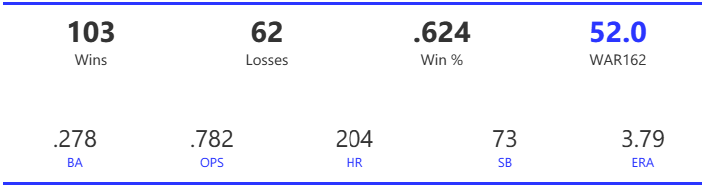
The Giants topped the league with 878 runs, 36 more than the Dodgers. They also launched 204 homers and swept the BA, OBP, SLG, and OPS categories behind a deep offense. The Giants ERA ranked just 6th in the NL, but they were 2nd in WHIP. Still, it was the offense that made the Giants pennant winners.
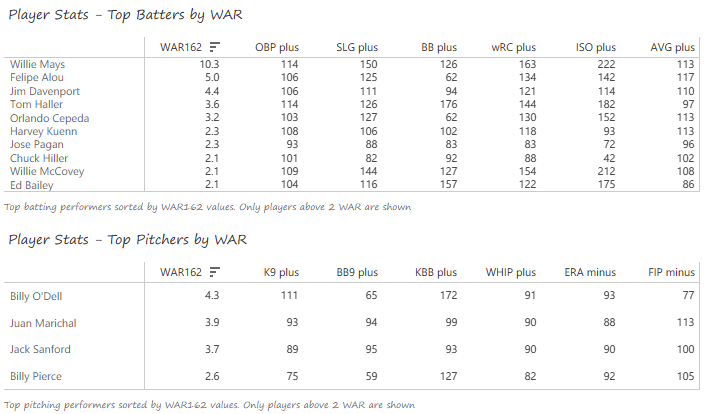
Willie Mays recorded one of his best seasons, mashing an NL-best 49 homers, with 141 RBI, 130 runs, 18 stolen bases, and a .304 BA, plus a Gold Glove in center field. Right fielder Felipe Alou batted .316 with 25 home runs and 98 RBI, and third baseman added a Gold Glove to go with his .297 BA. The Giants pitching was led by the trio of Billy O’Dell (19-14), Juan Marichal (18-11), and Jack Sanford (24-7). All three had ERAs in the mid-3s, so they weren’t dominant, just solid.

Summary

That’s it for the third entry in our MLB Team Rankings for the 1960s decade! Stay tuned for the countdown from #5 to #1, arriving in a few days. As always, thanks for reading!
1960s MLB Team Rankings Countdown: 15 through 11

Welcome to the second countdown post in our series of MLB team rankings for the 1960s. After decades with eight teams per league, the 1960s brought two waves of expansion – two new AL teams in 1961, two new NL teams in 1962, and two more for both in 1969. As a reminder, the teams are ranked from #20 through #1 based on aggregate WAR162. For the 1960s (1960-1969), a total of 198 teams were eligible, so the top 20 teams are a rather exclusive group – the top 10% for the decade. We’ll summarize each team, including portions of their team dashboard, and explain how they attained their ranking. So, without further ado, here are the teams ranked #15 through #11.

Here’s the interactive dashboard at Tableau Public: 1960s Top 20 MLB Teams Dashboard

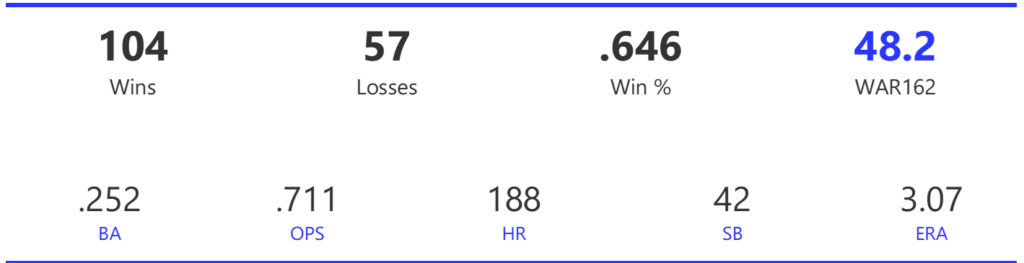
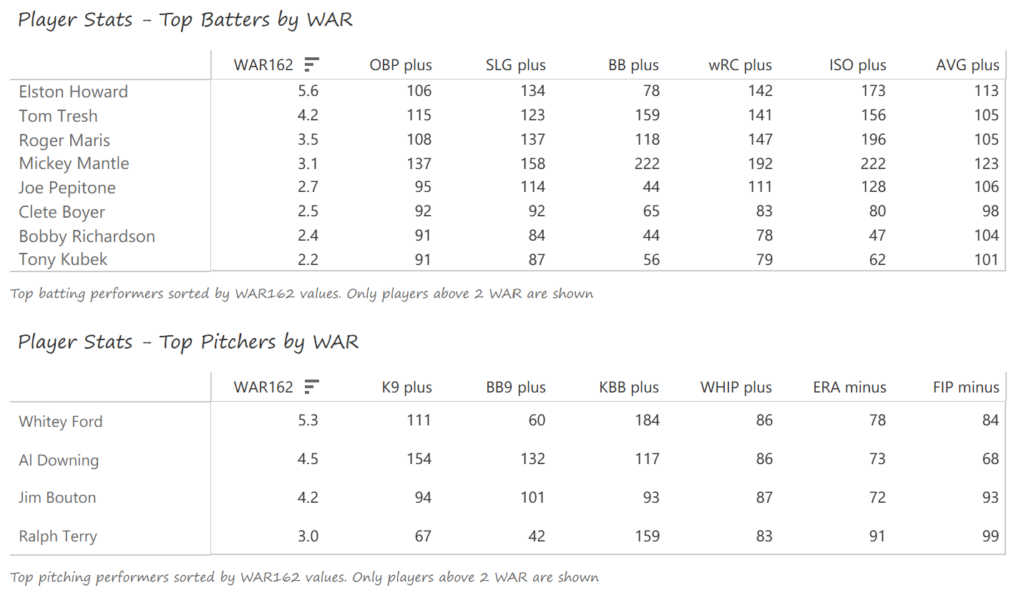
The 1963 Yankees won 104 games to cruise to the AL pennant by 10.5 games over the White Sox. The two teams were more evenly matched than the numbers suggest; Pythagorean projections have the Yankees just 2.5 games better than the Sox. The Yankees went to the World Series, only to be stunned by the Dodgers in a 4-game sweep.

The New Yorkers had a good offense, but not a dominant one. They ranked 2nd in runs, home runs, and BA, but just 7th in OBP and 3rd in OPS. The Yankees ranked dead last in walks, a dramatic departure from tradition. Pitching kept the Yankees at the top, as they led the AL in WHIP and ranked second behind the White Sox in ERA.

Elston Howard was the most effective position player for the Yankees, batting .287 with 28 homers and 85 RBI from his catcher position. Tom Tresh had 25 home runs and a .371 OBP as one of the few Yankees who would accept a walk (83 on the season), and Roger Maris added 23 homers. Mickey Mantle managed just 213 plate appearances due to injury, batting .314 with a 1.063 OPS. Joe Pepitone hammered 27 homers at age 22, but had just a .304 OBP. The Yankees benefited from an excellent age-34 season assembled by Whitey Ford (24-7, 2.74 ERA). Al Downing had the top hits and strikeout rates per 9 innings in the league with a 13-5 record, and Jim Bouton recorded a 21-7 record with a 2.53 ERA. Ralph Terry led the league in WHIP (1.063) and complete games (18) on the way to 17 wins.

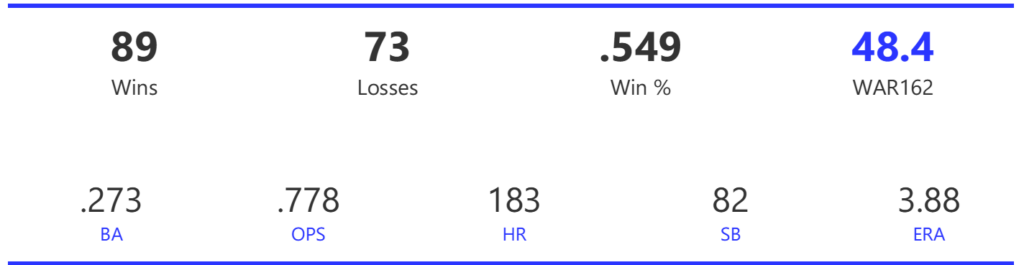
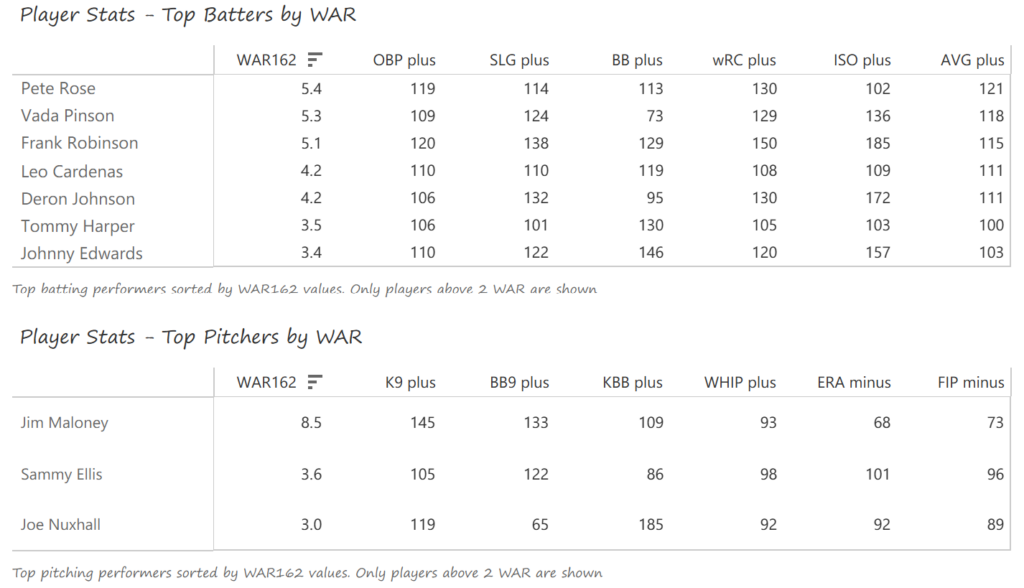
The Reds finished fourth in the NL, 8 games behind the Dodgers, despite winning 89 games. Pythagorean projections suggest that the Dodgers were quite lucky (+5 wins over expected) and the Reds were rather unlucky (-4 wins below expected). The Reds were good enough to win the NL pennant, but fortune had other ideas.

The Reds led the league in runs by a whopping 117-run margin over the Braves, helped by cozy Crosley Field. They ranked first in doubles and triples, and second to the Braves in home runs. The Reds also led the NL in each percentage metric – BA (.273), OBP (.339), SLG (.439), and OPS (.778). Pitching was their downfall, as they ranked 9th in both WHIP and ERA. The Reds staff struck out the most batters in the league; unfortunately, they also issued the most walks. Some of these numbers were tied to their ballpark, some were not.

Pete Rose emerged as an offensive force for the Reds, batting .312, with an NL-best 209 hits. Rose also scored 117 runs and had 81 RBI. Vada Pinson had a fine season (.305 BA, 22 homers, 94 RBI, 21 steals), and Frank Robinson batted .296 with 33 homers, 113 RBI, and 109 runs scored in his final Reds season. Shortstop Leo Cardenas batted .287, and Deron Johnson belted 32homers with an NL-best 130 RBI. Tommy Harper led the NL with 126 runs scored and stole 35 bases, and catcher Johnny Edwards added 17 homers. On the mound, Jim Maloney had a great season, with a 20-9 record, 2.54 ERA, 244 strikeouts, and 5 shutouts. Sammy Ellis went 22-10, and 36-year-old Joe Nuxhall was effective as a starter and reliever, recording an 11-4 mark.

The 1967 Cardinals ran away with the NL pennant, defeating the Giants by 10.5 games. They were a bit lucky to win 101 (Pythagorean projection was 97 wins), but were still the best NL team. The Cards went on to defeat the upstart Red Sox in a thrilling 7-game World Series.

The Cardinals had a solid offense, finishing just 7 runs behind the Cubs, leading the NL in steals, and ranking second in OBP and OPS. The pitching staff was also solid, trailing only the Giants in ERA and WHIP, and tying for second with 17 shutouts on the season.

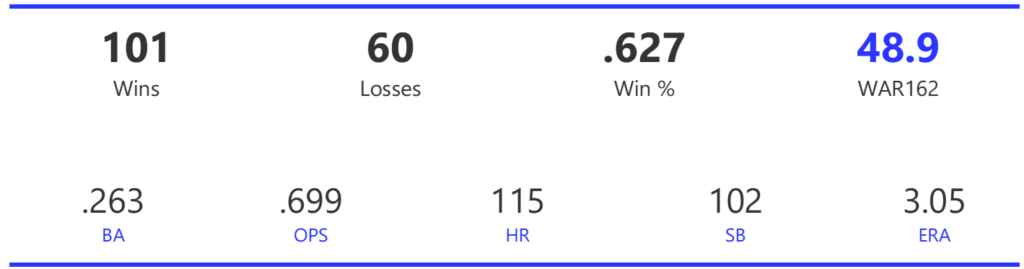
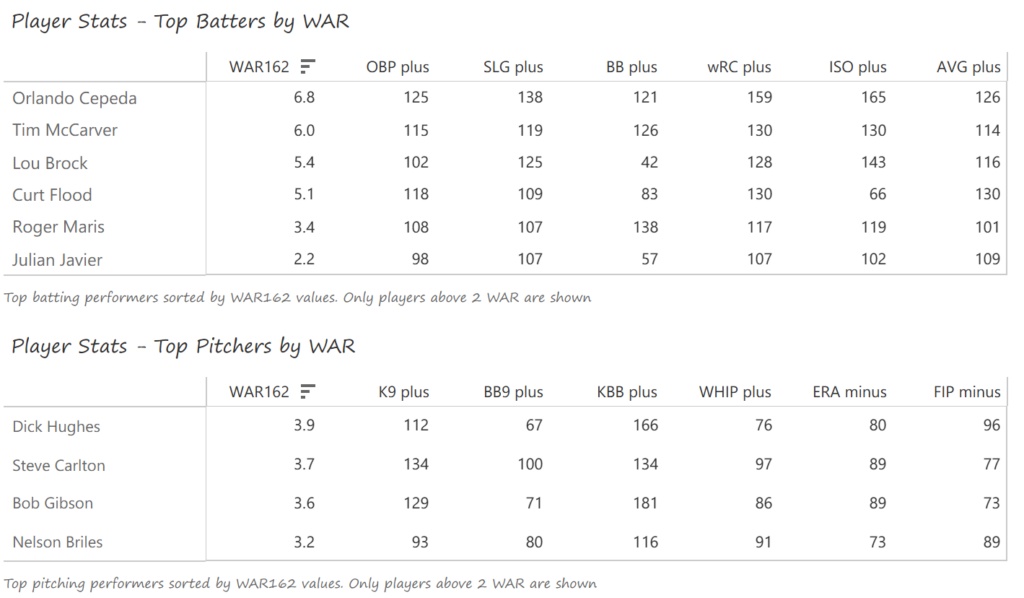
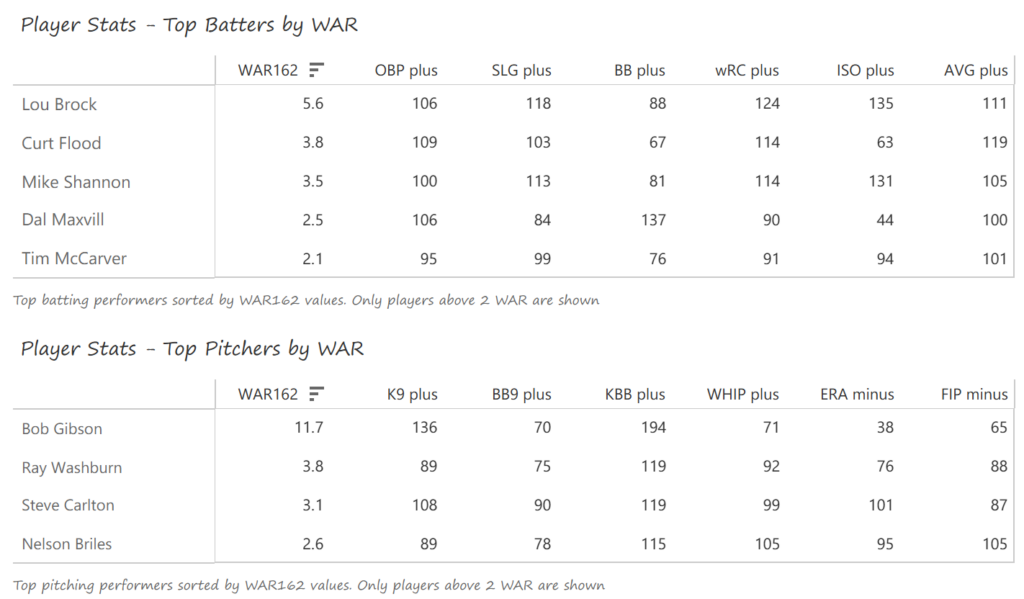
Orlando Cepeda earned NL MVP honors with a .325 BA, 25 home runs, 111 RBI (NL-best), and 37 doubles. Catcher Tim McCarver was second in MVP voting after a .295 BA with 14 homers and an excellent defensive season. Lou Brock led the league with 1123 runs and 52 stolen bases, and Curt Flood batted a robust .335 with Gold Glove defense in center field. Dick Hughes led a balanced pitching staff with a 16-6 mark and the top WHIP and hits per 9 innings marks in the NL. Steve Carlton (age 22) recorded a 14-9 campaign, and Bob Gibson posted a 13-7 record. Nelson Briles went 14-5 with a 2.43 ERA, working both in the rotation and out of the bullpen.

The 1966 Pirates finished a close third in the NL pennant race, just 3 games behind the Dodgers, and 1.5 back of a very lucky (+7 wins over projection) Giants team. The Pirates had identical 46-35 records at home and on the road in their near-miss season.

The Pirates had a very good offense, scoring 759 runs on the season, 2nd-most in the NL. They also led the league in doubles and triples. Their .279 BA was 16 points higher than the next-best mark, and they also led the league in OBP, SLG, and OPS. Unfortunately, the Pirates’ pitching was less effective than their hitting. The team ranked 4th in ERA and 7th in WHIP, and was no better than average in several other categories.

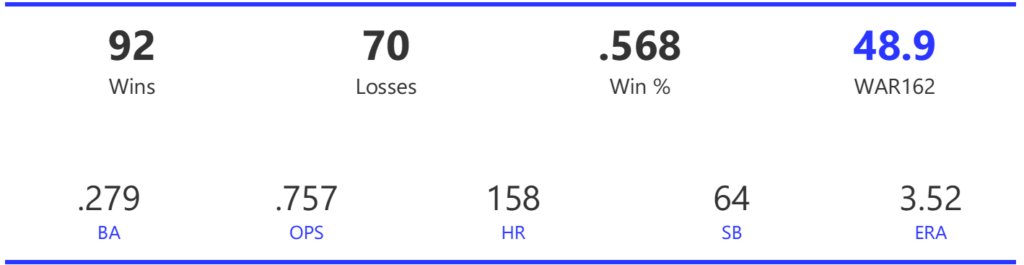
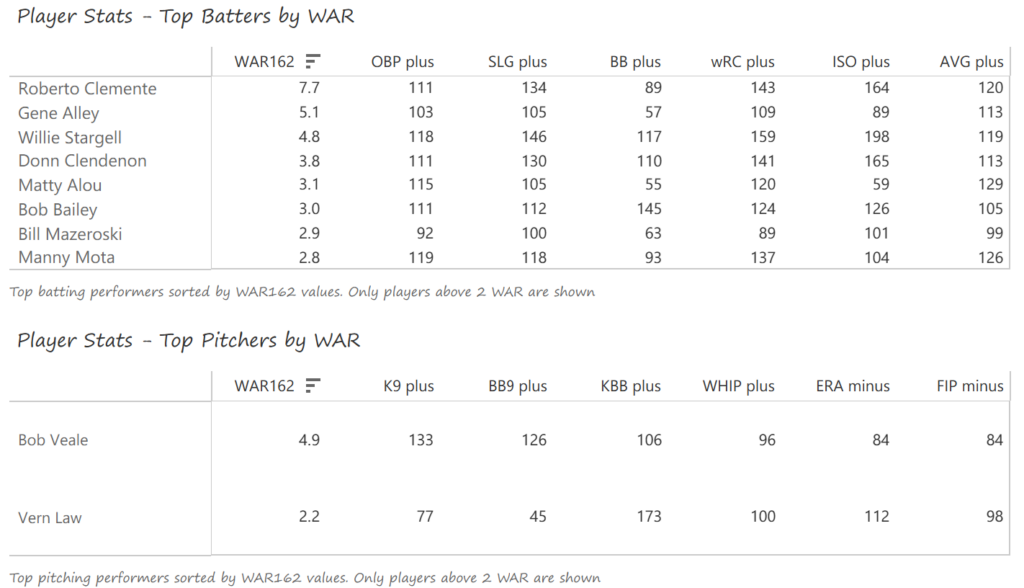
Right fielder Roberto Clemente was the clear leader of a deep offense, winning the NL MVP after a .317 BA, 29 homers, 119 RBI season. Clemente also scored 105 runs and claimed a Gold Glove. Gene Alley had a fine season at shortstop, batting .299 and winning a Gold Glove, and Willie Stargell belted 33 homers with 102 RBI and a .315 BA. Donn Clendenon batted .299 with 28 homers, and Matty Alou batted an NL-best .342. Bob Veale was the ace of a limited pitching staff, posting a 16-12 record with 229 strikeouts, aided by 36-year-old Vern Law, who added 12 wins.

The Dodgers edged out the Giants by 1.5 games and the Pirates by 3 games to claim the 1966 NL pennant. Their season ended on a low note when they were stunned in a World Series sweep at the hands of the Orioles.

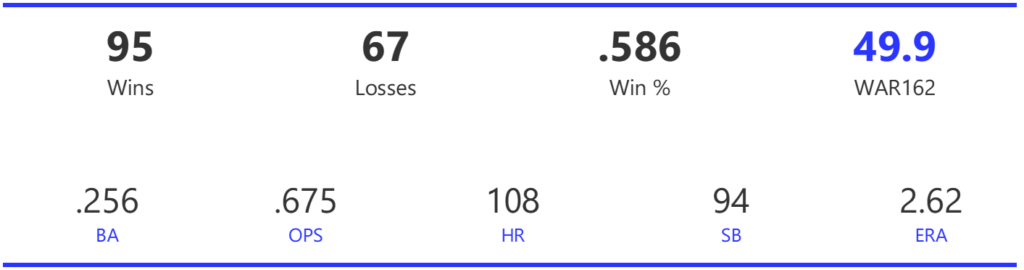
The Dodgers played home games at Dodger Stadium, notoriously known as a pitcher’s park. Even so, their offensive output was unimpressive, as they ranked 8th (out of 10) in runs scored, 7th in doubles, 10th in triples, and tied for 8th in home runs. Their .256 BA was 5th-best in the NL, as was their OBP, and they ranked a lowly 8th in OPS. Pitching was the Dodgers’ savior, with a 2.62 ERA and a 1.127 WHIP that ranked far ahead of their closest pursuers. They also led the league in strikeouts and strikeout-to-walk rate.

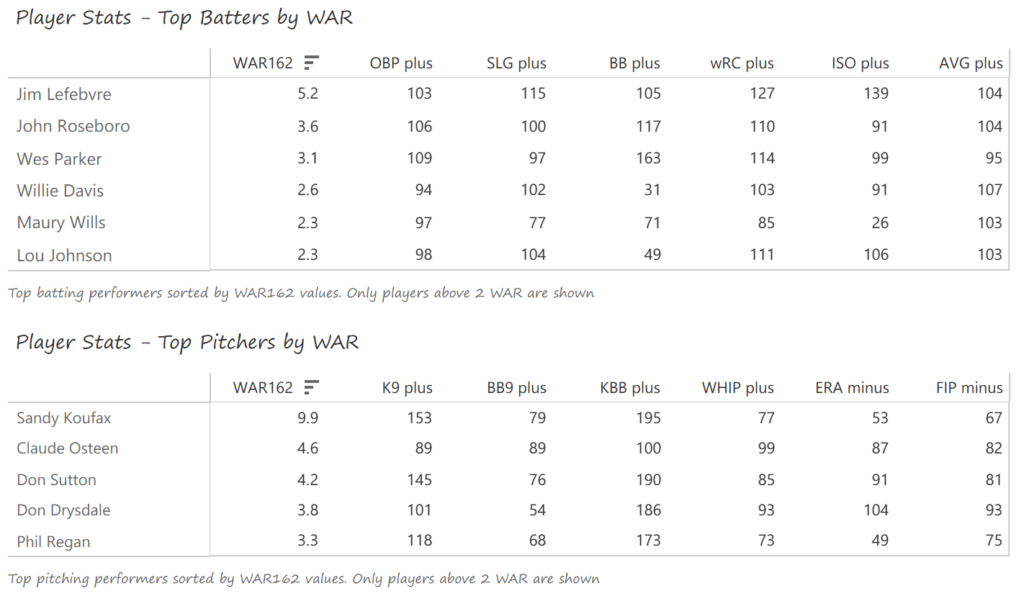
Jim Lefebvre led the offense with 24 homers, 74 RBI, and 69 runs scored, with catcher John Roseboro winning a Gold Glove and batting .276. Wes Parker was a solid presence at first base with a .351 OBP to help the Dodgers limited offense score often enough to win. On the mound, Sandy Koufax had a brilliant season, winning 27 games with a 1.73 ERA, 27 complete games, 317 strikeouts, and 5 shutouts, all best in the league. This performance earned Koufax the Cy Young Award for 1966. Claude Osteen won 17 games with a 2.85 ERA, Don Sutton had a fine age-21 season, winning 12 with a 2.99 ERA, and veteran Don Drysdale added another 13 wins. Phil Regan had a marvelous season out of the bullpen, posting a 14-1 mark with a 1.62 ERA and an NL-best 21 saves.

Summary

That’s it for the second entry in our MLB Team Rankings for the 1960s decade! Stay tuned for the countdown from #10 to #6, arriving in a few days. As always, thanks for reading!

1960s MLB Team Rankings Countdown: 20 through 16

Welcome to the first countdown post in our series of MLB team rankings for the 1960s. After decades with eight teams per league, the 1960s brought two waves of expansion – two new AL teams in 1961, two new NL teams in 1962, and two more for both in 1969. As a reminder, the teams are ranked from #20 through #1 based on aggregate WAR162. For the 1960s (1960-1969), a total of 198 teams were eligible, so the top 20 teams are a rather exclusive group – the top 10% for the decade. We’ll summarize each team, including portions of their team dashboard, and explain how they attained their ranking. So, without further ado, here are the teams ranked #20 through #16.

Here’s the interactive dashboard at Tableau Public: 1960s Top 20 MLB Teams Dashboard

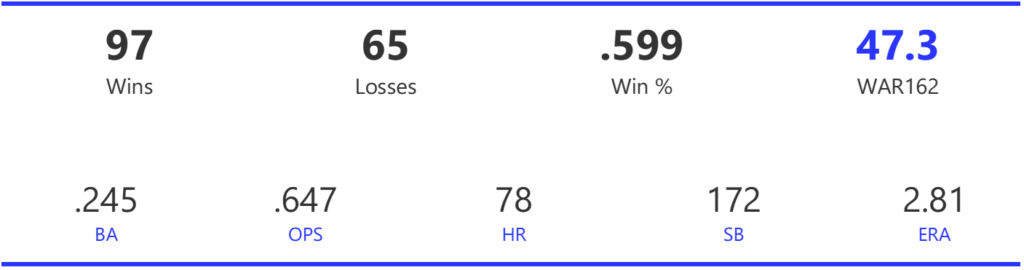
The 1965 Dodgers held off the rival Giants by two games to claim the NL pennant. The Dodgers projected as a 92-win team, so they were fortunate to win 97 games, but they made the most of it by defeating the Twins in a 7-game World Series.

Offense was not a strength for the Dodgers – their 608 runs placed 8th in a 10-team league, and they hit the fewest homers in the NL. Even within the pitching-friendly environment at Dodger Stadium, these were low numbers. The Dodgers ranked 7th, 6th, and 8th, respectively, in BA, OBP, and OPS. Fortunately, they had exceptional pitching, with league-leading numbers in ERA, WHIP, and shutouts, and ranked near the top in strikeouts and walks.

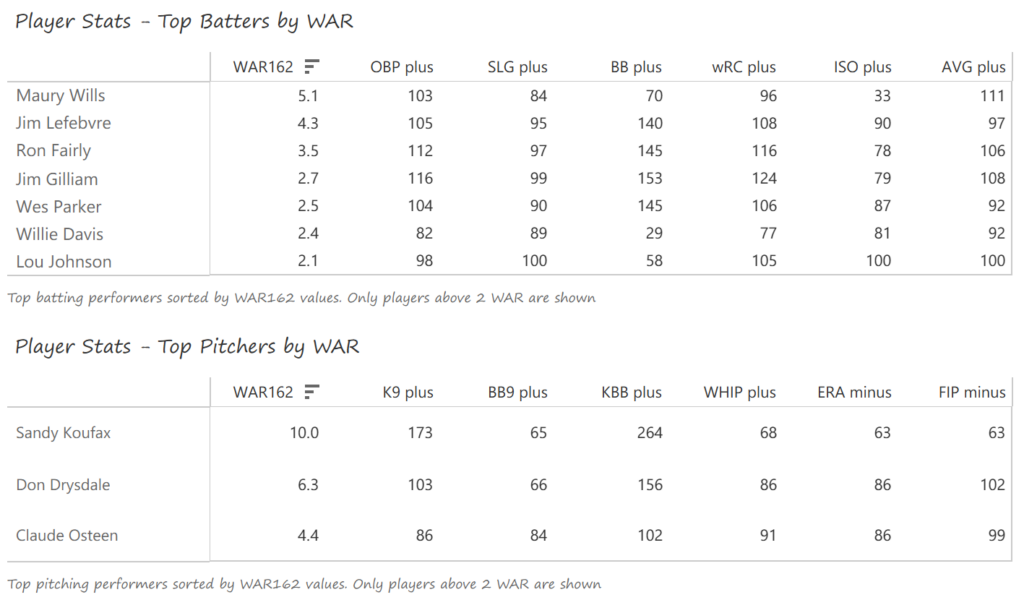
Maury Wills swiped 94 bases to lead the NL, while batting .286 and scoring 92 runs. His double-play partner Jim Lefebvre was effective at second base, earning Rookie of the Year honors, and Ron Fairly batted .274 with a .361 OBP. Additional support came from veteran Jim Gilliam (.280 BA), Wes Parker, and Willie Davis (25 steals). Interestingly, Wills, Lefebvre, Gilliam, and Parker were all switch-hitters, while Davis and Fairly batted from the left side. Sandy Koufax had a monster season, going 26-8 with a 2.04 ERA, 382 strikeouts, and a 0.855 WHIP, topping the NL in each category and winning the Cy Young award. Don Drysdale was an excellent second option, going 23-12 with a 2.77 ERA, and Claude Osteen added another 15 wins with a 2.79 ERA.

The Cardinals repeated as NL champs, defeating the Giants by 9 games before losing to the Tigers in a dramatic 7-game World Series.

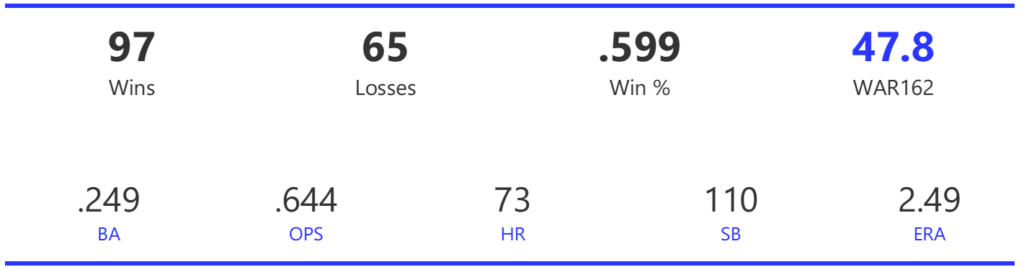
The Cardinals’ offense was quite average, tying for fourth in runs scored, and ranking just 8th (of 10) in home runs. They did place second in stolen bases, but were fourth or worse in BA, OBP, and OPS. The pitching was exceptional, even by the standards of the so-called Year of the Pitcher (NL-average ERA of 2.99). The Cards’ ERA of 2.49 topped the league, as did their 1.120 WHIP and 30 shutouts. They also ranked near the top in strikeouts and walks.

Lou Brock led the league in three metrics – doubles (46), triples (14), and steals (62). Outfield mate Curt Flood batted .301, and Mike Shannon had 15 homers and 79 RBI. Bob Gibson compiled a season for the ages with a 22-9 mark, 268 strikeouts, 13 shutouts, and a 1.12 ERA on his way to Cy Young and MVP honors. Ray Washburn posted a 14-8 record with a 2.26 ERA, and a young Steve Carlton provided a glimpse of the future with 13 wins.

The Giants finished second in the 1967 NL pennant race, trailing the Cardinals by 10.5 games. According to Pythagorean projections, the gap should have been about 4 games, but the Cardinals were clearly the better club.

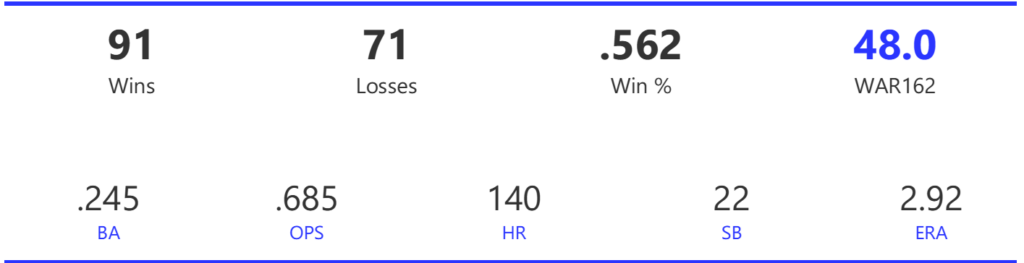
The Giants were a middle-of-the-pack offensive team, ranking 4th in runs and OPS, 6th in BA, and 5th in OBP. The team did have some power, trailing only the Braves in home runs. Pitching made the Giants a contender, as their 2.92 ERA and 1.177 WHIP topped the league. They ranked a bit lower in other metrics, but always above the NL average.

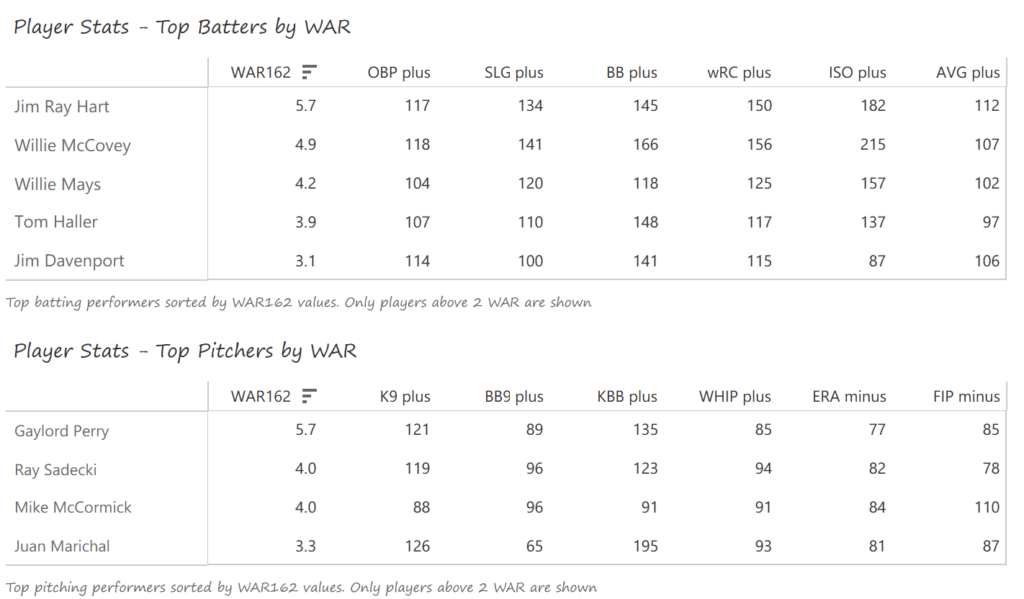
Third baseman Jim Ray Hart had a fine season, belting 29 homers to go with a .289 BA, 99 homers, and 98 runs scored. Willie McCovey led the Giants with 31 homers while batting .276 with 91 RBI, and 36-year-old Willie Mays added 22 homers. Tom Haller had an all-star season behind the plate, adding 14 homers to the mix. Gaylord Perry had a bad-luck 15-17 record despite his 2.61 ERA, while Ray Sadecki won 12 with a 2.78 ERA, and Mike McCormick claimed the Cy Young with a 22-10 mark and 2.85 ERA. Juan Marichal had a quiet season by his lofty standards, posting a 14-10 mark with a 2.76 ERA. He also posted the highest strikeout-to-walk rate in the NL. This foursome provided the Giants with a deep and consistent pitching staff for the 1967 season.

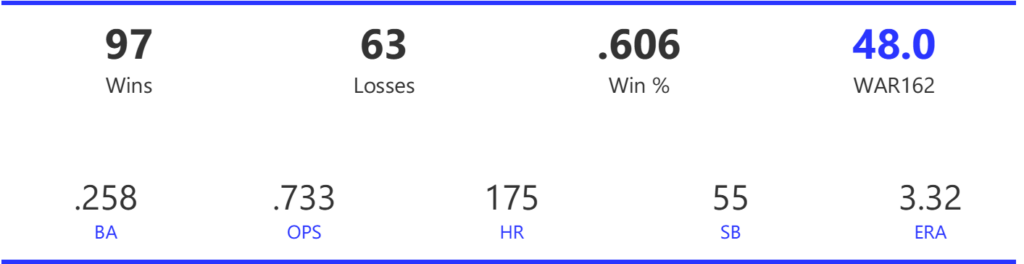
The 1966 Orioles topped the AL, beating the Twins by a solid 9-game margin to claim the AL pennant. The O’s then stunned the Dodgers in a 4-game World Series sweep.

The 1966 edition of the Orioles had a strong offense relative to their AL rivals. Their 755 runs were 36 more than the Tigers managed, and they finished just behind Detroit with 175 homers on the season. The team also led the AL with 243 doubles, and made a clean sweep of the BA, OBP, SLG, and OPS categories. The Orioles’ pitching was decidedly more ordinary, but possessed some young talent that would emerge over the next several seasons. The O’s ranked 4th in ERA and WHIP, and second in strikeouts behind the Indians.

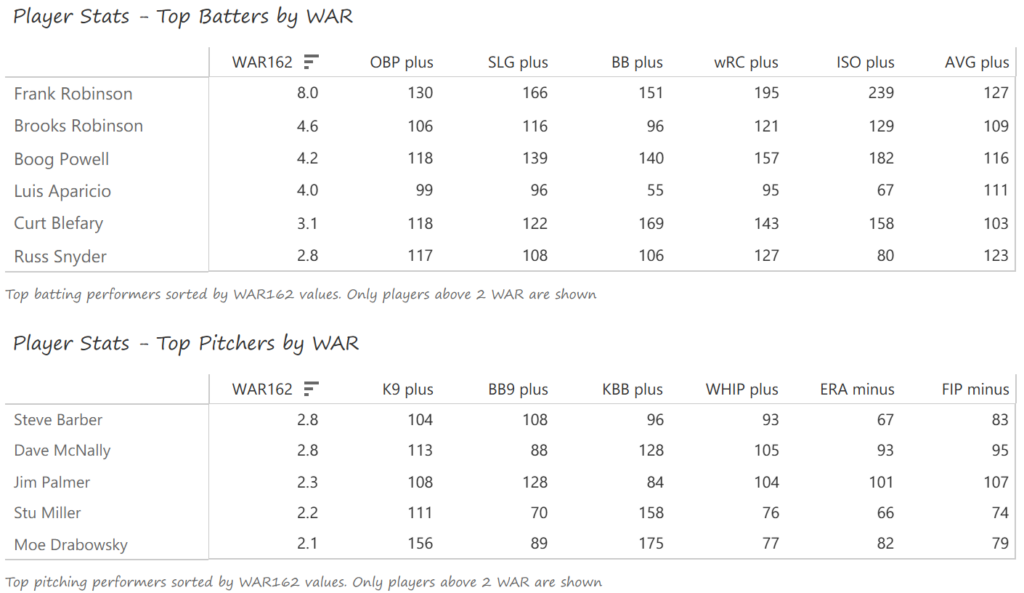
Triple Crown winner Frank Robinson was the offensive standout, leading the league in numerous batting metrics. Robinson batted .316 with a .410 OBP, 1.047 OPS, 122 runs scored, and 49 homers with 122 RBI on his way to MVP honors. His primary support came from defensive standout Brooks Robinson (23 homers, 100 RBI) and slugging first baseman Boog Powell (34 homers, 109 RBI). Shortstop Luis Aparicio added speed to the O’s lineup, swiping 25 bases and scoring 97 runs. The pitching staff was led by veteran Steve Barber, who posted a 10-5 record with 3 shutouts and a 2.30 ERA. Youngsters Dave McNally (age 23, 13-6 record) and Jim Palmer (age 20, 15-10 mark) provided a glimpse of future greatness on the mound for the Orioles.

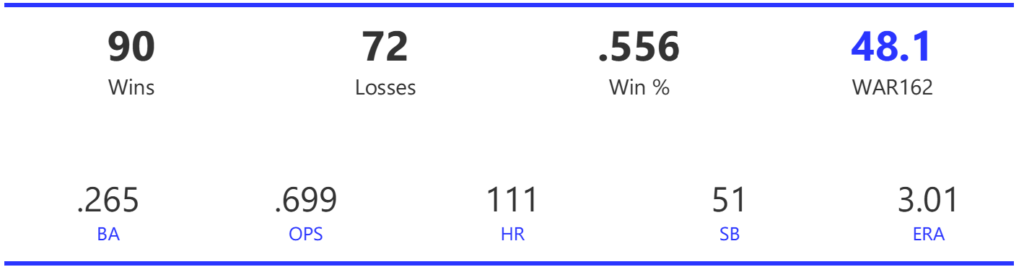
The Pirates finished third in the 1965 NL pennant race, trailing the Dodgers by 7 games and the Giants by 5 games. However, Pythagorean win projections have the Dodgers and Pirates at 92 wins, and the Giants at 91. The Dodgers and Giants had some favorable luck on their side; the Pirates did not.

The Pirates were not impressive offensively, finishing 5th in runs, 6th in homers, and 3rd in OPS. They were a bit better in the BA and OBP categories, ranking second behind the Reds. The Pirates’ pitching was solid, with the second-best NL ERA and 3rd-place rankings in shutouts and WHIP. The staff was average at best in the walk and strikeout categories.

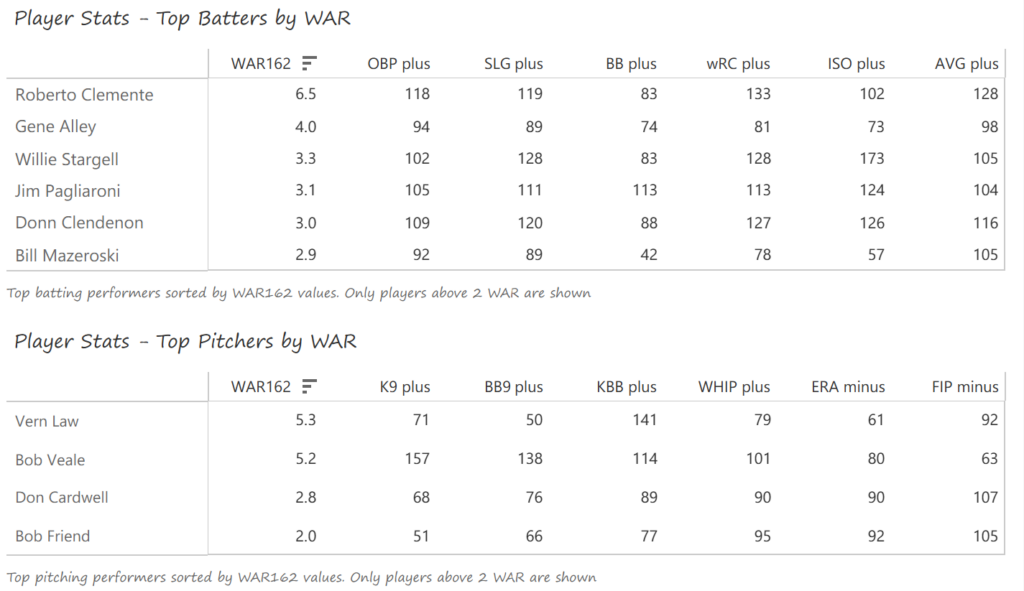
Roberto Clemente led the NL with a .329 average while scoring 91 runs and adding 14 triples along with his superlative defense. Young shortstop Gene Alley provided excellent defense, and Willie Stargell bopped 27 homers with 107 RBI. Catcher Jim Pagliaroni added 17 homers, and Donn Clendenon had 17 homers and a .301 BA. Vern Law had a terrific age-35 season, posting a 17-9 record with a 2.15 ERA, while Bob Veale went 17-12 with a 2.84 ERA despite leading the NL by dishing out 119 walks. Veale yielded just 5 home runs in 266 innings on the season, striking out 276 batters.

Summary

That’s it for the first entry in our MLB Team Rankings for the 1960s decade! Stay tuned for the countdown from #15 to #11, arriving in a few days. As always, thanks for reading!

1950s MLB Team Rankings Countdown: 5 through 1

Welcome to the final countdown post in our series of MLB team rankings for the 1950s. As a reminder, the teams are ranked from #20 through #1 based on aggregate WAR162. For the 1950s (1950-1959), a total of 160 teams were eligible (16 teams x 10 seasons), so the top 20 teams are a fairly exclusive group. We’ll summarize each team, including portions of their team dashboard, and explain how they attained their ranking. So, without further ado, here are the teams ranked #5 through #1.

Here’s the interactive dashboard at Tableau Public: 1950s Top 20 MLB Teams Dashboard

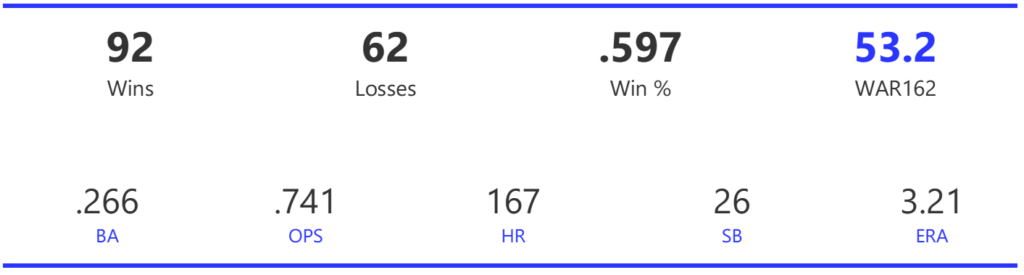
The Braves cruised to a second consecutive NL pennant, topping the Pirates by 8 games. Their season finished with a 7-game World Series defeat in a rematch with the Yankees.

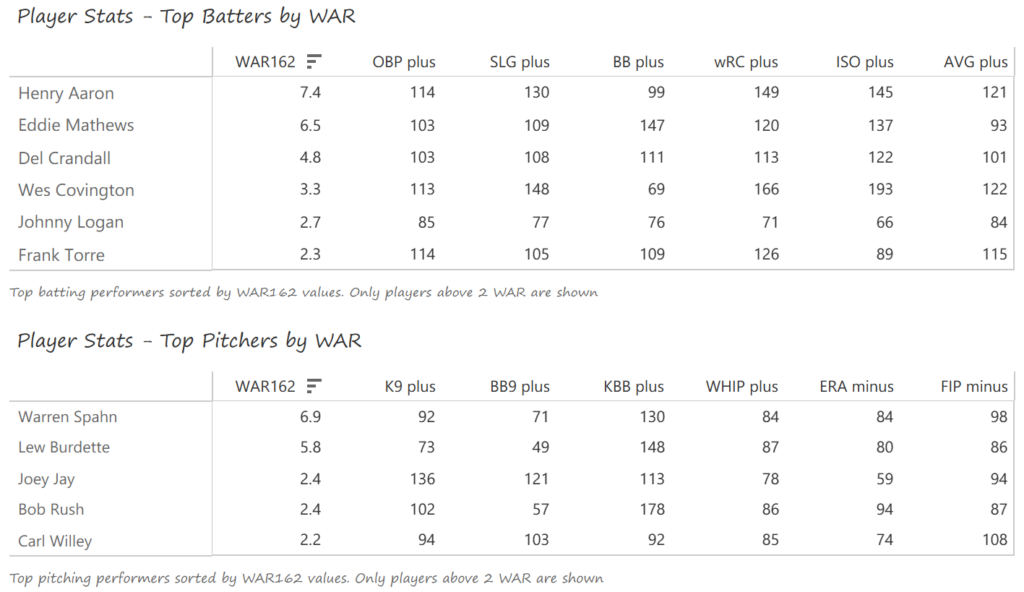
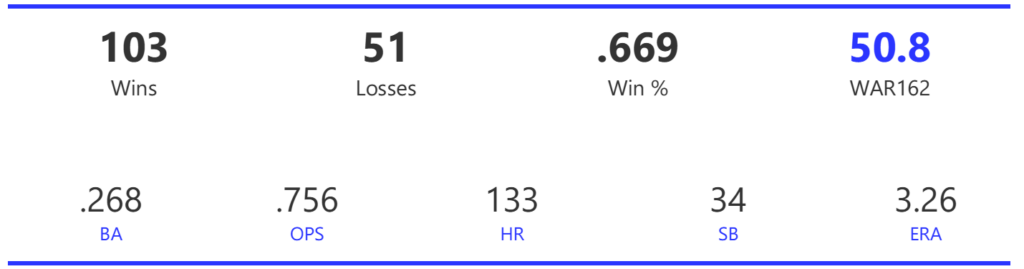
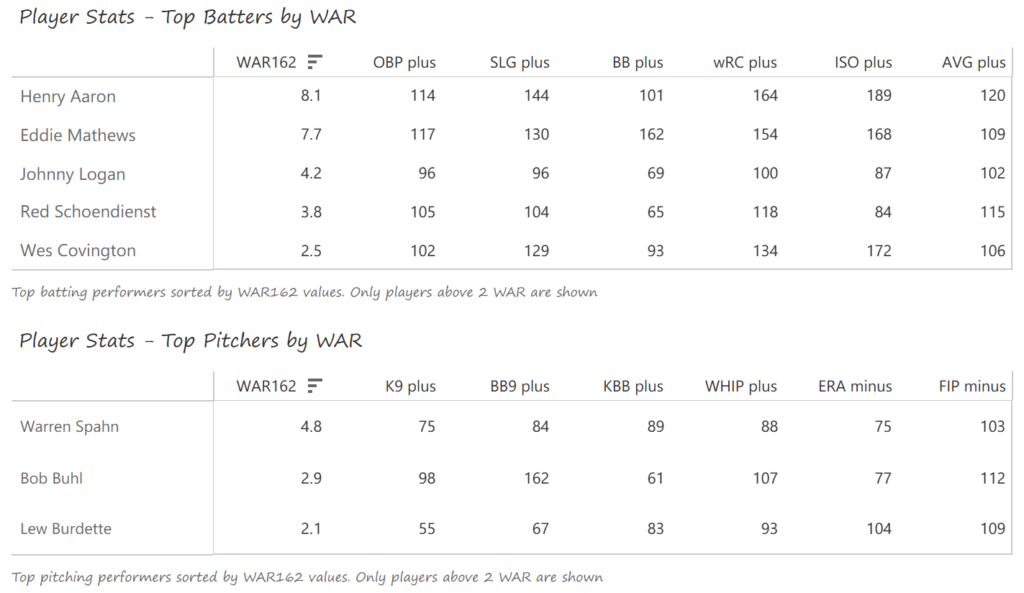
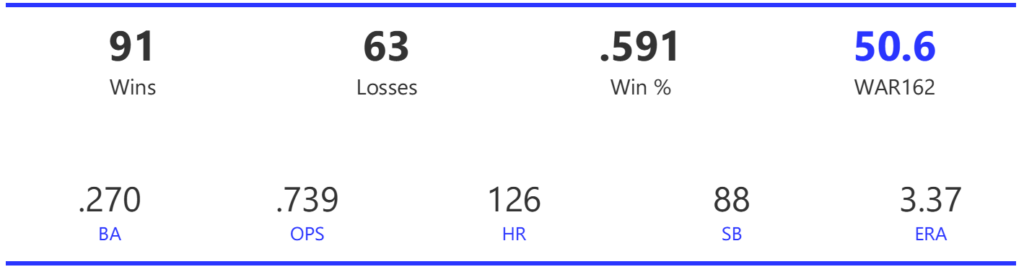
The Braves were not a powerful offensive squad despite the presence of some big-name stars. Their 675 runs ranked fourth, as did their 167 home runs in a power-laden NL season. They did manage to lead the league in BA (a virtual tie with the Phillies) but were third in OPS behind the Cubs and Giants. Pitching is what sets the Braves apart from their rivals, as they paced the NL in ERA, WHIP, shutouts, and strikeout-to-walk rate.

As usual, Hank Aaron and Eddie Mathews starred on offense for the Milwaukee club. Aaron batted .326 and stroked 30 homers, scored 109 runs, and had 95 RBI. Mathews belted 31 homers while drawing 85 walks, and catcher Del Crandall added 18 homers in his 131 games. Wes Covington homered 24 times in just 90 games played, batting .330. Warren Spahn had a fine age-37 season, posting a 22-11 record with 23 complete games and a 1.148 WHIP, all numbers topping the NL. Lew Burdette issued the fewest walks per 9 innings while winning 20 games, and the trio of Joey Jay (7-5), Bob Rush (10-6), and Carl Willey (9-7) combined for 26 wins behind the Spahn-Burdette duo.

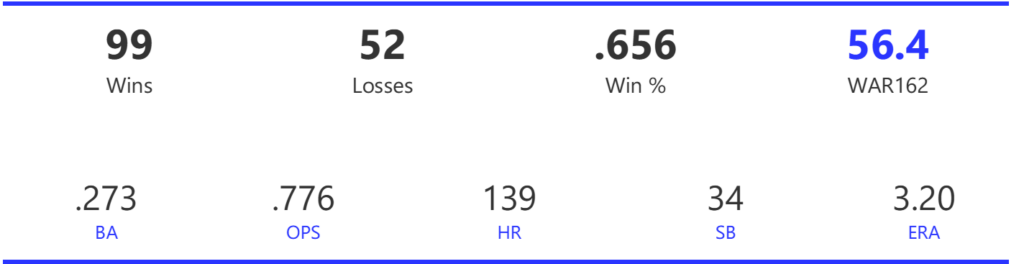
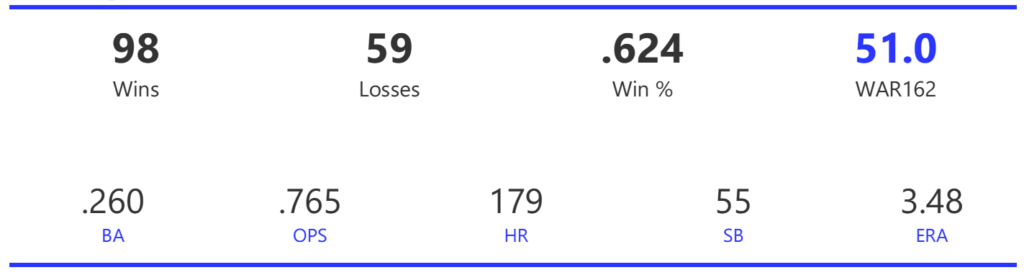
The Yankees repeated as AL champs in 1953, finishing 8.5 games ahead of the Indians. They then defeated the crosstown Dodgers in the World Series for the second consecutive season.

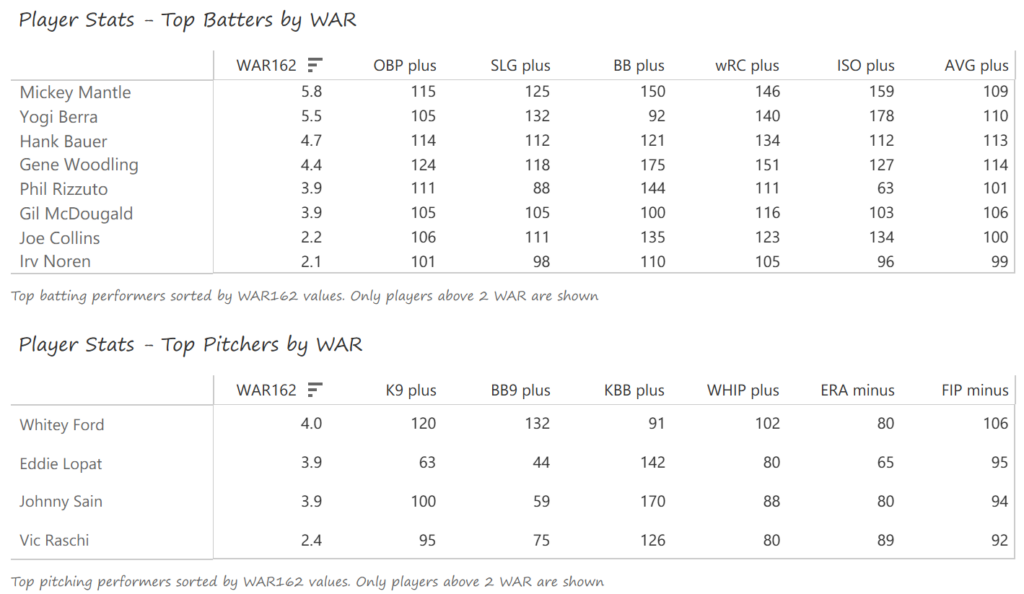
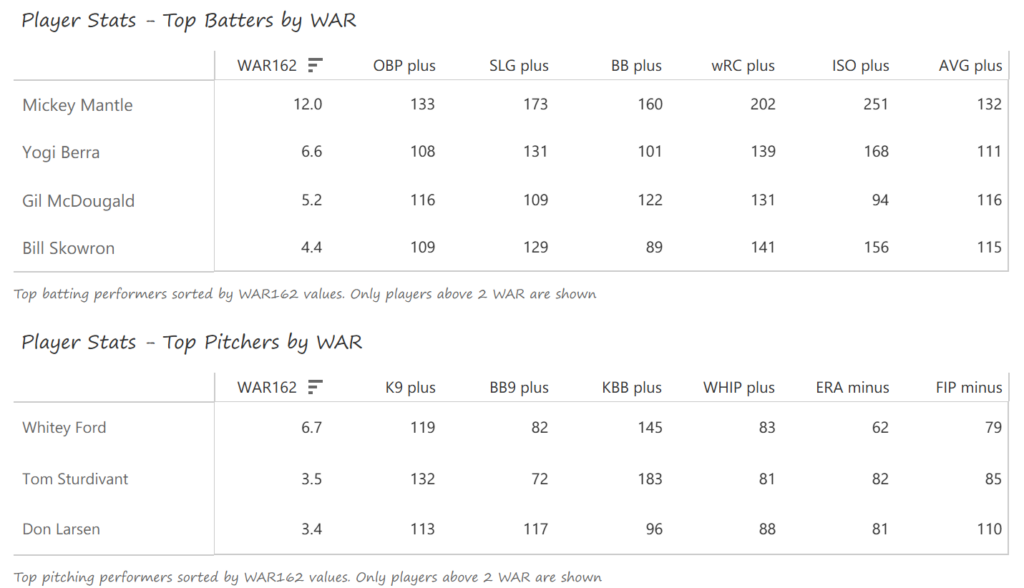
This edition of the Yankees had both a powerful offense and strong pitching. The offense produced 801 runs, 31 more than the Indians, and swatted 139 home runs, second in the league. The Yankees swept the BA, OBP, SLG, and OPS categories, with the Indians trailing them in each case. The pitching staff ERA of 3.20 was well ahead of the White Sox, and the team recorded the most shutouts, the best WHIP, and the second-best strikeout-to-walk rate in the AL.

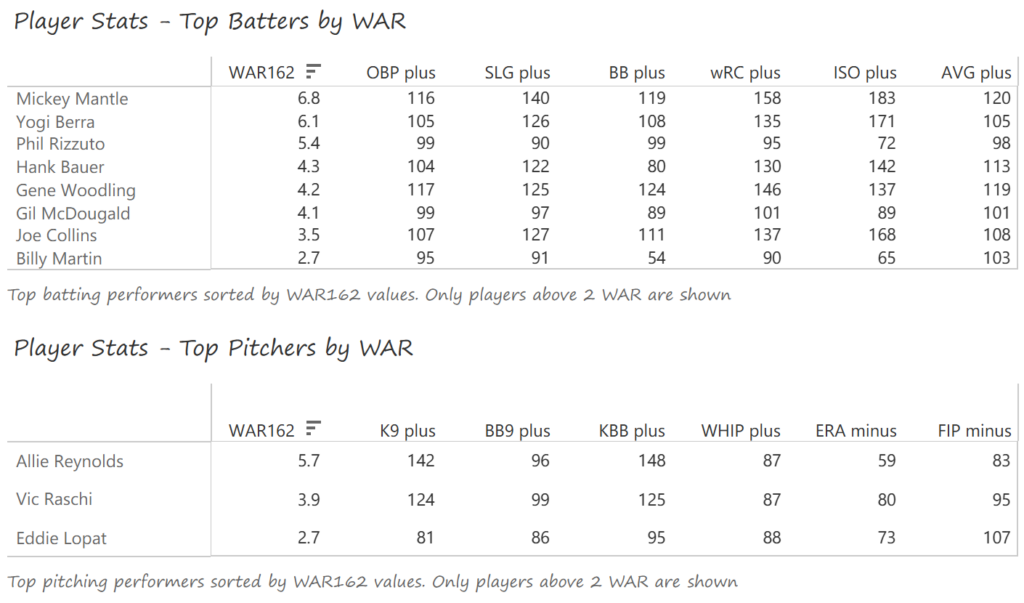
The offense was led by 21-year-old Mickey Mantle and veteran catcher Yogi Berra. Mantle scored 105 runs, had a .398 OBP, and launched 21 homers, while Berra had 27 homers with 108 RBI. Hank Bauer posted a .394 OBP, and teammate Gene Woodling had an AL-best .429 OBP for the season. Veteran shortstop Phil Rizzuto also excelled with a .383 OBP, and Gil McDougald batted .285 with 83 RBI. Whitey Ford went 18-6 with 3 shutouts, Eddie Lopat went 16-4 with a league-best 2.42 ERA, and veteran Johnny Sain went 14-7, largely in a relief role.

The 1955 Dodgers cruised to the NL title, finishing 13.5 games ahead of the Braves, and then conquered the Yankees (at last!) in a 7-game World Series. The Pythagorean projections had the Dodgers as a 95-win club, so they were a trifle lucky, but easily the top team in the NL.

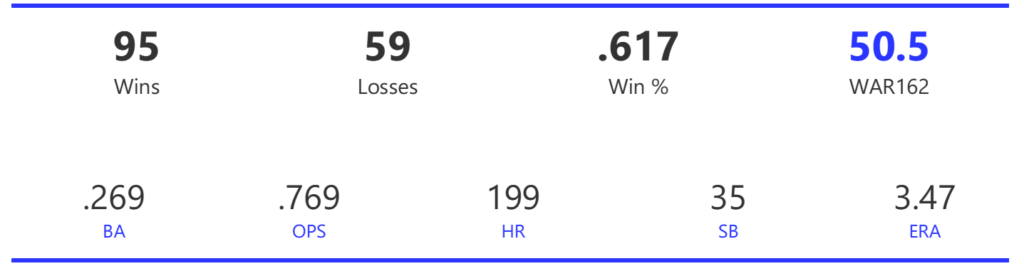
The Dodgers scored nearly 100 more runs than any of their rivals, with 857 for the season. They also blasted 201 homers and 230 doubles, and swept the BA, OBP, SLG, and OPS categories in 1955. This was a powerful offensive team that especially thrived at cozy Ebbets Field. Their pitching also led the NL in ERA, WHIP, strikeouts, and strikeout-to-walk rate, making the Dodgers the class of the league.

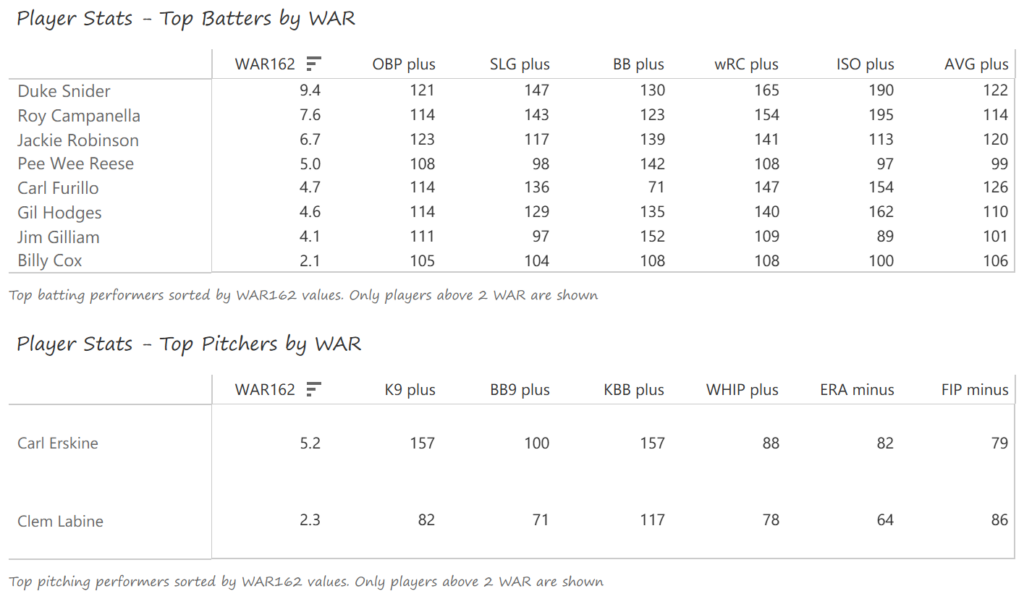
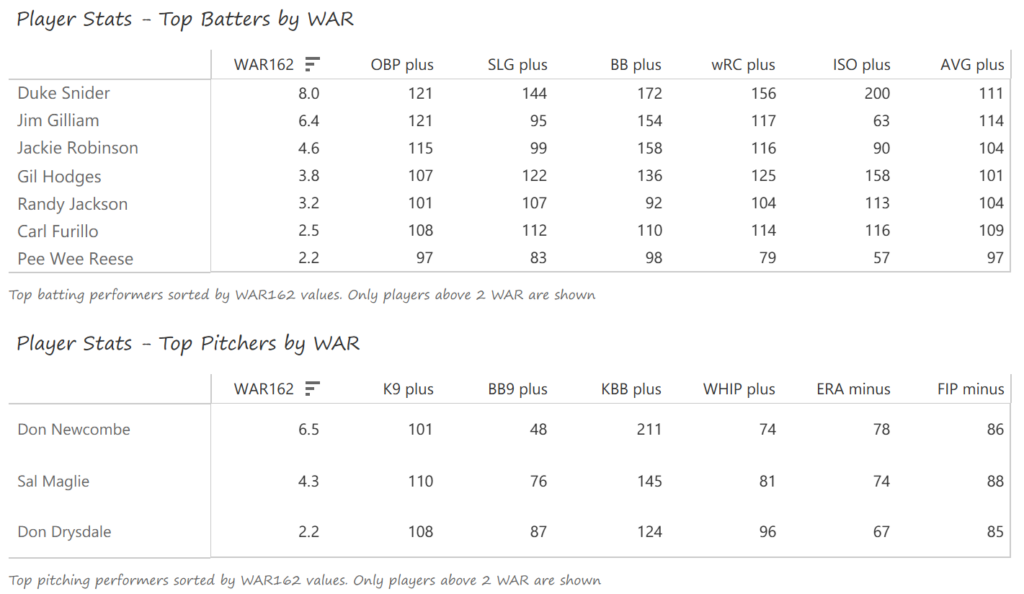
Duke Snider had an exceptional season, leading the NL with 126 runs scored and 136 RBI while batting .309 with a .418 OBP and 1.046 OPS fueled by 42 home runs. Roy Campanella was named NL MVP after a 32-homer, 107 RBI, .318 BA season, and Carl Furillo batted .314 with 95 RBI. Gil Hodges (27 HR, 102 RBI) and Pee Wee Reese (99 runs, .282 BA) also made strong contributions for a deep Dodgers lineup. Don Newcombe was the pitching star, logging a 20-5 record with an NL-best 1.113 WHIP, aided by Carl Erskine (11-8), Johnny Podres (9 wins), and reliever Clem Labine, who appeared in an NL-high 60 games, earning a 13-5 record.

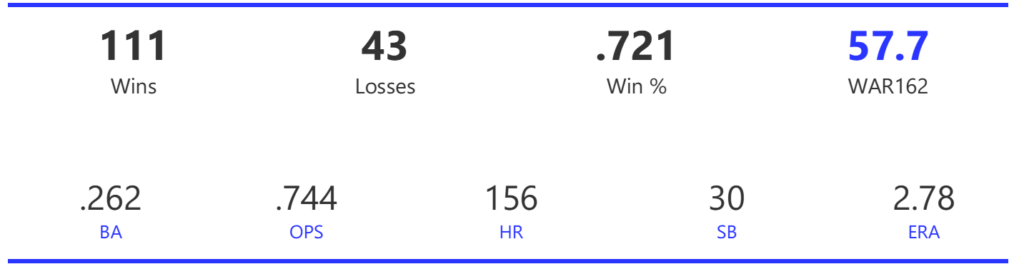
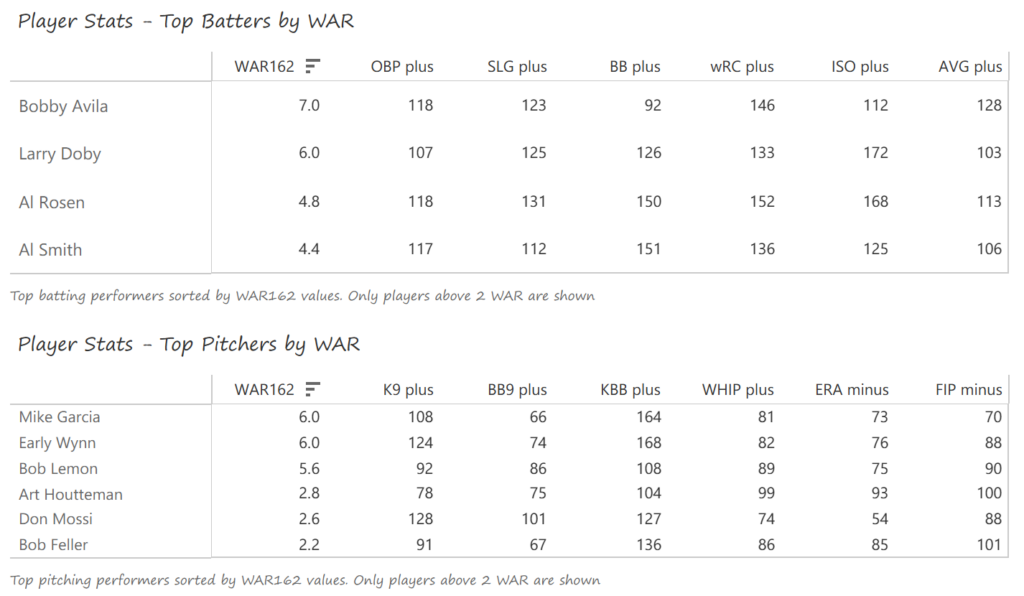
The 1954 Indians had the most impressive record of the decade, and one of the best of all-time. Luck played a role, as the Indians’ projection was for 104 wins. The team claimed the AL crown by 8 games over the Yankees, but was stunningly swept by the Giants in the World Series.

The Indians had a strong offense, although they trailed the Yankees in several categories. They ranked second in runs, home runs, and OPS, and just fourth in BA and OBP. Pitching was the strength of this team, as they posted a 2.78 ERA, well ahead of the White Sox and Yankees. The Indians staff issued the fewest walks, posted the best WHIP, and had the league’s highest strikeout-to-walk rate.

Bobby Avila was the offensive leader, batting .341 (AL-best) and scoring 112 runs. Larry Doby led the league with 32 homers and 26 RBI, Al Rosen batted .300 with 24 homers and 102 RBI, and Al Smith posted a .398 OBP. Mike Garcia (19-8, AL-best 2.64 ERA and 5 shutouts) and Early Wynn (23-11, 2.73 ERA) led the pitching corps, with Bob Lemon close behind, with a 23-7 record and 21 complete games.

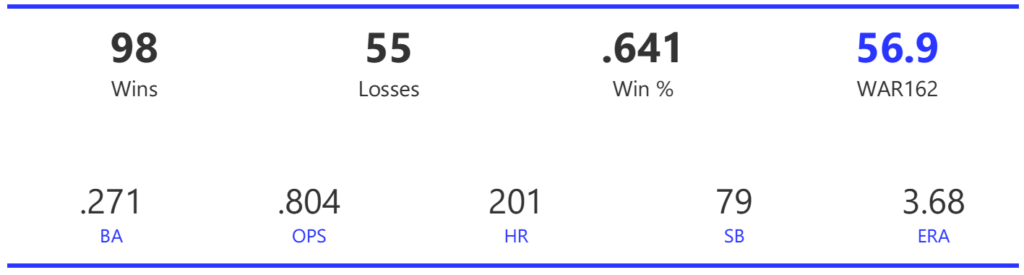
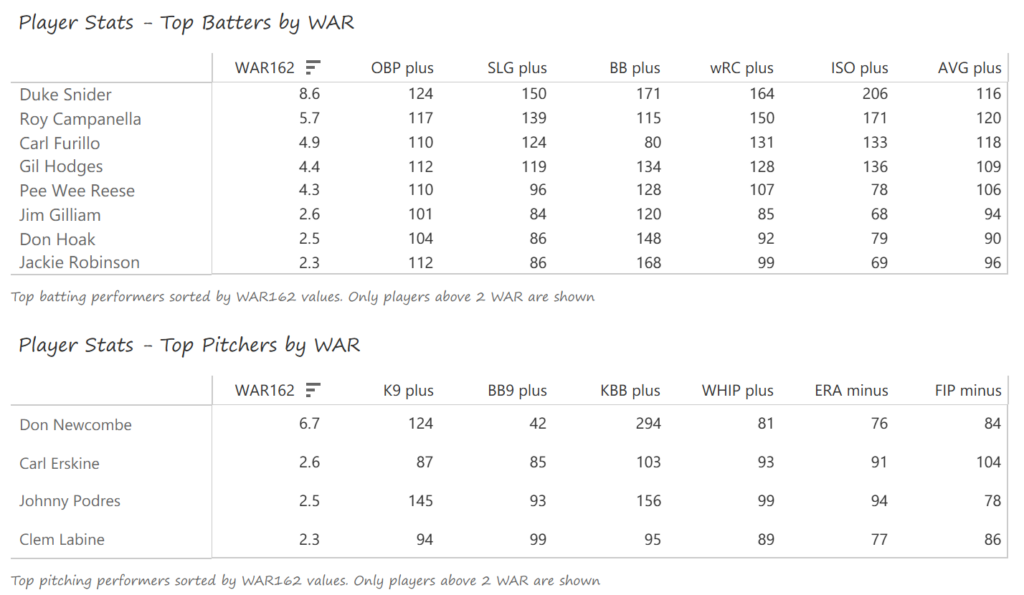
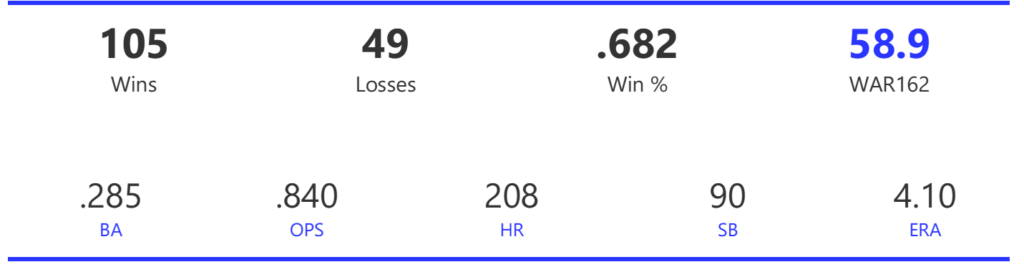
The 1953 Dodgers posted an impressive 60-17 home record on their way to 105 wins (versus a 99-win projection). This was plenty to beat the Braves by a 13-game margin for the NL pennant, before losing a 6-game World Series to the crosstown Yankees.

The Dodgers’ offense was likely the best of the 1950s, rolling up 955 runs, 187 more than their closest pursuers. They whacked 208 home runs and 274 doubles to top the NL in both categories, and swept the BA (.285), OBP (.366), SLG (.474), and OPS (.840) metrics. Their pitching was not quite as strong, ranking third in ERA and WHIP, but first in strikeouts and strikeout-to-walk rate.

Duke Snider had a career year, batting .336 with NL-best numbers in runs (132), SLG (.627), and OPS (1.046). Catcher Roy Campanella earned NL MVP honors, driving in an NL-best 142 runs while batting .312 with 41 home runs. Jackie Robinson had a fine season at age 34, stealing 17 bases, batting .329, and scoring 109 runs, and Pee Wee Reese scored 108 runs while playing his usual stellar defense at shortstop. Carl Furillo led the league with a .344 BA, Gil Hodges amassed 31 homers and 122 RBI, and Jim Gil liam earned Rookie of the Year honors with 21 steals, 17 triples (NL-best), and 100 walks. Carl Erskine was easily the top pitcher for the Dodgers, posting a 20-6 mark, while Clem Labine earned 11 wins with a 2.77 ERA in a primarily relief role.

Summary

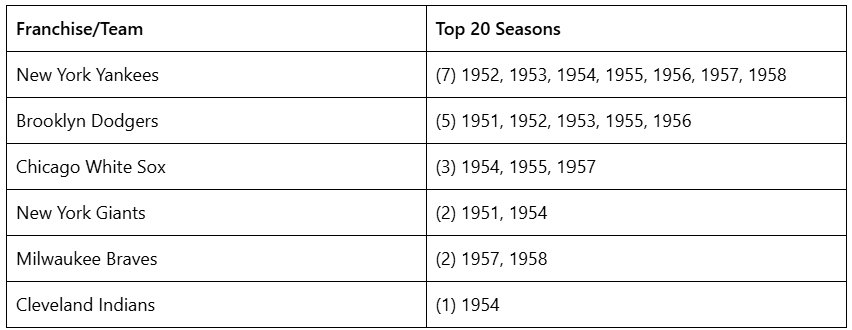
That’s it for the final entry in our MLB Team Rankings for the 1950s decade! Here’s a summary of the most dominant franchises of the 1950s:

1950s MLB Team Rankings Countdown: 10 through 6

Welcome to the third countdown post in our series of MLB team rankings for the 1950s. As a reminder, the teams are ranked from #20 through #1 based on aggregate WAR162. For the 1950s (1950-1959), a total of 160 teams were eligible (16 teams x 10 seasons), so the top 20 teams are a fairly exclusive group. We’ll summarize each team, including portions of their team dashboard, and explain how they attained their ranking. So, without further ado, here are the teams ranked #10 through #6.

Here’s the interactive dashboard at Tableau Public: 1950s Top 20 MLB Teams Dashboard

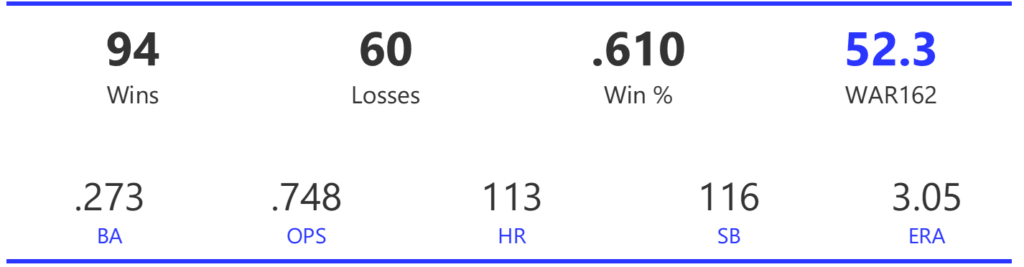
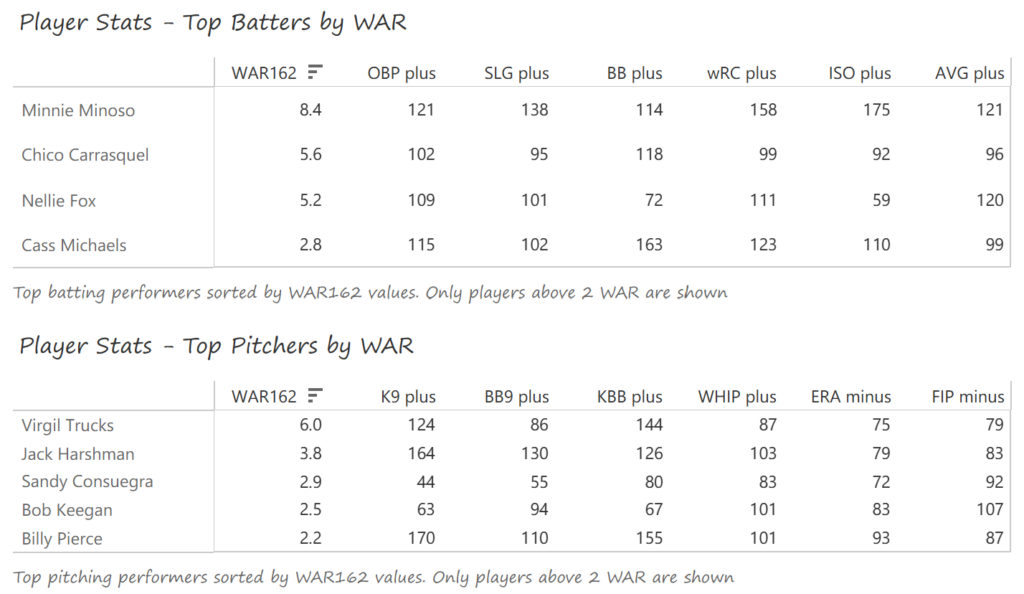
The White Sox won 94 games in 1954, and were projected for 98, and finished just third in the AL pennant race behind the Indians (111-43) and Yankees (103-51). However, the ’54 season set the table for multiple Southside Chicago contenders for the rest of the decade.

The White Sox were not a prolific offensive team; their 711 runs were well behind both the Yankees and Indians. They did rank second in BA and OBP, but just fourth in OPS due to a lack of home-run power. The Sox excelled in stealing bases compared to their rivals in the decade, and piled up 98 in the 1954 season. Pitching was a comparative strength, as the team’s 3.05 ERA and 1.281 WHIP trailed only the Indians. They were first in both strikeouts and strikeout-to-walk rate for the season.

Outfielder Minnie Minoso was the offensive leader for the team, recording 119 runs scored, 116 RBI, 19 triples (AL-best), and 20 homers to go with a .320 BA. Chico Carrasquel (.348 OBP) at shortstop and Nellie Fox (.319 BA) at second formed a strong defensive pair in the middle of the infield. On the mound, Virgil Trucks was the top gun, recording a 19-12 record with a 2.79 ERA at age 37. Jack Harshman went 14-8 with a 2.95 ERA to provide further support.

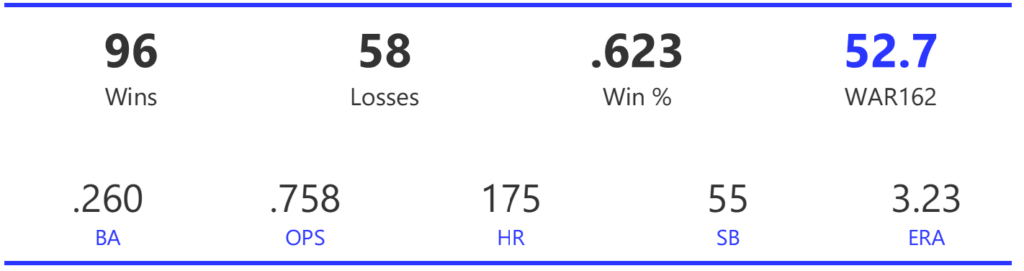
The rest of this countdown post features four Yankees teams ranked #9 through #6, starting with the 1955 club. The Yankees won the AL pennant by three games over the Indians (and five ahead of the White Sox) before dropping the World Series in a 7-game thriller versus the Dodgers.

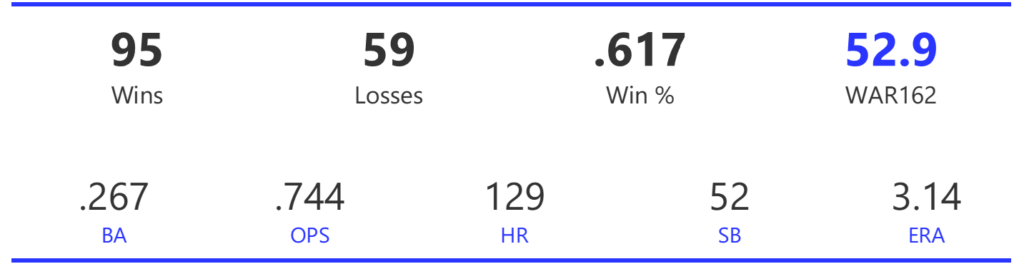
The Yankees easily led the AL with 175 homers and finished second in runs scored, behind the Tigers. Their mediocre BA (.260) and OBP (.340) were offset by a league-best .758 OPS, courtesy of the team’s long-ball power. The pitching staff had a strong season, leading the AL in ERA and hits per 9 innings, but finished just third in WHIP due to a high propensity to issue walks.

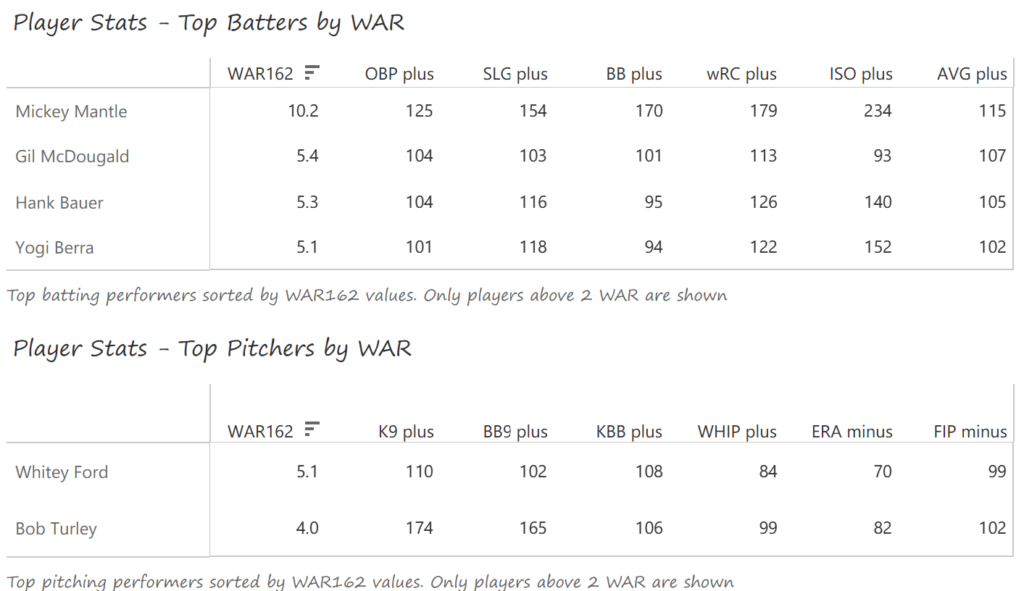
Mickey Mantle had a big season, leading the AL in OBP, SLG, OPS, walks, triples, and home runs. Gil McDougald (.361 OBP), Hank Bauer (20 homers), and Yogi Berra (27 homers, 108 RBI) provided strong offensive and defensive support for the Yanks. Whitey Ford was the standout on the mound, authoring an 18-7 record with 18 complete games (AL-best) while Bob Turley posted a 17-13 campaign. Both Ford (113) and Turley (AL-high 177) were prone to issuing free passes to batters, but excelled despite their control issues.

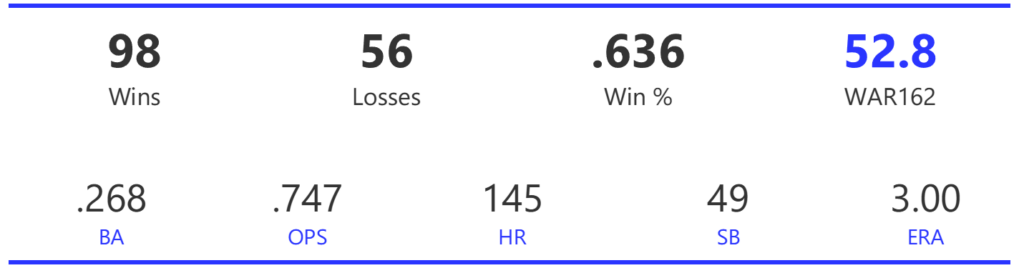
The 1957 Yankees claimed the AL pennant by 8 games over the White Sox, their third consecutive pennant, and a remarkable 7th since 1950. Only the 1954 Indians kept the Yankees from winning every pennant of the decade through 1957. Unfortunately, the Yankees were defeated by the Milwaukee Braves in a 7-game World Series.

The Yankees’ offense ranked at or near the top in most categories in 1957 – first in runs, triples, BA, SLG, and OPS, and second in homers and OBP. The pitching staff carved out a 3.00 ERA, far ahead of the White Sox’s 3.35. The staff also earned the most saves (42), and yielded the fewest hits per 9 innings (7.7). They ranked third in WHIP due to issuing lots of walks and ranked second in strikeouts.

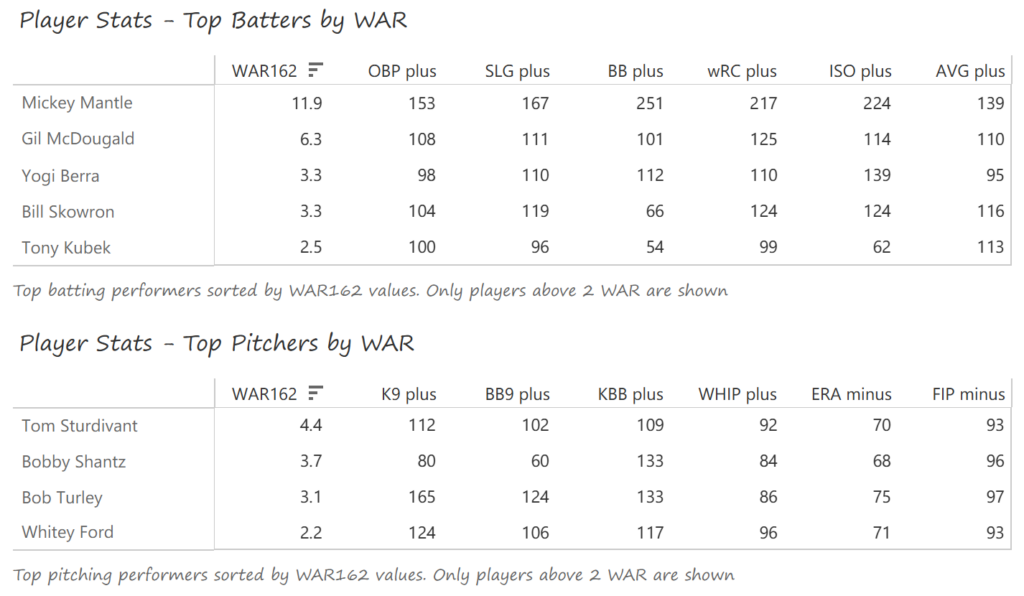
Mickey Mantle had one of his greatest seasons, earning AL MVP honors with 121 runs, 146 walks (both AL-best), and batting .365 with a 1.177 OPS. Gil McDougald had another strong season, batting .289 with a .362 OBP from his shortstop position, and Yogi Berra (24) and Bill Skowron (17, .304 BA) added home run power to the mix. Tom Sturdivant led the way on the mound, posting a 16-6 mark with a 2.54 ERA, and Bobby Shantz went 11-5 with a league-best 2.45 ERA. Bob Turley (13-6, 2.71 ERA) and Whitey Ford (11-5 in just 129 innings) rounded out a balanced staff.

The 1958 Yankees land at #7, just ahead of the 1957 team. The 1958 team was projected to win 96 games based on run differential, but still cruised to the title 10 games ahead of the White Sox. The New Yorkers then avenged their prior year World Series defeat by topping the Braves in seven games.

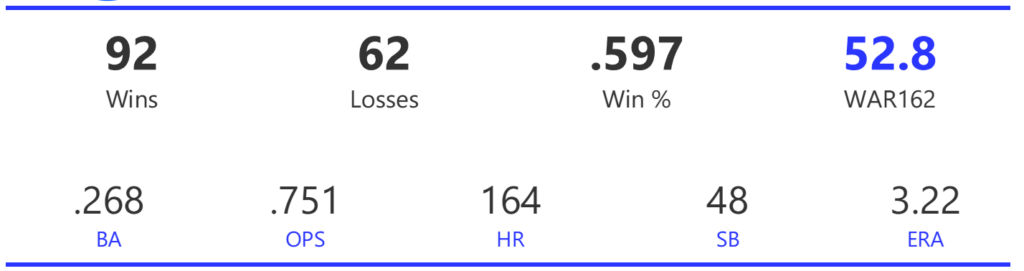
The Yankees easily topped the AL with 759 runs scored, 62 more than the Red Sox. They also topped the AL with 164 homers, a .268 BA, .416 SLG, and .751 OPS. The pitching staff once again topped the AL in ERA, as well as shutouts and saves, while placing second in strikeouts and third in WHIP.

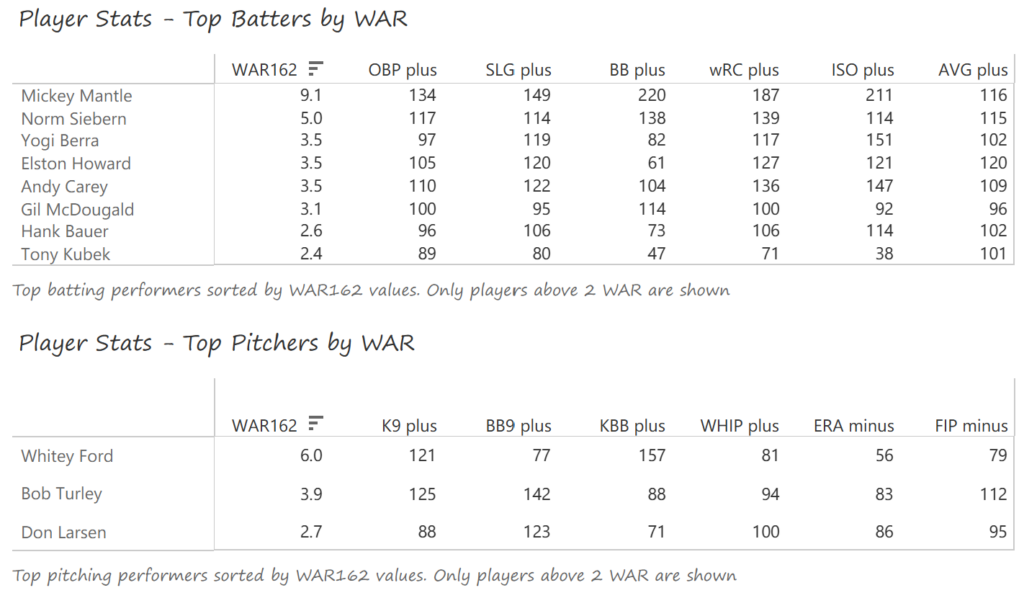
Once again, Mickey Mantle led the Yankees offense, belting 42 home runs, scoring 127 runs, drawing 129 walks (all AL-best) while batting .304 with a 1.035 OPS. Norm Siebern turned in a fine age-24 season, with a .300 BA, and Yogi Berra had 22 homers and 90 RBI from the catcher position. Elston Howard batted .314 as a utility player, and Andy Carey slugged 12 homers with 45 RBI in just 366 plate appearances. The pitching was again led by Whitey Ford (14-7, AL-best 2.01 ERA with 7 shutouts) and Cy Young winner Bob Turley (21-7, 2.97 ERA).

The 1952 Yankees continue our run of consecutive teams from the Bronx. The Yankees topped Cleveland in a hotly contested pennant race, claiming the pennant by a two-game margin. They then went on to defeat the Dodgers in a 7-game World Series.

The Yankees had a very good offense in 1952, although they trailed the Indians in both runs and home runs. The 1952 team boasted the league’s highest BA and ranked second in OPS, close behind the Indians. Pitching was a strength, with the staff leading the AL in ERA and shutouts, while ranking third in WHIP and strikeout-to-walk rate.

The offense was led by the 20-year-old Mickey Mantle, who batted .311 with an AL-best .924 OPS, and veteran catcher Yogi Berra, who slugged 30 homers and accumulated 98 RBI. Shortstop Phil Rizzuto had a fine age-34 season, stealing 17 bases and scoring 89 runs while playing excellent defense. More depth was provided by Hank Bauer (.293 BA, 17 homers), Gene Woodling (.309 BA, .397 OBP), and Gil McDougald (11 homers, 78 RBI). Allie Reynolds led the league with a 2.06 ERA and 6 shutouts while compiling a 20-8 record at age 35. Vic Raschi contributed 16 more wins, and Eddie Lopat added 10 as a capable third starter.

Summary

That’s it for the third entry in our MLB Team Rankings for the 1950s decade! Stay tuned for the countdown from #5 to #1, arriving in a few days. As always, thanks for reading!
1950s MLB Team Rankings Countdown: 15 through 11

Welcome to the second countdown post in our series of MLB team rankings for the 1950s. As a reminder, the teams are ranked from #20 through #1 based on aggregate WAR162. For the 1950s (1950-1959), a total of 160 teams were eligible (16 teams x 10 seasons), so the top 20 teams are a fairly exclusive group. We’ll summarize each team, including portions of their team dashboard, and explain how they attained their ranking. So, without further ado, here are the teams ranked #15 through #11.

Here’s the interactive dashboard at Tableau Public: 1950s Top 20 MLB Teams Dashboard

The Yankees put together a 103-win season, only to finish 8 games behind the Indians, who enjoyed a historic season. Even accounting for a hefty dose of luck for Cleveland, they were the better team in 1954.

The Yankees had a dominant offense that outscored the Indians by 59 runs and placed second in doubles, triples, and home runs. They were just ahead of the White Sox in BA and OBP, and well ahead of their rivals in OPS. While the Yankees’ pitching was sound, their performance was far behind the Indians’ numbers. The New Yorkers ranked third in ERA, third in WHIP, and second in shutouts. Their other pitching metrics were typically ahead of league average, but not comparable to the Indians’ or White Sox’ performances.

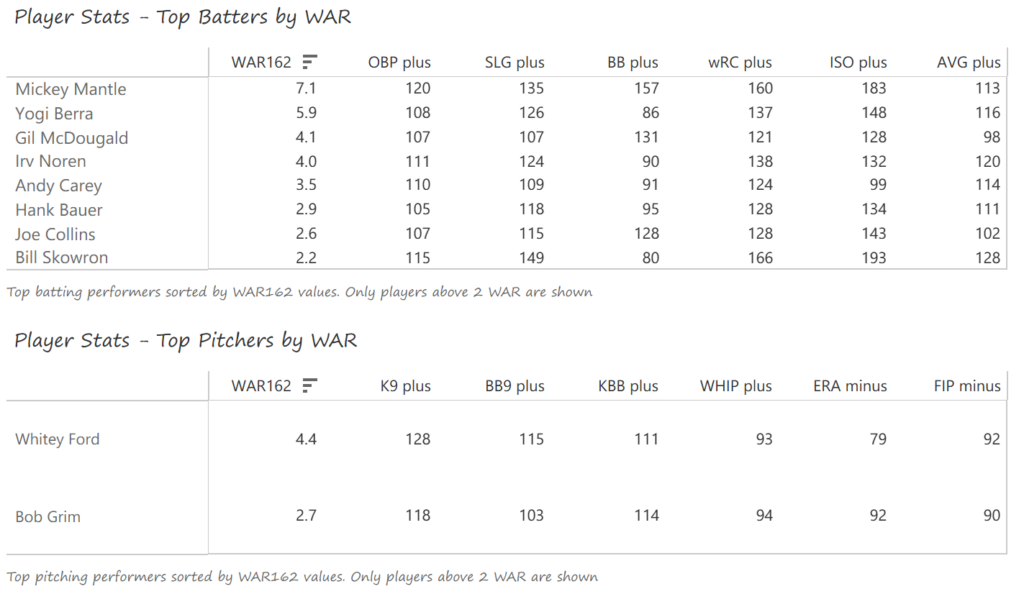
Mickey Mantle and Yogi Berra were the offensive stars for the Yankees, with Mantle batting .300, belting 27 homers, and leading the AL with 129 runs scored. Berra (AL MVP) batted .307 from his catcher spot, with 22 homers and 125 RBI. Gil McDougald was a standout at second base, Irv Noren batted .319 as a fourth outfielder, and Andy Carey batted .302 from his third base position. Whitey Ford led the pitching staff with a 16-8 record and 2.82 ERA, followed by Rookie of the Year Bob Grim (20-6, 3.26 ERA).

The 1956 Yankees coasted to a 9-game margin over the Indians to repeat as AL champs. They then avenged their 1955 World Series loss by defeating the Dodgers in seven games.

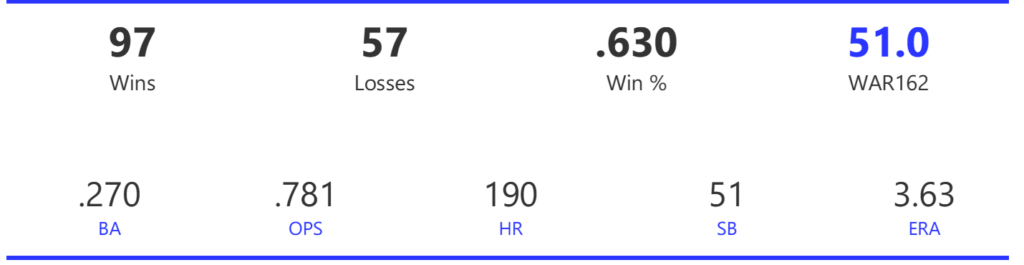
The Yankees’ pennant odds were enhanced by a powerful offense that totaled 857 runs, 68 more than the Tigers. They also walloped 190 homers, leading to the top OPS ranking despite placing third in BA and fourth in OBP. The Yankees’ pitching was solid, if not at the level of the Indians. The team ranked second in ERA, third in WHIP, and third in strikeouts.

Mickey Mantle had a monster Triple Crown season, batting .353 with 52 homers and 130 RBI. He also led the AL in runs (132), SLG (.705), and OPS (1.169). Yogi Berra was a capable second act, belting 30 homers with 105 RBI, and Gil McDougald batted .311 with a .405 OBP from the shortstop position. Bill Skowron added another 23 homers to go with a .308 BA for a loaded Yankees offense. Whitey Ford again topped the Yankees staff, winning 19 games with an AL-best 2.47 ERA, ably supported by Tom Sturdivant (16-8, 3.30 ERA) and Don Larsen (11-5, 3.26 ERA).

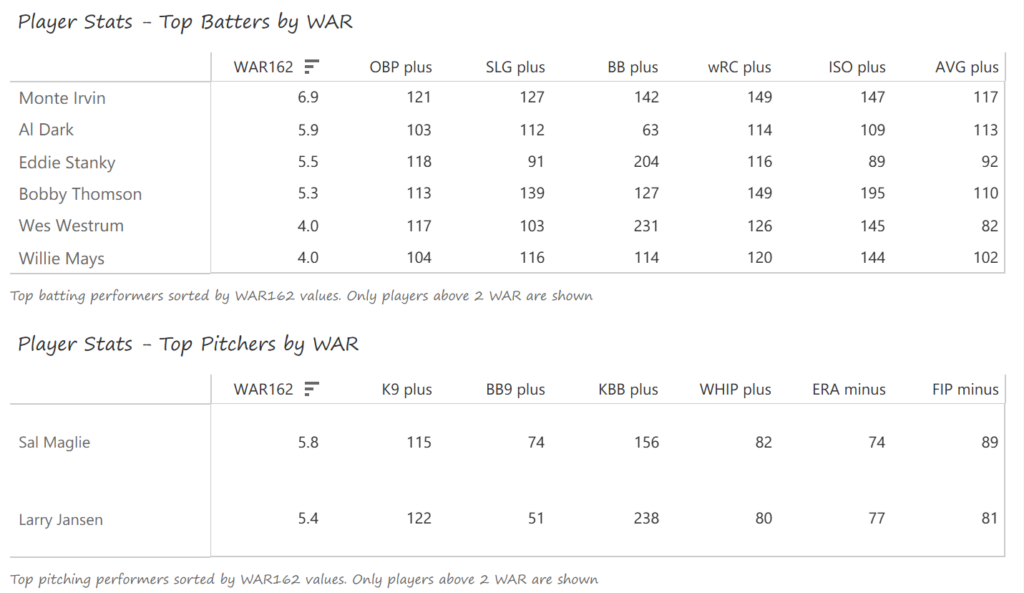
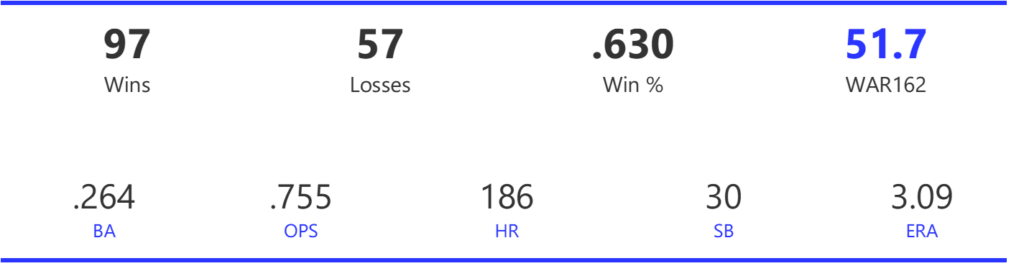
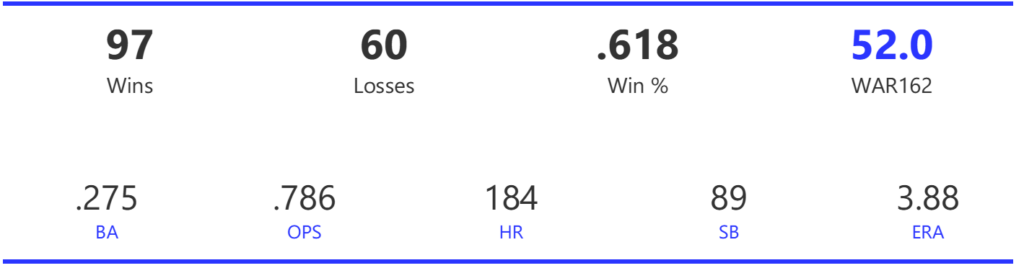
The 1951 Giants shocked the world with an amazing stretch run to catch the rival Dodgers and then top them in a single tiebreaker game to claim the NL pennant. However, they couldn’t top the other New York team, losing to the Yankees in a six-game World Series.

The Giants trailed the Dodgers by a considerable 74 runs for the season, ranking second for the season. They also trailed their rivals in home runs (184-179), OBP, and OPS, and ranked just fourth in BA. This was a solid offense, but not quite as potent as the crosstown Dodgers unit. Pitching helped offset the offensive gap, as the Giants’ 3.48 ERA easily topped the NL. They also led the league in WHIP and strikeout-to-walk rate.

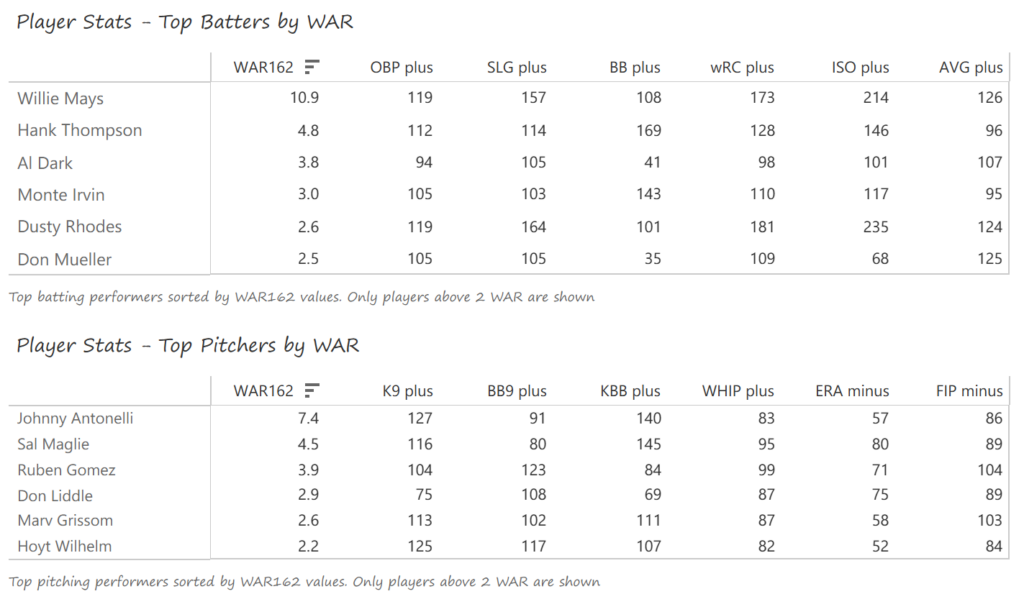
Monte Irvin had a fine season for the Giants, stroking 21 homers and batting .312 with a .415 OBP, while leading the NL with 121 RBI. Al Dark provided pop from the shortstop position, tallying an NL-best 41 doubles, batting .303, and scoring 114 runs. Eddie Stanky (127 walks, .401 OBP) and Bobby Thomson (32 homers, 101 RBI) provided strong support, further aided by catcher Wes Westrum (.400 OBP) and a 20-year-old Willie Mays (20 homers). Sal Maglie and Larry Jansen were the pitching star, with each winning 23 games. Maglie led the NL in fewest hits per 9 innings (7.7) while Jansen led in strikeout-to-walk rate (2.59).

Another Giants team takes #12; the 1954 team topped the rival Dodgers by five games before stunning the favored Indians in a World Series sweep.

The Giants offense ranked third in runs, well behind both the Cardinals and Dodgers, although they matched the Dodgers with 186 home runs. Their .264 BA and .332 OBP were around league average levels, and even their OPS was a distant third in the NL. This was not a great offensive team, despite the presence of some star players. Pitching carried the Giants in ’54, led by an NL-best 3.09 ERA. The staff ranked third in WHIP, but first in the fewest hits per 9 innings.

The 23-year-old Willie Mays was now a full-blown star for the Giants, batting .345 with a 1.078 OPS and 13 triples, all topping the league. Mays also launched 41 homers, had 110 RBI, and scored 119 runs while winning the NL MVP award. His supporting cast included Hank Thompson (26 homers, .389 OBP) and Al Dark (.293 BA, 20 homers). Johnny Antonelli was the top pitcher, winning 21 games with NL-bests in ERA (2.30), shutouts (6), and hits per 9 innings (7.3). Veteran Sal Maglie won 14 games at age 37, and Rubén Gómez added 17 wins with a 2.88 ERA.

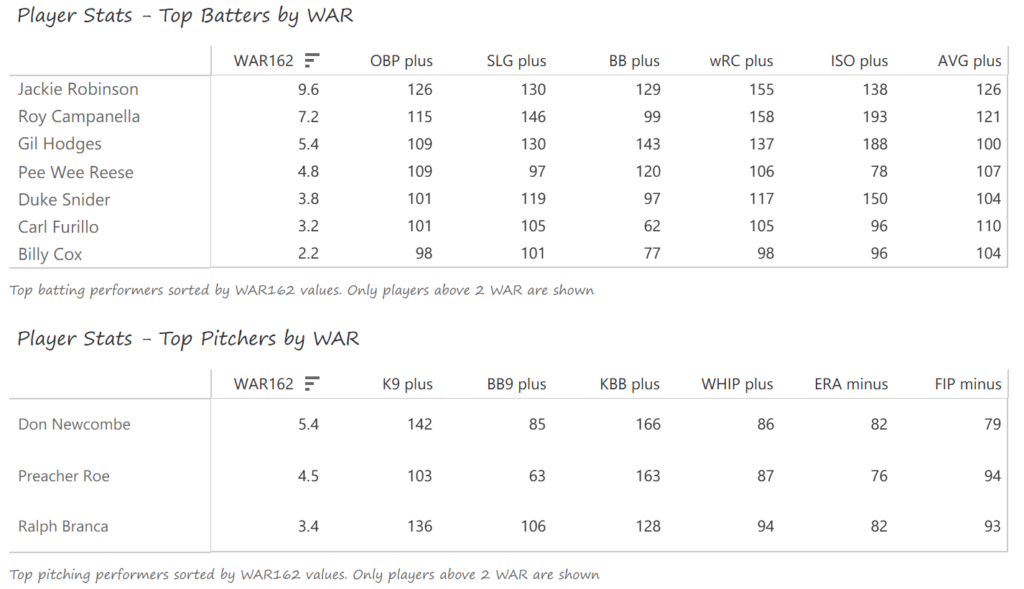
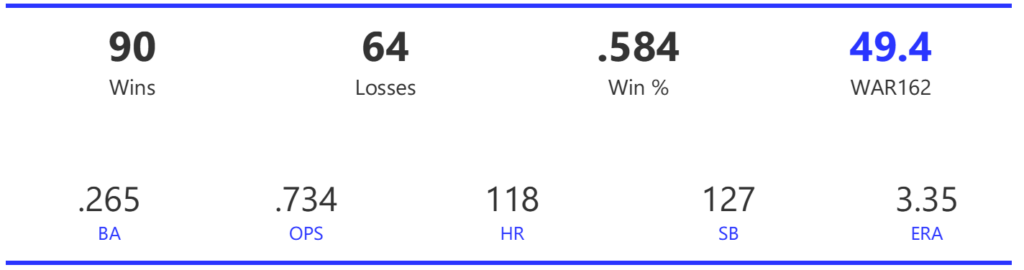
The 1951 Dodgers are famously recalled as the team that lost a tiebreaker game to Bobby Thomson and the Giants after holding a substantial lead late into the season. In WAR162 terms, the Dodgers rank two spots ahead of the Giants; the Giants had a bit more luck on their side in the 1951 season.

The Dodgers had a high-powered offense, scoring 855 runs to easily top the NL, and also leading the league in doubles, home runs, stolen bases, BA, OBP, and OPS. There were multiple stars on the offensive side of the ball to keep the team in contention. The pitching was not as strong, ranking fifth in ERA and third in WHIP, although they led the NL in strikeouts and had the second best strikeout-to-walk rate.

Jackie Robinson had one of his best campaigns, batting .338 with a .429 OBP, 25 steals, and 106 runs scored. Roy Campanella was the NL MVP with 323 homers, 108 RBI, and a .325 BA from his catcher spot, and Gil Hodges launched 40 homers and scored 118 runs. Pee Wee Reese batted .286 while excelling in the field, and Duke Snider belted 29 home runs. On the mound, Don Newcombe won 20 and led the NL with 164 strikeouts, and Preacher Roe went 22-3. Ralph Branca added 13 wins as the Dodgers third starter.

Summary

That’s it for the second entry in our MLB Team Rankings for the 1940s decade! Stay tuned for the countdown from #10 to #6, arriving in a few days. As always, thanks for reading!
1950s MLB Team Rankings Countdown: 20 through 16

Welcome to the first countdown post in our series of MLB team rankings for the 1950s. As a reminder, the teams are ranked from #20 through #1 based on aggregate WAR162. For the 1950s (1950-1959), a total of 160 teams were eligible (16 teams x 10 seasons), so the top 20 teams are a fairly exclusive group. We’ll summarize each team, including portions of their team dashboard, and explain how they attained their ranking. So, without further ado, here are the teams ranked #20 through #16.

Here’s the interactive dashboard at Tableau Public: 1950s Top 20 MLB Teams Dashboard

The 1957 White Sox had a fine season, but finished second, 8 games behind the Yankees. This edition was part of a group of very competitive Chicago teams starting in the mid-50s, and including the 1954 and 1955 teams.

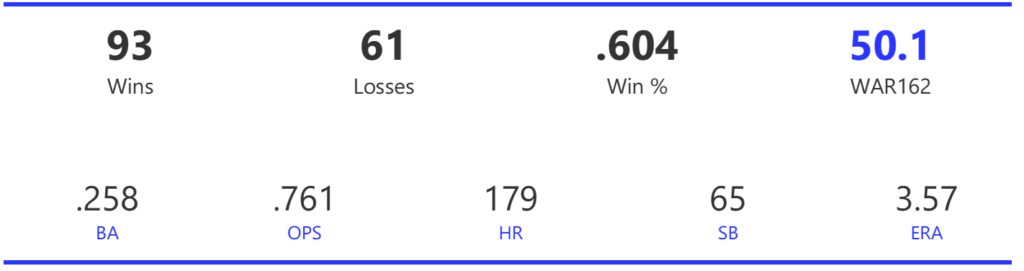
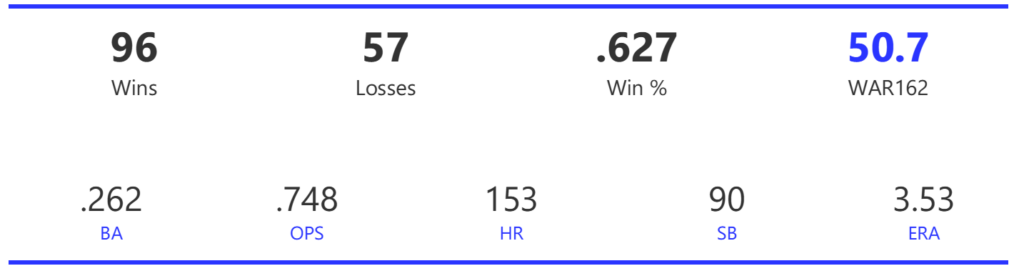
The Sox had a good offense, finishing third in runs behind the Yankees and Red Sox, and easily leading the league in stolen bases. They ranked third in BA and OPS, but first in walks and OBP; the team was built on reaching base and manufacturing runs. Pitching was a strength, although the team’s 3.35 ERA was a distant second to the Yankees. The White Sox staff led the AL in shutouts and ranked second in WHIP.

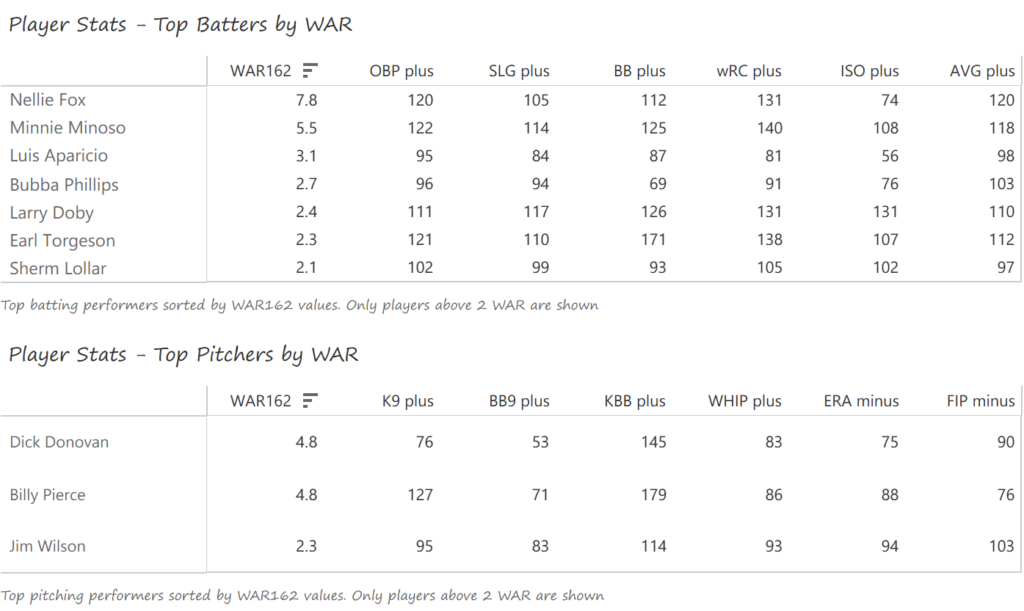
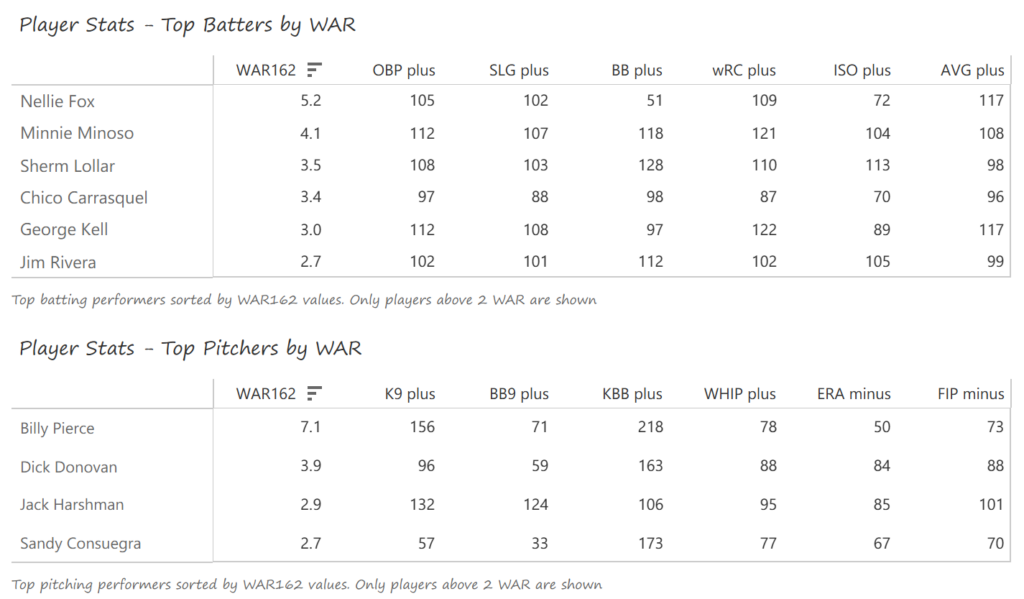
Nellie Fox and Minnie Minoso were the star position players for Chicago, with Fox batting .317 (.403 OBP) and scoring 110 runs while playing a standout second base. Minoso led the league with 36 doubles and batted .310; he also was hit by 21pitches as part of his .408 OBP. Shortstop Luis Aparicio led the AL with 28 steals as part of a productive supporting cast. Dick Donovan (16-6, 2.77 ERA) and Billy Pierce (20-12) led the pitching staff.

The Dodgers nosed out the Braves (by 1 game) and the Redlegs (by 2 games) in an exciting NL pennant race before falling to the Yankees in a seven-game World Series. The loss was especially bittersweet, as the Dodgers moved from Brooklyn to Los Angeles for the 1958 season, leaving their fan base behind.

The Dodgers scored 720 runs on the season, well behind the 775 from the Redlegs, and trailed them in home runs as well. They ranked just fourth in BA, but first in OBP, thanks to drawing 64 more walks than their closest competitor. Their .761 OPS ranked second for the season. The pitching was solid, ranking a distant second (to the Braves) in ERA and first in WHIP, strikeouts, and strikeout-to-walk rate.

Duke Snider had one of his best seasons, belting 43 homers, drawing 99 walks, and sweeping the OBP (.399), SLG (.598), and OPS (.997) categories. Jim Gilliam enjoyed a fine season, stealing 21 bases while batting .300 with a .399 OBP, and 37-year-old Jackie Robinson posted a .382 OBP with 12 steals in 117 games. Gil Hodges (32 homers, 87 RBI) and Randy Jackson provided additional support. The mound was anchored by Don Newcombe, who led the NL in wins (27) and WHIP (0.989) on his way to the NL MVP and Cy Young awards. Sal Maglie had a fine age-39 season, winning 13 games with a 2.87 ERA.

The Braves bounced back from their near miss in 1956 with a comfortable 8-game margin over the Cardinals to claim the 1957 pennant. They went on to defeat the Yankees in a seven-game World Series.

The Braves topped the NL with 772 runs, 25 more than the Redlegs. They also slugged 199 home runs, had 62 triples, and a .442 slugging percentage, all tops in the league. The team ranked second in BA and OPS, a single point behind the Redlegs. The Braves’ pitching posted the second-best ERA in the NL, but had only the fifth-best WHIP, due to issuing the second-most walks in the league.

Hank Aaron and Eddie Matthews formed a fearsome power duo for Milwaukee; Aaron slugged 44 homers with 132 RBI and 118 runs scored, all NL-best numbers. Mathews popped 32 homers of his own to go with 109 runs scored and 94 RBI, and Johnny Logan batted .279 while providing exceptional defense at shortstop. Red Schoendienst batted .310 from his second base position to round out the top position performers. The ageless Warren Spahn posted a 21-11 record with 18 complete games at age 36, winning the Cy Young award in the process. Bob Buhl was the next best option for the Braves, going 18-7 with a 2.74 ERA, and Lew Burdette had an ordinary season by his standards, but still managed 17 wins.

The 1955 White Sox finished third in the AL, behind the Yankees and Indians. Their Pythagorean win projection had them winning 95 games, 8 more than the Indians’ projection, but still trailing the Yankees.

Offense was an issue for the Sox, as their 725 runs ranked just fourth for the season, even though they topped the AL with a .268 BA. Unfortunately for Chicago, they lacked power, ranking just sixth in home runs, seventh in triples, and third in doubles. This combination led to a fifth-place OPS ranking. Pitching kept the Sox in the hunt, with the second-best ERA and top WHIP in the AL. The pitching staff issued the fewest walks in the league, leading to the second-best strikeout-to-walk rate behind the Indians.

The White Sox lacked big-name hitters in their lineup, relying on their pitching and contributions from a variety of batters. Second baseman Nellie Fox led the way with a .311 BA, and an AL-best 17 hit by pitches, followed by Minnie Minoso and his .387 OBP and 19 steals. Catcher Sherm Lollar had a strong season behind the plate while batting .261 with 16 homers, and shortstop Chico Carrasquel played fine defense and scored 83 runs for the Sox. Billy Pierce was the mound ace, winning 15 while topping the AL in ERA (1.97), WHIP, and strikeout-to-walk rate. Dick Donovan was the team’s next best option, and also logged 15 wins.

The Dodgers rebounded from their 1951 collapse and loss to the Giants by finishing 4.5 games ahead of their crosstown rivals to claim the NL pennant. They then lost to the Yankees in a seven-game World Series.

The Dodgers easily topped the NL in runs and had a curious split where they were better on the road (51-24) than at home (45-33). Their 153 homers were tops in the league, as were the team’s 90 stolen bases. They ranked just third in BA, but topped the NL in both OBP and OPS. The Dodgers pitching ranked second in ERA and first in strikeouts, but just fourth in WHIP, as the staff issued plenty of walks.

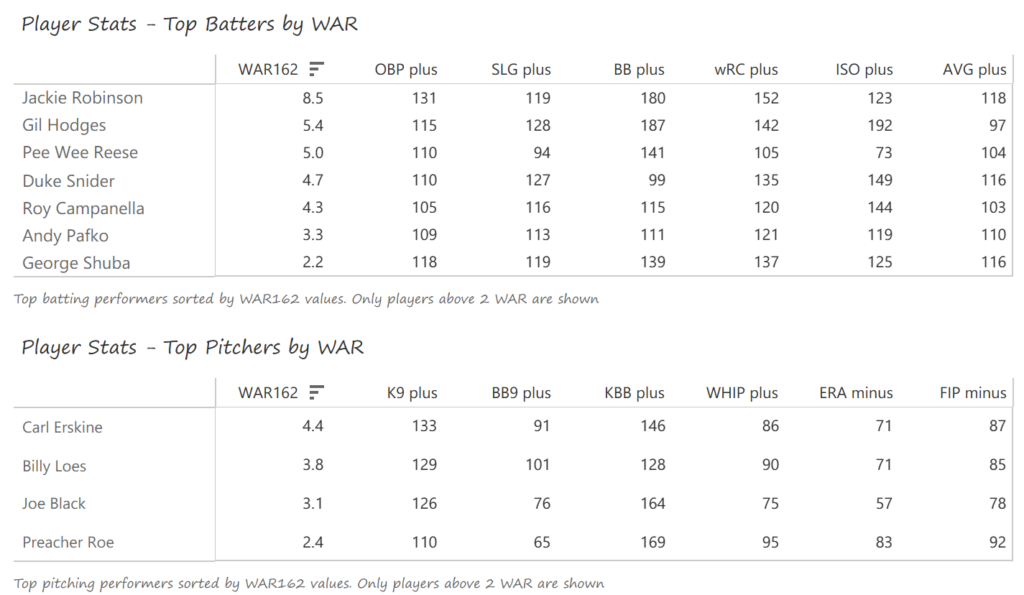
Jackie Robinson had one of his finest seasons, leading the NL with a .440 OBP and stealing 24 bases while drawing 106 walks and scoring 104 runs. Gil Hodges drew 107 walks and hammered 32 homers, and Pee Wee Reese led the league with 30 steals while drawing another 86 walks. Duke Snider batted .303 with 21 homers, and Andy Pafko added another 19 long balls. Carl Erskine posted a 14-6 mark with a 2.70 ERA to lead the pitching corps, aided by Billy Loes (13-8, 2.69 ERA) and Joe Black (15-4, 15 saves, 2.15 ERA).

Summary

That’s it for the first entry in our MLB Team Rankings for the 1950s decade! Stay tuned for the countdown from #15 to #11, arriving in a few days. As always, thanks for reading!